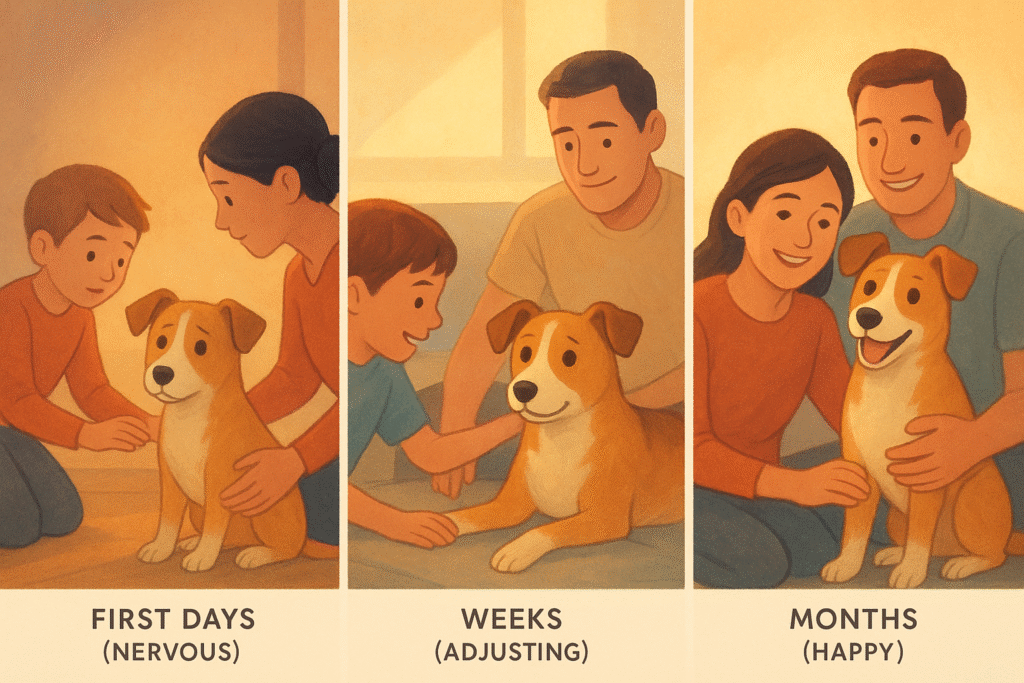

Rescue dog regression after adoption means a dog appears to lose progress they had already made—for example, house-training accidents return, walks become difficult again, barking increases, or the dog can no longer settle alone. A setback does not automatically mean the adoption is failing, but it is useful information that something changed in the dog’s health, environment, stress level, or training difficulty.
Start by reducing pressure, restoring a predictable routine, and returning to the last version of the activity the dog could handle comfortably. Track what happened before the change and how long recovery takes. Sudden, severe, or widespread behavior change should be discussed with a veterinarian, especially when it includes pain, appetite or drinking changes, elimination changes, aggression, or unusual fatigue.
Quick Answer: What Should You Do When Progress Goes Backward?
- Protect safety first. Use gates, doors, leashes, and separate areas to prevent bites, escapes, or conflict.
- Check for medical changes. Sudden regression may be connected to pain, illness, medication, sensory change, or digestive or urinary problems.
- Reduce the dog’s stress load. Pause visitors, crowded outings, daycare, difficult walks, and unnecessary handling.
- Restore the previous routine. Return to familiar meal, toilet, walk, rest, and bedtime patterns.
- Make training easier. Shorten duration, increase distance from triggers, lower distractions, and reward small successes.
- Track the pattern. Record what changed, when the behavior occurs, and how quickly the dog returns to baseline.
- Get help when needed. Biting, severe panic, guarding, sudden house-soiling, or behavior you cannot manage safely requires professional guidance.
What Rescue Dog Regression Can Look Like
Regression may affect one behavior or several parts of daily life.
| Change you notice | Possible contributors | First step |
|---|---|---|
| House-training accidents return | Medical issue, schedule change, too much freedom, missed signals | Arrange appropriate veterinary advice and increase toilet opportunities |
| The dog refuses walks again | Trigger stacking, frightening event, pain, route difficulty | Shorten the outing and return to the last comfortable location |
| Barking or lunging increases | Stress load, reduced distance, lack of recovery, new trigger | Create more distance and reduce exposure |
| The dog cries or panics when left | Alone-time increased too quickly, schedule change, separation-related distress | Stop testing long absences and return to a duration the dog can handle |
| Growling or guarding appears | Resource conflict, pain, increased access, feeling trapped | Create distance, manage the resource, and do not punish warnings |
| The dog avoids touch | Pain, handling sensitivity, loss of choice, startling experience | Stop forced handling and schedule a vet check when the change is sudden |
| Previously known cues seem “forgotten” | Higher distraction, stress, unclear cue, skill not generalized | Practice in an easier environment with better reinforcement |
| Chewing or destruction increases | Distress, boredom, access changes, insufficient rest or enrichment | Prevent access, review the context, and address underlying stress |
| Sleep becomes restless | Noise, pain, schedule change, fear, temperature, medical problem | Restore quiet rest and review health signs |
The important question is not “Why is my dog bad again?” Ask: What changed before the behavior changed?
Is It Regression—or New Information?
Not every behavior that appears later is a skill the dog lost.
True regression
The dog could previously perform a behavior reliably under the same conditions but can no longer do so. For example, a dog who relaxed alone for 20 minutes on many occasions now becomes distressed within two minutes in the same setup.
Behavior emerging after initial inhibition
Some dogs are unusually quiet, still, or avoidant during the earliest days in a new environment. As they move around more, encounter more situations, and make more choices, barking, guarding, fear, or frustration may become visible. This may feel like regression even though you are seeing the behavior clearly for the first time.
A skill that was never generalized
A dog who sits in the kitchen may not understand the same cue outdoors, around visitors, or near another dog. Difficulty in a more distracting context is usually a training-stage issue, not defiance or memory loss.
A new trigger or changed environment
Construction noise, weather, visitors, travel, a new pet, a changed work schedule, pain, or one frightening event can alter behavior. The dog is responding to a different situation.
Avoid assuming the dog is “testing boundaries,” manipulating the family, or revealing a bad personality. Describe observable behavior and context before deciding what it means.
Why Rescue Dogs Regress After Adoption
Several causes may overlap.
Stress accumulated faster than the dog could recover
A vet visit, busy walk, visitor, thunderstorm, and poor sleep may each seem manageable alone. Together, they can push a dog beyond their coping ability. This is often called trigger stacking.
A dog may react to the final event even when that event appears minor. Read Trigger Stacking in Dogs to identify the events that accumulated before the setback.
The difficulty increased too quickly
Common examples include:
- Increasing alone time from minutes to hours
- Moving from a quiet street to a crowded park
- Allowing full access to the home before house-training is reliable
- Adding visitors, daycare, grooming, and training in the same week
- Moving close to a trigger because the dog succeeded once at a greater distance
- Expecting a cue to work without rewards in a new environment
Progress at one level does not guarantee readiness for the next. Training plans need smaller steps than people often expect.
The routine changed
Meal, toilet, sleep, walking, medication, and caregiver changes can affect behavior. A dog may lose predictable opportunities to rest or eliminate when the household returns to work or school.
Use the rescue dog first-week schedule as a template for rebuilding a simpler routine, even if the dog has been home longer than a week.
Pain or illness developed or became more noticeable
Pain can affect sleep, house training, walking, handling, tolerance, appetite, and social behavior. Urinary or gastrointestinal problems can look like house-training regression. Dental, ear, skin, joint, or back pain may appear as avoidance, growling, or resistance.
Do not assume every setback is emotional or behavioral. Training cannot resolve an untreated medical cause.
The dog is over threshold
A dog who is over threshold is too stressed or aroused to learn effectively. They may stop taking food, stare, freeze, pull frantically, bark, lunge, hide, or become unable to respond to familiar cues.
Repeating commands or using higher-value treats may not solve the problem when the environment is still too difficult. Increase distance, end the exposure, and allow recovery. SaveADoggo explains how to recognize a dog that is too stressed to learn.
Development or aging changed the dog’s needs
Adolescence can affect attention, arousal, and social behavior. Aging can bring pain, sensory loss, sleep changes, or cognitive changes. Neither should be treated as a reason to punish the dog; adjust the plan and involve the veterinarian when appropriate.
A 72-Hour Reset Plan
This plan is not a guaranteed cure or a fixed decompression rule. It is a short period for reducing variables, observing patterns, and deciding what support is needed.
First 24 hours: stabilize safety and routine
- Prevent access to situations where biting, escape, guarding, or conflict may occur.
- Return meals, toilet trips, medication, walks, and bedtime to familiar times.
- Cancel optional visitors, daycare, training class, and crowded outings.
- Use short, quiet toilet trips and walks appropriate to the dog’s comfort.
- Allow uninterrupted sleep in a protected resting area.
- Stop testing the behavior that regressed.
- Note appetite, water intake, elimination, mobility, sleep, and pain-related behavior.
Next 24 hours: identify what changed
Review the previous seven to fourteen days:
- Did work, school, travel, or caregiver schedules change?
- Were there visitors, repairs, storms, fireworks, grooming, or vet appointments?
- Did walk distance, training duration, freedom, or alone time increase?
- Was there a conflict over food, toys, furniture, or a person?
- Did the dog slip, fall, become ill, start medication, or show pain?
- Did rest decrease or several stimulating events happen close together?
Look for clusters rather than searching for one dramatic cause.
Final 24 hours: choose one easier starting point
Select one behavior and return to the last successful version. Examples:
- A two-minute absence instead of twenty minutes
- The driveway instead of a full neighborhood walk
- A gate between the dog and visitor instead of a greeting
- One room of supervised access instead of the entire home
- One-second touch followed by a pause instead of extended petting
- A cue in the quiet kitchen instead of outdoors
If the dog cannot succeed at the easier level, stop progressing and obtain professional guidance.
How to Respond to Specific Types of Regression
House-training regression
First consider health, especially when accidents begin suddenly, occur during sleep, involve straining or frequent small amounts, or are accompanied by increased thirst, blood, diarrhea, vomiting, or discomfort.
While arranging appropriate veterinary advice:
- Increase supervised toilet opportunities.
- Return to the previously successful toilet location and cue.
- Limit unsupervised access to the home.
- Track time, amount, surface, and what happened beforehand.
- Clean accidents with an appropriate enzymatic cleaner.
- Do not punish, scold, or push the dog’s face toward the accident.
Walking regression
A dog who suddenly freezes, refuses equipment, pulls home, or reacts more strongly may be painful, frightened, or overloaded.
- Check paws, equipment fit, walking surface, weather, and mobility.
- Use a quieter time and shorter route.
- Let the dog turn away from a trigger.
- Increase distance before asking for cues.
- Avoid dragging, leash corrections, or forcing distance.
- Contact the veterinarian when the change is sudden or movement seems uncomfortable.
Alone-time regression
Do not use a “cry it out” test. Repeated panic can make alone time harder.
- Return to the shortest absence the dog can manage calmly.
- Separate departure cues from actual long absences.
- Arrange a sitter, family member, or other safe support for unavoidable time away.
- Record video when it can be done safely to identify pacing, vocalization, drooling, exit scratching, or inability to eat.
- Seek qualified help when distress begins quickly or the dog may injure themselves.
Training regression
Before deciding the dog forgot a cue, check:
- Is the environment more distracting?
- Is the reward still valuable in this context?
- Has the cue changed between household members?
- Is the dog tired, painful, frightened, or over threshold?
- Did duration, distance, or distraction increase at the same time?
Reduce one difficulty at a time. Reward the easier response and rebuild gradually.
Touch or handling regression
Stop forced contact and consider pain. A dog who previously accepted grooming, collar handling, lifting, or petting may avoid or snap when something hurts.
Invite the dog to approach, keep touch brief, pause for consent, and avoid cornering. Schedule a veterinary examination when the response is new, body-area specific, or associated with mobility or appetite changes.
Growling, guarding, snapping, or biting
Treat escalation as a safety issue, not a phase to wait out.
- Stop approaching and create distance.
- Separate children, visitors, and other pets.
- Do not punish warnings or take items by force.
- Use barriers and remove predictable conflict setups.
- Contact a veterinarian when pain may be involved.
- Obtain qualified behavior help promptly.
Use SaveADoggo’s guides for resource guarding, biting or mouthing after adoption, and growling at a new owner for situation-specific safety steps.
What Not to Do During a Setback
- Do not punish accidents, fear, barking, growling, hiding, or avoidance.
- Do not increase pressure to prove the dog still knows a skill.
- Do not repeatedly expose the dog to a trigger until they “get over it.”
- Do not remove barriers or management because the dog had one good day.
- Do not add several new interventions at once.
- Do not assume exercise will fix every form of stress.
- Do not change food, supplements, medication, and training simultaneously without veterinary guidance.
- Do not compare the dog’s timeline with another rescue dog.
- Do not conceal snapping or biting from professionals responsible for safety.
The American Veterinary Society of Animal Behavior recommends reward-based training and environmental management rather than aversive methods. A setback is a reason to reduce difficulty and investigate—not to become more forceful.
Use an ABC Log to Find Patterns
ABC stands for antecedent, behavior, and consequence.
- Antecedent: What happened immediately before the behavior?
- Behavior: What did the dog actually do, described without labels?
- Consequence: What happened immediately afterward?
Add health and recovery information so the record is more useful.
| Date and time | Antecedent | Observable behavior | What happened next | Sleep, food, pain, health | Recovery time |
|---|---|---|---|---|---|
| Example: Monday, 6 p.m. | Visitor entered after a long walk | Dog froze, barked, and moved behind sofa | Visitor left room; dog received space | Poor nap; ate normally | 25 minutes |
Avoid entries such as “stubborn,” “jealous,” or “dominant.” Observable detail helps a veterinarian or behavior professional evaluate the case.
The 30-Day Rescue Dog Progress Tracker provides a broader format for tracking trends beyond individual incidents.
When to Call the Veterinarian
Contact a veterinarian promptly when regression:
- Appears suddenly or affects several behaviors at once
- Includes new sensitivity to touch, lifting, grooming, or movement
- Occurs with limping, stiffness, hiding, panting at rest, or poor sleep
- Includes appetite, drinking, urination, or stool changes
- Is accompanied by vomiting, diarrhea, weight change, weakness, or lethargy
- Begins after a fall, injury, illness, procedure, or medication change
- Involves an older dog with new confusion or nighttime restlessness
- Includes uncharacteristic growling, snapping, or aggression
Cornell University’s College of Veterinary Medicine identifies reactions to touch and uncharacteristic snapping or growling as possible pain-related behavior changes.
Bring your log, videos captured safely, medication list, and adoption records. This first vet visit guide can help organize the appointment.
When to Get Behavior Help
Contact a qualified, reward-based behavior professional when:
- The dog has bitten, snapped, or made forceful tooth contact.
- Children, vulnerable adults, visitors, or other pets may be at risk.
- Guarding affects food, objects, furniture, doorways, or people.
- Separation distress includes panic, destruction, or self-injury risk.
- Fear prevents necessary toileting, veterinary care, or safe movement.
- Regression continues despite reducing difficulty and restoring routine.
- Several triggers are involved or the pattern is difficult to identify.
- You cannot safely perform normal care or feel afraid at home.
Ask the professional what methods and tools they use and whether they coordinate with veterinarians. Avoid dominance-based confrontation, punishment of warnings, flooding, and guaranteed timelines. SaveADoggo explains when to call a trainer or behaviorist.
How Long Does Rescue Dog Regression Last?
There is no universal timeline. A minor schedule-related setback may improve after the routine is restored. Stress-related behavior may take longer because the dog needs recovery time and smaller training steps. Pain, separation-related distress, resource guarding, and serious fear require treatment directed at the cause.
Measure progress by trends rather than waiting for a specific date:
- Recovery after a trigger becomes faster.
- The dog can succeed at an easier version of the task.
- Early stress signals replace barking, lunging, or snapping.
- Appetite, sleep, elimination, and movement return to baseline.
- Incidents become less frequent, less intense, or more predictable.
- Household members follow the same management plan.
Do not use the 3-3-3 rule or another timeline as a deadline. Individual dogs adjust at different rates, and sudden regression still deserves investigation.
Frequently Asked Questions
Is rescue dog regression normal after adoption?
Some setbacks occur as the environment, routine, and expectations change. However, severe, sudden, or widespread regression should not be dismissed as normal adjustment. Check health, recent stressors, training difficulty, and safety.
Why is my rescue dog getting worse after doing well?
The dog may be experiencing accumulated stress, increased difficulty, reduced rest, schedule change, pain, or a new trigger. Behavior that first appears later may also be new information rather than a skill the dog lost. Track the context before choosing a response.
Does regression mean the shelter misrepresented the dog?
Not necessarily. Behavior changes across shelter, foster, and adoptive environments because the triggers, space, people, resources, and routines differ. Share new safety information with the organization, but avoid assuming deception without evidence.
Should I restart the 3-3-3 rule?
The 3-3-3 rule is a general illustration, not a treatment protocol. You can return to useful basics—predictable routine, fewer demands, more rest, safe management, and gradual exposure—without expecting behavior to change on a fixed schedule.
Why did my rescue dog start having accidents again?
Possible causes include urinary or digestive problems, schedule change, stress, missed toilet signals, or too much unsupervised freedom. Sudden accidents or accidents accompanied by straining, increased thirst, blood, pain, vomiting, or diarrhea need veterinary advice.
Should I ignore regressed behavior?
No. Avoid punishment, but do not simply wait while the dog rehearses unsafe or distressing behavior. Prevent the setup, reduce difficulty, investigate health, and reinforce an achievable alternative.
Can one frightening event cause regression?
Yes. A fall, dog encounter, loud noise, painful handling experience, or other event may change how the dog responds to a place or activity. Return to a safe distance or easier version and rebuild gradually rather than forcing repetition.
When is regression an emergency?
Seek urgent help when there is a serious bite, uncontrolled aggression, breathing difficulty, collapse, inability to urinate, severe pain, repeated vomiting, suspected poisoning, or another immediate medical or safety threat. Use local emergency veterinary, medical, animal-control, or emergency services as appropriate.
Sources and Further Reading
- American Veterinary Society of Animal Behavior: Position Statements and Humane Dog Training
- Cornell University College of Veterinary Medicine: Recognizing Pain in Dogs
- Cornell University College of Veterinary Medicine: Anxious Behavior in Dogs
- VCA Animal Hospitals: Dog Aggression Diagnosis and Overview
The Save A Doggo Editorial Team creates practical, welfare-first resources for rescue-dog adopters, foster families, and shelter supporters. We prioritize primary and authoritative sources, distinguish observation from diagnosis, correct material errors transparently, and explain when veterinary or qualified behavior support is needed. We do not claim veterinary credentials or professional review unless a named, verifiable reviewer has approved the final article.