
The first month with a rescue dog can feel full of questions. Is your dog sleeping more because they feel safe or because they are unwell? Is a quiet day progress or shutdown? A simple daily record replaces guesswork with patterns while allowing your dog to settle at their own pace.
Quick Answer: A rescue dog progress tracker should record a day-one baseline, food and water, sleep, elimination, medication, stress triggers, recovery time, voluntary trust behaviors, and health changes. Write observable facts rather than labels such as “good” or “stubborn.” Review patterns weekly, but contact a veterinarian promptly when a health or safety concern should not wait.
Record a day-one baseline
Your baseline is a starting snapshot, not a judgment of who your dog will become. Record what you know from the shelter, rescue, foster home, and veterinary records, then add what you observe during your rescue dog’s first 24 hours at home.
| Baseline item | Day-one information |
|---|---|
| Adoption date and arrival time | ________________________________ |
| Age, weight, and known health history | ________________________________ |
| Previous food and feeding routine | ________________________________ |
| Usual walking and toilet routine | ________________________________ |
| Current medication and veterinary directions | ________________________________ |
| Known fears, triggers, and handling preferences | ________________________________ |
| First-day appetite, drinking, urine, and stool | ________________________________ |
| First resting place and approximate sleep | ________________________________ |
| Exact behaviors I want to track | ________________________________ |
Use neutral descriptions. “Stayed under the table for 20 minutes after the doorbell” is more useful than “acted badly.” “Approached when I sat sideways” provides more information than “finally trusted me.”
Daily essentials: Food, water, sleep, elimination, and medication
Complete the tracker at roughly the same time each day. A short, consistent entry is more useful than a detailed diary you abandon after three days.
- Food: Record whether the dog ate all, most, some, or none of each meal. Note treats and food changes.
- Water: Record noticeable increases or decreases and how often the bowl needed refilling. Keep fresh water continuously available.
- Sleep: Estimate total rest, overnight interruptions, chosen sleeping place, and whether the dog appeared able to settle.
- Elimination: Record urine and bowel movements, location, stool appearance, accidents, straining, or blood.
- Medication: Mark whether each prescribed medication was given as directed and note any observable change afterward.
Do not restrict water to reduce accidents. The ASPCA’s general dog-care guidance recommends continuous access to clean, fresh water. Never change or stop medication based only on the tracker. If a dose is missed or vomited, contact the prescribing clinic for instructions rather than guessing or doubling it.
Stress triggers and recovery time
Do not deliberately expose your dog to something frightening just to test progress. Record triggers that occur during ordinary life and the conditions surrounding them.
| Record | Example of an objective entry |
|---|---|
| Trigger | Delivery person entered the porch at 2:10 p.m. |
| Distance and setting | Dog was behind a gate about 15 feet away. |
| Observable behavior | Body stiffened, ears moved back, dog barked and retreated. |
| Guardian response | Increased distance, closed the curtain, and scattered familiar treats. |
| Recovery | Resumed sniffing and rested on bed after approximately 12 minutes. |
Define recovery using behaviors normal for your dog: taking food gently, sniffing, resting, drinking, playing, or returning to a familiar location. Recovery time can be more informative than the initial reaction because it shows how long your dog needs to feel functional again.
Trust and handling milestones
Trust milestones should be voluntary. Do not reach toward, corner, restrain, hug, or repeatedly touch a dog to see whether they “allow” it. Instead, record choices the dog makes when an option to move away remains available.
Possible observations include:
- Approached a household member without being called
- Chose to rest in the same room as someone
- Ate or drank with a person nearby
- Displayed loose posture or slept in a more open position
- Accepted the harness without retreating
- Initiated play, sniffing, or gentle contact
- Recovered more easily after a routine sound or movement
- Moved to a safe resting place instead of escalating
Not every dog becomes physically affectionate, and affection is not the only measure of trust. The RSPCA’s rescue-dog guidance recommends allowing dogs to settle and build relationships at their own pace.
Week 1 review
The first week is primarily about safety, routine, and establishing a clearer baseline. Do not grade your dog on obedience, sociability, or affection.
At the end of day seven, ask:
- Is the dog eating and drinking consistently?
- Where and when do they sleep most comfortably?
- Is an elimination pattern beginning to appear?
- Which household sounds, movements, people, or locations create stress?
- What helps the dog recover?
- Which activities seem calming rather than merely tiring?
- Are any health changes developing?
If several routines changed during the week, note that limitation. You may not be able to tell which change affected the dog.
Week 2 review
Compare week two with the baseline rather than with another dog. Look for steadier eating, more predictable elimination, additional sleep locations, shorter recovery after familiar events, or more voluntary exploration.
If your dog appears medically well and is recovering comfortably from daily experiences, introduce only one low-pressure change at a time. For example, slightly extend a quiet walk or add a brief visit from one calm person. Avoid stacking several new experiences on the same day.
A single difficult day does not erase progress. Record what was different: weather, visitors, sleep disruption, construction noise, a changed walk, a veterinary visit, or another event.
Weeks 3–4 review
By weeks three and four, the log may reveal patterns that were invisible during the first few days. You may notice that your dog handles visitors better after a quiet morning, rests more deeply in one room, or needs longer recovery after busy walks.
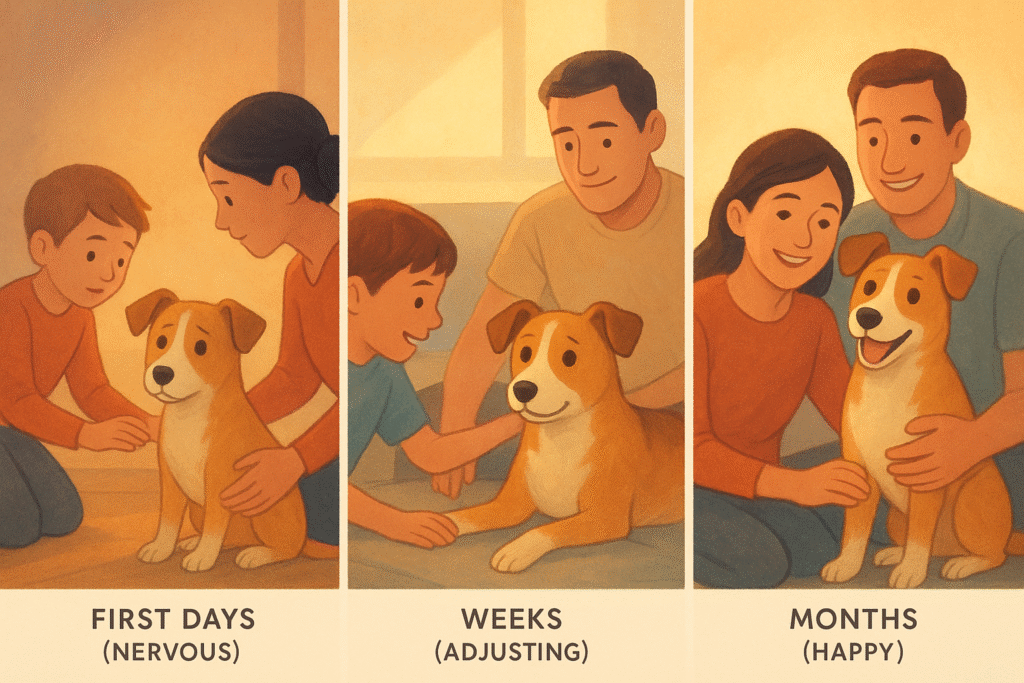
The popular 3-3-3 guideline can help guardians remember that adjustment takes time, but it is not a deadline, diagnosis, or promise. A dog does not fail because they need longer than three days, three weeks, or three months.
Review:
- Which triggers are becoming easier, unchanged, or harder?
- Which forms of enrichment support calm recovery?
- Does the dog seek help, distance, or a safe place when worried?
- Are handling and walking becoming safer?
- Which signs of relaxation now appear more often?
- What should remain predictable for another month?
Health and behavior red flags
A tracker helps identify change, but it should never become a reason to wait when a dog may need care.
| What you observe | What to do |
|---|---|
| Difficulty breathing, pale or blue-tinged gums, collapse, loss of consciousness, seizure activity, difficulty standing, severe bleeding, major injury, or suspected poisoning | Contact the nearest emergency veterinary hospital and leave promptly. |
| Repeated vomiting or diarrhea, blood in urine or stool, straining, pain, marked lethargy, or a concerning change in eating, drinking, urination, or behavior | Contact your veterinarian promptly for individual guidance. |
| Escalating growling, snapping, biting, escape attempts, self-injury, panic when left alone, or inability to rest | Create distance and safe management, then contact your veterinarian and a qualified reward-based behavior professional. |
| A mild change that resolves and does not recur | Record the event and continue observing, unless your veterinarian has given different instructions. |
The ASPCA identifies signs such as pale gums, rapid breathing, difficulty standing, loss of consciousness, seizures, and excessive bleeding as reasons emergency care may be needed. When you are unsure whether a change can wait, call a veterinary professional.
Do not punish growling, accidents, avoidance, or fear responses. The American Veterinary Society of Animal Behavior recommends reward-based methods for training and behavior modification.
What to share with a veterinarian or trainer
Professionals do not need every sentence from a month-long diary. Give them a concise pattern summary supported by the relevant entries.
Summary template: “The change began on [date]. It occurs around [trigger, routine, or time]. We observe [specific behavior or physical sign]. It lasts approximately [time] and happens [frequency]. The dog usually recovers when [what helped]. Food, water, sleep, elimination, and medication changed as follows: [details]. Here are the relevant photos or videos.”
For a veterinarian, include medication records, appetite and water changes, urine and stool notes, vomiting, mobility, pain behavior, and the timing of physical symptoms. For a trainer or behavior consultant, include the trigger, distance, body language, recovery time, safety concerns, and what happened immediately before and after the behavior.
Video can be useful when safely captured during an event that occurs naturally. Never recreate fear, pain, aggression, or distress to obtain footage. Ask behavior professionals whether they use reward-based methods consistent with current AVSAB guidance.
Printable 30-day tracker
Use one short entry per column. Add a separate page only when an event needs more detail.
| Day/date | Food and water | Sleep/rest | Urine and stool | Medication | Stress and recovery | Trust or health note |
|---|---|---|---|---|---|---|
| 1 ______ | ________ | ________ | ________ | ________ | ________ | ________ |
| 2 ______ | ________ | ________ | ________ | ________ | ________ | ________ |
| 3 ______ | ________ | ________ | ________ | ________ | ________ | ________ |
| 4 ______ | ________ | ________ | ________ | ________ | ________ | ________ |
| 5 ______ | ________ | ________ | ________ | ________ | ________ | ________ |
| 6 ______ | ________ | ________ | ________ | ________ | ________ | ________ |
| 7 ______ | ________ | ________ | ________ | ________ | ________ | ________ |
| 8 ______ | ________ | ________ | ________ | ________ | ________ | ________ |
| 9 ______ | ________ | ________ | ________ | ________ | ________ | ________ |
| 10 _____ | ________ | ________ | ________ | ________ | ________ | ________ |
| 11 _____ | ________ | ________ | ________ | ________ | ________ | ________ |
| 12 _____ | ________ | ________ | ________ | ________ | ________ | ________ |
| 13 _____ | ________ | ________ | ________ | ________ | ________ | ________ |
| 14 _____ | ________ | ________ | ________ | ________ | ________ | ________ |
| 15 _____ | ________ | ________ | ________ | ________ | ________ | ________ |
| 16 _____ | ________ | ________ | ________ | ________ | ________ | ________ |
| 17 _____ | ________ | ________ | ________ | ________ | ________ | ________ |
| 18 _____ | ________ | ________ | ________ | ________ | ________ | ________ |
| 19 _____ | ________ | ________ | ________ | ________ | ________ | ________ |
| 20 _____ | ________ | ________ | ________ | ________ | ________ | ________ |
| 21 _____ | ________ | ________ | ________ | ________ | ________ | ________ |
| 22 _____ | ________ | ________ | ________ | ________ | ________ | ________ |
| 23 _____ | ________ | ________ | ________ | ________ | ________ | ________ |
| 24 _____ | ________ | ________ | ________ | ________ | ________ | ________ |
| 25 _____ | ________ | ________ | ________ | ________ | ________ | ________ |
| 26 _____ | ________ | ________ | ________ | ________ | ________ | ________ |
| 27 _____ | ________ | ________ | ________ | ________ | ________ | ________ |
| 28 _____ | ________ | ________ | ________ | ________ | ________ | ________ |
| 29 _____ | ________ | ________ | ________ | ________ | ________ | ________ |
| 30 _____ | ________ | ________ | ________ | ________ | ________ | ________ |
Weekly pattern summary
| Review | What improved? | What remained difficult? | Health or safety concern? | One appropriate next step |
|---|---|---|---|---|
| Week 1 | ________ | ________ | ________ | ________ |
| Week 2 | ________ | ________ | ________ | ________ |
| Week 3 | ________ | ________ | ________ | ________ |
| Week 4 | ________ | ________ | ________ | ________ |
Frequently Asked Questions
What if I miss a day?
Resume with the current day. Do not reconstruct details from memory unless you clearly label them as estimates.
Can several household members use the tracker?
Yes. Use one shared log and add initials to entries so differences in observation or routine can be understood.
Should I record videos?
Brief video may help a veterinarian or trainer if an event occurs naturally and filming is safe. Never provoke or repeat distress to obtain footage.
Should I continue tracking after day 30?
Continue if the log remains helpful, a concern is unresolved, or a veterinarian or behavior professional requests more information. You can reduce it to the few variables that matter most.
Safety note: This tracker is an observation tool, not a diagnostic test or substitute for veterinary care. Contact a veterinarian about health changes, medication concerns, pain, or sudden behavior changes. Use qualified, reward-based professional help for aggression, severe fear, escape risk, or separation distress.
Sources & Further Reading
- RSPCA: Getting Ready for Your Rescue Dog
- American Veterinary Society of Animal Behavior: Position Statements
- ASPCA: General Dog Care
- ASPCA: Emergency Care for Your Pet
Print the tracker, complete it once a day, and review patterns at the end of each week.

The Save A Doggo Editorial Team creates practical, welfare-first resources for rescue-dog adopters, foster families, and shelter supporters. We prioritize primary and authoritative sources, distinguish observation from diagnosis, correct material errors transparently, and explain when veterinary or qualified behavior support is needed. We do not claim veterinary credentials or professional review unless a named, verifiable reviewer has approved the final article.