
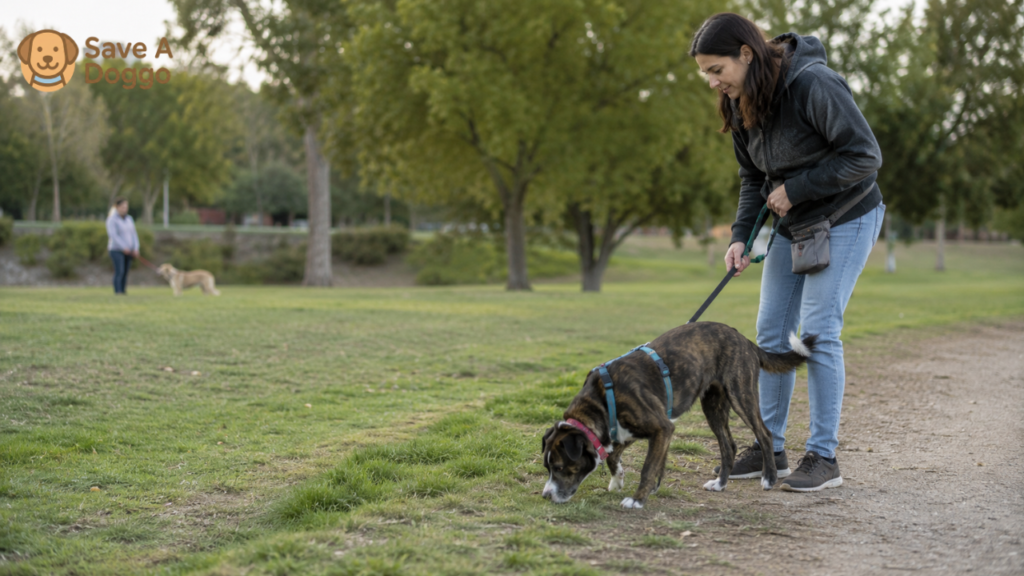
Dog over threshold training is not about pushing a rescue dog harder until they “get used to it.” It is about noticing when stress has become too high for learning, then changing the setup before your dog has to bark, lunge, freeze, hide, or shut down.
Quick Answer: A dog is over threshold when they are too stressed, excited, scared, or frustrated to learn well. Signs may include refusing food, hard staring, lunging, barking, freezing, frantic pulling, or being unable to respond to simple cues. Move farther away, lower the intensity, add recovery time, and restart only when your dog can think again.
What Dog Over Threshold Training Really Means
In dog training, “threshold” means the point where a dog can no longer comfortably process a trigger and learn from the situation. The trigger might be another dog, a stranger, a visitor, a skateboard, traffic, handling, a doorway, a vet lobby, or a sound.
Being under threshold does not mean your dog feels nothing. It means they can notice the trigger and still stay connected enough to eat, sniff, look away, respond to a known cue, or move with you. Being over threshold means their nervous system has shifted into survival mode. At that point, more exposure is not better training.
Cornell’s canine anxiety guidance describes stress-related signs such as panting, trembling, barking, lip licking, and showing the whites of the eyes. The RSPCA also emphasizes that dogs communicate through body language such as posture, ears, tail, avoidance, and facial tension. Those small signals are your early warning system.
Green, Yellow, and Red Zone Signs
A simple color system can help you decide whether to continue, adjust, or stop.
| Zone | What you may see | What it means | What to do |
|---|---|---|---|
| Green | Loose body, soft eyes, can eat, can sniff, can look away, responds to easy cues | Your dog is aware but still able to learn | Continue briefly and reward calm choices |
| Yellow | Stiff body, scanning, slower eating, pulling, whining, lip licking, ears pinned, delayed response | Your dog is getting close to threshold | Increase distance, lower intensity, shorten the session |
| Red | Barking, lunging, freezing, hiding, refusing food, frantic pulling, snapping, unable to disengage | Your dog is over threshold | End exposure safely and move to recovery |
The green zone is where most learning happens. The yellow zone is useful information, but it is not a place to linger. The red zone is not a training opportunity; it is a safety and recovery moment.
If you are still learning your dog’s signals, pause here and study how to read your rescue dog’s body language. The earlier you notice yellow-zone signs, the less often your dog needs to escalate to red.
Food as Information, Not Proof
Food is helpful, but it is not a perfect stress test. Some dogs refuse food when worried. Some take food roughly even while highly aroused. Some eat because they are conflicted, then explode when the trigger gets closer.
Use food as one piece of information:
- Takes food softly and reorients: likely still under threshold.
- Takes food but grabs hard: arousal may be rising.
- Sniffs food and turns away: the situation may be too intense.
- Cannot notice food at all: stop and increase distance.
- Eats only when the trigger disappears: the trigger may have been too close.
Do not use treats to lure your dog closer to something scary. VCA’s guidance on desensitization and counterconditioning explains that behavior-change work should begin at an intensity low enough that the pet is not showing fear or stress. Food should help create safety, not pull the dog past their comfort line.
Distance and Intensity Variables
Distance is the easiest variable to see, but it is not the only one. A dog across the street may be fine if standing still, but too much if barking, staring, running, or pulling toward your dog.
Adjust these variables one at a time:
- Distance: farther away is usually easier.
- Movement: still triggers are often easier than fast-moving triggers.
- Sound: quiet is easier than barking, yelling, engines, or metal noises.
- Duration: one second of exposure is easier than one full minute.
- Direction: a trigger moving away is often easier than one moving directly toward your dog.
- Environment: open space is usually easier than narrow sidewalks, elevators, doorways, or vet lobbies.
- Your dog’s starting state: hunger, pain, poor sleep, heat, and previous stress can lower tolerance.
A good session starts where your dog can succeed now, not where you wish they could succeed. If your rescue dog can calmly watch a trigger from 80 feet away, start there. If 80 feet is still too close, choose 120 feet, a visual barrier, or a different day.
How to End a Session Early
Ending early is not failure. It is one of the most protective skills you can build as a handler.
Use a calm exit routine before your dog reaches the red zone:
- Say a simple phrase such as “Let’s go” or “This way.”
- Turn your body away from the trigger.
- Use food on the ground to encourage sniffing and movement if your dog can still eat.
- Move behind a car, hedge, fence, doorway, or other visual barrier.
- Give your dog time to breathe, sniff, and reorient before deciding what happens next.
Avoid tight leash pressure, corrections, scolding, or forcing your dog to sit and watch. AVSAB’s humane training position supports reward-based methods and states that aversive tools and physical or psychological punishment should not be used for training or behavior modification.
Recovery Between Repetitions
A repetition is not finished when the trigger disappears. It is finished when your dog has recovered enough to learn again.
Signs your dog may be ready for another easy repetition include:
- breathing slows
- body softens
- dog can sniff naturally
- dog can take food gently
- dog can look back at you
- dog can move away without panic
- dog is no longer locked onto the trigger area
If recovery takes longer after each repetition, the session is becoming too hard. Stop while your dog still feels successful. This is especially important for rescue dogs with unknown histories because stress may stack quickly across the day.
A Simple Session Scorecard
Use this scorecard after each exposure. The goal is not to get a perfect score. The goal is to know when to continue, adjust, or stop.
| Question | Green: Continue | Yellow: Adjust | Red: Stop |
|---|---|---|---|
| Can my dog take food? | Yes, softly | Yes, but hard or distracted | No |
| Can my dog disengage? | Looks away or checks in | Needs help turning away | Cannot stop staring or pulling |
| Body language? | Loose and curious | Stiff, scanning, lip licking | Freezing, barking, lunging, hiding |
| Recovery time? | Quickly returns to baseline | Takes longer than usual | Cannot settle safely |
| Next step? | One more easy repetition | Add distance or reduce intensity | End session and recover |
Session Notes Template
| Date | Trigger | Starting distance | Zone | Recovery time | Next plan |
|---|---|---|---|---|---|
| ________ | Dog / person / sound / handling / car / visitor | ________ | Green / Yellow / Red | ________ | Closer / same / farther / easier setting |
| ________ | Dog / person / sound / handling / car / visitor | ________ | Green / Yellow / Red | ________ | Closer / same / farther / easier setting |
Pair this with a positive reinforcement training plan so your dog is being paid for safe, doable choices instead of being pushed into reactions.
Common Threshold Mistakes
- Waiting for a big reaction before helping: yellow-zone signs count. Do not wait for barking or lunging.
- Using obedience to hold the dog near a trigger: a sit-stay is not useful if the dog is internally panicking.
- Moving closer too quickly: progress should be based on relaxed body language, not the calendar.
- Repeating too many times: a good first repetition can become a bad fifth repetition if recovery is ignored.
- Training after a stressful day: poor sleep, visitors, grooming, vet visits, or loud noises can lower tolerance.
- Assuming treats fix everything: food helps only when the setup is easy enough for learning.
- Punishing warning signs: growling, barking, or moving away are information. Suppressing them does not remove the underlying stress.
If your dog often reaches the red zone, review broader rescue dog anxiety signs and bring your notes to your veterinarian or behavior professional.
When to Get Help
Get professional help sooner if your dog has bitten, snapped, redirected onto you, repeatedly lunged, panicked, tried to escape, or cannot recover after exposure. Also get help if the behavior is new, worsening, or paired with changes in appetite, sleep, mobility, pain signs, or overall health.
Start with your veterinarian to rule out medical contributors. Pain, illness, sensory changes, and medication effects can change behavior and stress tolerance. For fear, aggression, or severe reactivity, ask for a referral to a board-certified veterinary behaviorist, certified applied animal behaviorist, or qualified force-free trainer experienced with the specific trigger.
The MSD Veterinary Manual notes that behavior problems are shaped by learning, environment, genetics, and medical factors. That is why a careful plan looks at the whole dog, not just the moment of reaction.
FAQs
Is being over threshold the same as being disobedient?
No. A dog over threshold may be unable to respond because stress or arousal is too high. Treat it as information that the setup is too hard, not as defiance.
Can my dog be over threshold from excitement, not fear?
Yes. Excitement, frustration, fear, pain, and stress can all push a dog past the point where they can learn well. The training answer is still to lower intensity and rebuild calmly.
Should I ask for a sit when my dog sees a trigger?
Only if your dog can do it easily and stay relaxed. If sitting makes your dog feel trapped or causes hard staring, use distance and movement instead.
How do I know the right starting distance?
Start where your dog can notice the trigger, take food softly, disengage, and recover quickly. If any of those disappear, you are too close or the trigger is too intense.
Can I train every day?
Yes, if sessions are short, easy, and followed by recovery. But hard exposure every day can stack stress. Quiet decompression days are part of a good training plan.
Brief Safety Note
This article is general education, not a diagnosis or a personalized behavior plan. If your dog has bitten, snapped, lunged, panicked, or redirected toward a person or animal, use distance and barriers immediately and consult your veterinarian and a qualified force-free behavior professional.
Sources & Further Reading
- AVSAB: Position Statements and Humane Dog Training
- RSPCA: Understanding Dog Body Language
- Cornell Riney Canine Health Center: Anxious Behavior in Dogs
- VCA Animal Hospitals: Desensitization and Counterconditioning
- MSD Veterinary Manual: Behavior Problems of Dogs
Use the scorecard to stop while your dog is still able to learn.
The Save A Doggo Editorial Team creates practical, welfare-first resources for rescue-dog adopters, foster families, and shelter supporters. We prioritize primary and authoritative sources, distinguish observation from diagnosis, correct material errors transparently, and explain when veterinary or qualified behavior support is needed. We do not claim veterinary credentials or professional review unless a named, verifiable reviewer has approved the final article.