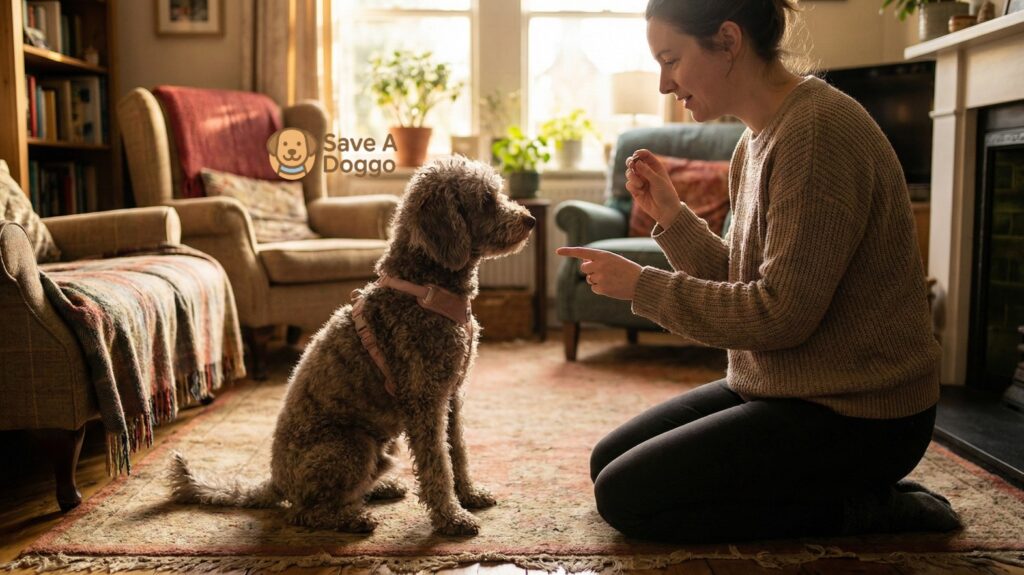
If you are learning about trigger stacking in dogs, you may already know the feeling: your rescue dog seemed “fine” all morning, then suddenly barked, lunged, hid, snapped, or panicked over something small. Often, the final event is not the whole story. It is the last drop in a stress bucket that has been filling for hours.
Quick Answer: Trigger stacking in dogs means several stressful, exciting, painful, or overwhelming events happen before your dog has fully recovered. The final reaction may look sudden, but the dog’s nervous system may already be overloaded. Track one full day, watch early body-language changes, add recovery time, and train only when your dog can still think, eat, and disengage.
What Trigger Stacking in Dogs Means
“Trigger stacking” is a practical training phrase, not a veterinary diagnosis. It describes cumulative stress: one trigger happens, then another, then another, before the dog has settled back to their normal baseline.
A trigger can be anything that changes your dog’s emotional or physical state. It may be scary, exciting, frustrating, painful, confusing, or simply too much. For a rescue dog, common triggers include visitors, traffic, other dogs, handling, grooming, hunger, poor sleep, loud appliances, children running, doorbells, vet visits, car rides, or unfamiliar places.
Think of it like a bucket:
| Stress bucket level | What it may look like | Best response |
|---|---|---|
| Low | Loose body, curious sniffing, can take food, can look away | Train easy skills and reward calm choices |
| Rising | Scanning, lip licking, yawning, pulling, whining, stiff posture | Add distance, slow down, reduce the next demand |
| Nearly full | Hard staring, barking, freezing, refusing food, hiding | Stop training and move to recovery |
| Overflowing | Lunging, snapping, panic, redirected biting, escape attempts | Create safety, end exposure, contact a professional if risk is present |
Cornell’s canine anxiety guidance notes that anxious behavior can include signs such as barking, panting, shaking, lip licking, and showing the whites of the eyes, and that predictable routines can help dogs cope with unsettling situations. The key is noticing the earlier signs, not waiting for the overflow.
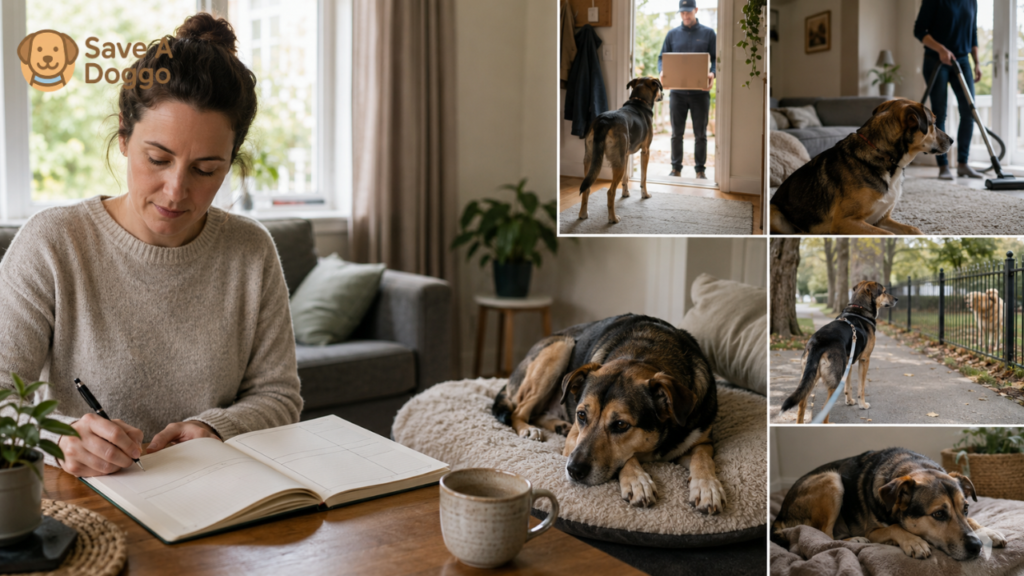
A Real-Life-Style Example Across One Day
The sequence below is a realistic illustration, not a documented case history. Replace it with your dog’s actual 24-hour notes before making conclusions.
| Time | Event | Dog’s possible response | Bucket effect |
|---|---|---|---|
| 6:30 a.m. | Poor sleep because of hallway noise | Restless, slow to settle, more clingy than usual | Starts the day partly full |
| 8:00 a.m. | Walk includes garbage truck and barking dog behind fence | Pulls home, scans, refuses treats outside | Stress rises |
| 11:00 a.m. | Toenail check after muddy potty break | Pulls paw away, lip licks, turns head | Handling adds pressure |
| 2:00 p.m. | Delivery knock at front door | Barks and runs to window | Bucket nearly full |
| 6:00 p.m. | Short neighborhood walk | Stiffens at passing dog across street | Recovery still incomplete |
| 7:30 p.m. | A spoon drops in the kitchen | Dog startles, barks hard, hides, or snaps if touched | Looks “sudden,” but it was stacked |
The spoon was not the real cause by itself. It was the final event after a day of poor sleep, noise, handling, door activity, and incomplete recovery.
Subtle Early Signals
Many rescue dogs do not go from calm to explosive in one step. The earlier signals are just quieter. The RSPCA’s dog body-language guidance describes worried dogs as showing signs such as lowered posture, tucked tail, ears back, yawning, lip licking, avoiding eye contact, and turning away.
Watch for patterns like:
- taking treats harder than usual or refusing food
- moving more slowly or becoming unusually still
- following you from room to room
- panting when the room is not hot
- shaking off repeatedly when not wet
- sniffing frantically instead of casually
- whale eye, hard staring, or head turning
- jumping at normal household sounds
- sleeping less deeply or waking often
- needing longer to settle after walks or visitors
If you are unsure what these signals mean, spend time learning how to read your rescue dog’s body language. A tiny early warning is a gift: it gives you time to help before your dog has to shout.
Why the Final Trigger Looks “Small”
The final trigger often gets blamed because it is the easiest thing to see. “He snapped when I touched his collar.” “She barked at a leaf blower.” “He lost it when the neighbor walked by.” But if you zoom out, that moment may have followed hours of stress.
This is especially common with newly adopted dogs because daily life is still unfamiliar. A dog may be learning the household routine, hearing new appliances, sleeping in a new place, meeting new people, and trying to understand new handling expectations. Even good events can be tiring if they are intense.
Excitement can stack too. A long playdate, a busy walk, guests, car rides, and training class can fill the bucket even when nothing “bad” happened. The body still needs recovery.
Build a 24-Hour Trigger Log
Before changing the training plan, record one full day. Do not try to interpret everything at first. Just collect the sequence.
| Time | Event or trigger | Body language | Intensity 1-5 | Recovery time | What helped? |
|---|---|---|---|---|---|
| ________ | Noise / walk / visitor / handling / dog / child / meal / car | Loose / stiff / hiding / barking / scanning / refusing food | 1 2 3 4 5 | ________ | Distance / quiet room / sniffing / chew / nap / easier route |
| ________ | Noise / walk / visitor / handling / dog / child / meal / car | Loose / stiff / hiding / barking / scanning / refusing food | 1 2 3 4 5 | ________ | Distance / quiet room / sniffing / chew / nap / easier route |
| ________ | Noise / walk / visitor / handling / dog / child / meal / car | Loose / stiff / hiding / barking / scanning / refusing food | 1 2 3 4 5 | ________ | Distance / quiet room / sniffing / chew / nap / easier route |
How to Score Intensity
- 1: notices the trigger, stays loose, can eat and disengage
- 2: mild concern, brief pause, recovers quickly
- 3: stiff, scanning, pulling, barking once or twice, slower recovery
- 4: repeated barking, hiding, refusing food, hard staring, difficult to redirect
- 5: panic, lunging, snapping, biting, escape attempts, or cannot recover safely
Look for clusters. A single intensity-3 event may be manageable. Four intensity-2 events before lunch may explain why the evening walk falls apart.
Add Recovery Time
Recovery is not wasted time. It is part of training. If your dog has had a hard morning, the kindest afternoon plan may be quiet, predictable, and boring.
Good recovery options include:
- a quiet room away from windows and foot traffic
- a safe chew or food puzzle your dog already handles well
- a sniffy potty break instead of a busy walk
- soft bedding and uninterrupted sleep
- white noise if hallway or street sounds are difficult
- fewer visitors, errands, grooming tasks, and training demands that day
For many rescue dogs, decompression walks can help because they emphasize sniffing, distance, and choice rather than mileage or obedience. The goal is not to tire the dog out. It is to help the dog return to a state where learning is possible.
Reduce Stacked Events
Once you see the pattern, reduce the pileup. You do not need to eliminate every trigger forever. You need to stop scheduling too many hard things back-to-back.
- Use the one-hard-thing rule: if your dog has a vet visit, skip guests and busy walks that day.
- Buffer handling: do not combine nail trims, baths, visitors, and training class in one afternoon.
- Choose quieter routes: after a stressful event, walk where your dog can sniff and avoid close passes.
- Plan aftercare: follow visitors, grooming, daycare, boarding, or travel with rest.
- Protect sleep: a dog who is constantly interrupted may start the next day with a fuller bucket.
- Use management early: close blinds, block window barking, use distance, and give a safe room before the dog escalates.
If your dog’s stress signs appear often, review broader rescue dog anxiety signs and bring your log to your veterinarian or behavior professional.
Training Below Threshold
Training works best when your dog is aware of the trigger but still able to think. VCA’s guidance on desensitization and counterconditioning explains that exposure should begin at a low enough level that the pet is not showing fear or stress, and that rewards can help change the emotional response. AVSAB’s humane training position supports reward-based methods and advises against aversive tools or punishment.
Below threshold usually means your dog can:
- take food gently
- turn away from the trigger
- respond to a simple cue they already know
- sniff the ground or check in with you
- move away without panic
- recover within a reasonable time for that dog
Above threshold usually means training should pause. If your dog is barking hard, lunging, hiding, freezing, or refusing food, the lesson is no longer “learn this skill.” The lesson becomes “survive this moment.” Add distance, reduce intensity, and try again another day at an easier level.
When Reactions Need Professional Assessment
Some trigger stacking can be managed with better routines, more recovery, and lower-pressure training. But get help sooner if reactions include bites, snapping, redirected aggression toward family members, repeated lunging, panic that does not settle, self-injury, escape attempts, or sudden behavior changes.
Start with your veterinarian if the behavior is new, worsening, or paired with signs of pain, illness, appetite change, sleep disruption, or disorientation. Pain and medical discomfort can lower a dog’s tolerance. For serious fear, aggression, or bite risk, ask for referral to a board-certified veterinary behaviorist or a qualified force-free behavior professional.
FAQs
Is trigger stacking the same as anxiety?
No. Trigger stacking describes how stressors add up over time. Anxiety is a broader emotional or medical-behavior concern that should be assessed by a veterinarian or qualified behavior professional when it affects safety or quality of life.
Can happy events cause trigger stacking?
Yes. Exciting events can still be arousing. A fun playdate, visitors, car rides, and a busy training class may all add stimulation, even if your dog enjoyed parts of the day.
How long should my dog recover after a stressful event?
There is no universal recovery time. Track your own dog. If they can eat, rest, disengage, sleep normally, and respond softly again, they are likely closer to baseline.
Should I train through a reaction so my dog gets used to it?
No. Forcing a dog to stay close to a trigger while they are scared or overwhelmed can make the association worse. Move farther away and restart at an easier level.
What if my dog reacts more at night?
Look at the whole day. Evening reactions may reflect accumulated stress, fatigue, hunger, household noise, darkness, or fewer escape options. A 24-hour log can show whether nighttime is the true trigger or just the overflow point.
Brief Safety Note
This article is general education, not a diagnosis or a personalized behavior plan. If your dog has bitten, snapped, lunged, panicked, or redirected onto a person or another animal, prioritize distance and barriers, avoid punishment, and consult your veterinarian and a qualified force-free behavior professional.
Sources & Further Reading
- Cornell Riney Canine Health Center: Anxious Behavior in Dogs
- RSPCA: Understanding Dog Body Language
- AVSAB: Position Statements and Humane Dog Training
- VCA Animal Hospitals: Desensitization and Counterconditioning
- MSD Veterinary Manual: Behavior Problems of Dogs
Track one full day before changing the training plan.
The Save A Doggo Editorial Team creates practical, welfare-first resources for rescue-dog adopters, foster families, and shelter supporters. We prioritize primary and authoritative sources, distinguish observation from diagnosis, correct material errors transparently, and explain when veterinary or qualified behavior support is needed. We do not claim veterinary credentials or professional review unless a named, verifiable reviewer has approved the final article.