Quick Answer
A shelter dog profile is a snapshot, not a guarantee or a complete personality test. Read every label as an invitation to ask for context: Where was the behavior observed? How often? Around whom? What happened immediately before and after it? A dog described as “shy,” “high energy,” or “needs to be the only pet” may behave differently in a home, but you should never assume a warning will disappear after adoption.
The goal is not to decode a perfect dog from a short listing. It is to learn whether the dog’s known needs fit your real home, schedule, skills, budget, and safety limits.
Start With Facts, Then Read the Story
Most listings mix several kinds of information:
- Recorded facts: approximate age, weight, sex, medical status, intake date, and adoption location.
- Direct observations: behavior seen by staff or foster caregivers.
- History reported by someone else: previous owner notes, finder reports, or transfer records.
- Marketing language: a friendly summary designed to help the dog get noticed.
- Unknowns: situations the shelter has not tested or observed.
These categories do not have equal certainty. “Lived successfully with a cat for two years” is more specific than “may do well with cats.” “No known history with children” does not mean safe or unsafe; it means the organization lacks enough information.
What Common Profile Labels May Mean
| Profile phrase | A useful interpretation | What to ask next |
|---|---|---|
| Shy at first | The dog may avoid, freeze, hide, or need more distance in unfamiliar situations | How long does recovery take, and what helps? |
| High energy | The dog may need more movement, play, training, or structured enrichment | What does a normal day look like in foster care? |
| Needs a patient adopter | Progress may be slow or the dog may need careful management | Which tasks are currently difficult? |
| Best as the only pet | There may be conflict, fear, prey interest, guarding, or simply limited data | Was this based on home history, shelter observation, or a formal introduction? |
| Older children recommended | The dog may be uncomfortable with fast movement, noise, handling, or resource conflict | What age and behavior can the dog currently tolerate? |
| House-trained | The dog stayed clean in a previous setting or foster home | For how long, on what schedule, and were there any accidents? |
| Crate-trained | The dog has entered or rested in a crate in at least one setting | Can the dog stay relaxed with the door closed and the person gone? |
| Would love a yard | The dog may enjoy outdoor access, but this does not automatically mean a yard is required | Is the concern exercise, toileting, fear of streets, or escape risk? |
| Selective with dogs | Responses may differ by dog, distance, leash pressure, or setting | What introductions have been completed and what did staff observe? |
| No small animals | The organization has a safety concern or insufficient confidence | Is this based on known history, observed chasing, or precaution? |
| Velcro dog | The dog stays close to people | Has anyone observed the dog alone by video? |
| Protective | This vague label may describe barking, guarding, fear, or aggression | What exact behavior occurred, toward whom, and in what context? |
Avoid turning positive labels into guarantees. “Friendly” does not mean comfortable with every person. “Good with dogs” does not mean safe with every dog in every setting. “Calm in the kennel” may reflect relaxation, fatigue, illness, or shutdown.
The 18 Questions Worth Asking
Daily life
- What does a normal 24-hour routine look like for this dog?
- Where has the dog been observed: kennel, foster home, previous home, or adoption event?
- How much physical activity and mental enrichment does the dog currently receive?
- Can the dog settle and sleep after activity?
- How often does the dog need bathroom breaks?
Handling and health
- How does the dog respond to a leash, harness, collar, grooming, and being touched?
- Are there medical conditions, medications, pending tests, or follow-up appointments?
- Has pain been considered when behavior changed?
- What veterinary records and preventive-care dates will come with the adoption?
Home and relationships
- Has the dog lived with adults, children, dogs, cats, or other animals?
- Which interactions were directly observed, and which were reported?
- Does the dog guard food, toys, resting spaces, doorways, or people?
- How does the dog respond to visitors, delivery sounds, and unfamiliar people?
- How does the dog behave in hallways, elevators, cars, and on neighborhood walks?
Time alone and safety
- Has the dog been left alone in a home, and was video used to observe the response?
- Has the dog attempted to escape a crate, yard, door, harness, or vehicle?
- Has the dog ever bitten, snapped, or injured a person or animal? Ask for the full context allowed by local rules.
- What post-adoption support and return policy does the organization provide?
Write the answers down. A decision made from notes is usually more realistic than one made while emotionally overwhelmed in the meeting room.
Separate “Unknown” From “No”
An unknown history is common in rescue work. Treat it as a planning gap, not proof of a problem and not proof of safety.
For example:
- “Not tested with cats” means you need management and a careful introduction plan; it does not mean the dog loves or hates cats.
- “No bite history reported” means no incident is known to the organization; it is not a guarantee that a bite can never occur.
- “House-training unknown” means you should begin with a beginner routine and prevent accidents.
A responsible shelter should be comfortable saying, “We do not know.” Honest uncertainty is more useful than false confidence.
Compare the Dog With Your Non-Negotiables
Create three columns before you visit:
| Must work | Can manage with support | Cannot safely manage |
|---|---|---|
| Examples: legal housing, safe with a resident pet after proper assessment, manageable medical plan | Examples: leash skills, beginner house training, moderate grooming | Examples: severe bite risk around a young child, escape risk you cannot contain, costs beyond your budget |
Do not move an item from “cannot safely manage” simply because you feel sorry for the dog. A good match protects the dog from another stressful move and protects the household from preventable risk.
Use SaveADoggo’s lifestyle matching guide and 25 shelter questions to complete the comparison.
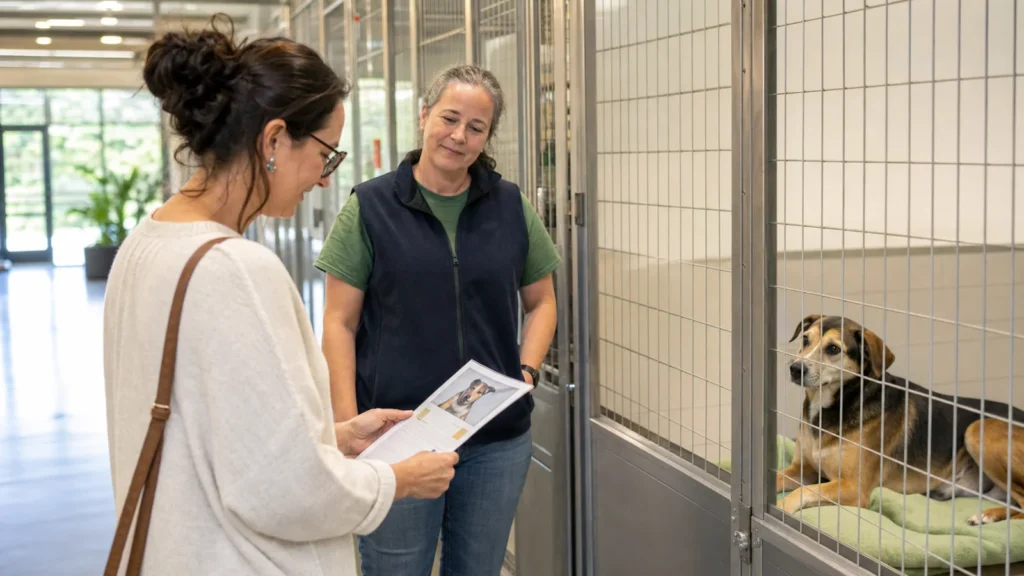
During the Meet-and-Greet
Observe without staging a stressful test. Notice whether the dog can move away, recover after a small surprise, take breaks, sniff, and re-engage. Do not hug, corner, remove food, grab the collar, or deliberately provoke a reaction to “see what happens.”
Ask the staff member to show you the dog’s familiar handling routine. If the organization permits it, consider a second meeting, a household introduction, or foster-to-adopt rather than making a same-day decision.
The foster-to-adopt guide explains what should be confirmed in writing before a trial placement.
Red Flags in the Process
Pause if an organization:
- refuses reasonable questions about known behavior or health;
- pressures you to adopt immediately without reviewing household fit;
- minimizes a disclosed bite or escape event;
- cannot explain legal ownership, fees, medical authorization, or return terms;
- promises that love alone will solve a serious behavior or medical concern;
- describes aversive punishment as the required solution;
- asks you to hide information from a landlord, insurer, veterinarian, or family member.
One incomplete answer may reflect a busy shelter, not bad intent. A pattern of pressure and missing records is different.
Frequently Asked Questions
Are shelter dog profiles accurate?
They can contain valuable observations, but they are limited by time, setting, history, and available staff. Use the profile as the start of a structured conversation.
What does “dog selective” mean?
It usually means the dog’s response varies by the other dog or situation. Ask for specific observations and do not assume the dog can safely live with your resident dog without an appropriate introduction.
Should I avoid a dog with unknown history?
Not automatically. Decide whether you have enough flexibility, management ability, and support to handle uncertainty safely.
Is a foster-home report more useful than a kennel observation?
It can reveal sleep, toileting, alone time, household noise, and daily routines that a kennel cannot. It is still one environment and not a guarantee of identical behavior in your home.
What if the profile and staff answers conflict?
Ask when each note was recorded and whether the profile needs updating. Use the most recent, specific, directly observed information while planning conservatively.
Sources and Further Reading
- Petfinder Pro, Tips for Great Pet Listings
- Petfinder, General Pet Adoption Information
- RSPCA, How to Adopt a Rescue Dog or Puppy
- Best Friends Animal Society, Adopt a Pet

The Save A Doggo Editorial Team creates practical, welfare-first resources for rescue-dog adopters, foster families, and shelter supporters. We prioritize primary and authoritative sources, distinguish observation from diagnosis, correct material errors transparently, and explain when veterinary or qualified behavior support is needed. We do not claim veterinary credentials or professional review unless a named, verifiable reviewer has approved the final article.