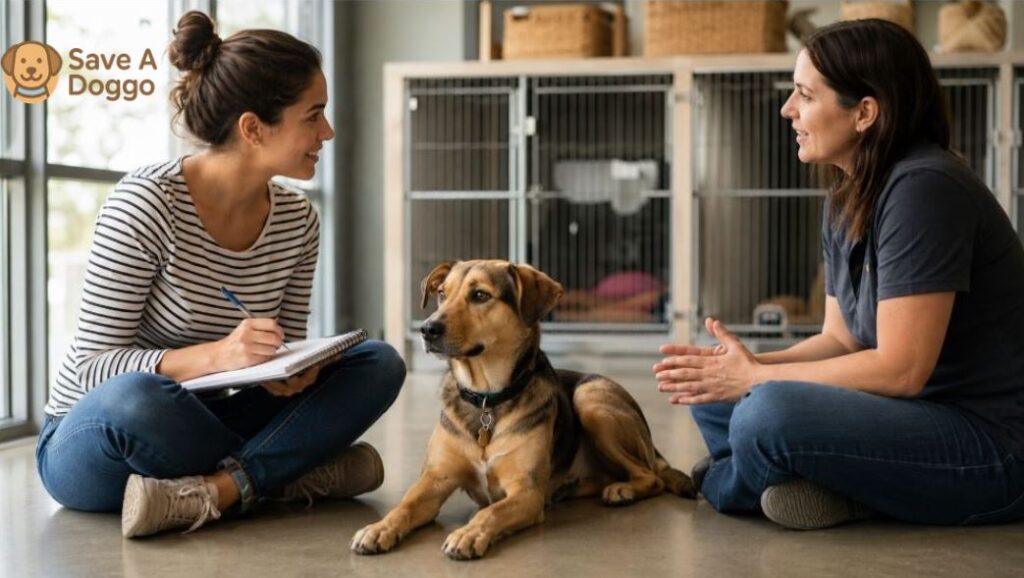
It is easy to forget important questions when a hopeful face is looking through the kennel door. Bringing a written list gives you room to listen, take notes, and make a decision based on the individual dog—not assumptions, pressure, or an incomplete profile.
Quick Answer: Before adopting, ask about the dog’s medical records, medication, behavior, handling, daily routine, time alone, house-training, other animals, children, visitors, foster observations, adoption costs, post-adoption support, and return policy. For every important answer, clarify whether it was directly observed, reported by someone else, or remains unknown.
Medical and preventive-care questions
Medical questions help you prepare; they are not a substitute for your own veterinarian’s examination. Request written records whenever available and plan the first veterinary visit after adoption.
- 1. What veterinary examinations and medical records are available? Ask for dates, findings, test results, treatment notes, and the name of the clinic that provided care. A verbal summary is helpful, but written records are easier for your veterinarian to review.
- 2. Which preventive-care steps are complete, pending, or unknown? Ask specifically about vaccines, parasite screening or prevention, spay or neuter status, dental evaluation, and microchipping. Avoid relying on the general phrase “up to date” without dates or documentation.
- 3. Are there known health conditions, injuries, allergies, or mobility concerns? Include skin, ears, teeth, digestion, breathing, vision, hearing, pain, previous surgery, and activity restrictions. Ask what was diagnosed by a veterinarian versus merely suspected.
- 4. Is the dog taking medication or following a special diet? Request the medication label, veterinary instructions, remaining supply, refill plan, diet details, and follow-up schedule. Do not change medication or diet without veterinary guidance.
- 5. Have staff recently observed changes in appetite, drinking, elimination, energy, coughing, vomiting, or diarrhea? Ask when the change began, whether a veterinarian evaluated it, and what follow-up was recommended. Daily observations can reveal concerns not yet reflected in a formal record.
Behavior and handling questions
Ask about context, body language, and recovery rather than requesting a label such as “good,” “dominant,” or “aggressive.” A useful answer describes what happened before, during, and after the behavior.
- 6. How does the dog show fear or stress, and what helps them recover? Ask about freezing, hiding, barking, pacing, retreating, growling, escape attempts, or refusing food. Find out whether distance, quiet, familiar people, food, or a safe resting place helps.
- 7. Is there any known history of growling, snapping, biting, lunging, or guarding? Request the setting, trigger, people or animals involved, injury details, warning signals, and management used afterward. “No bite reported” is different from extensive handling with no concerning behavior observed.
- 8. How does the dog respond to leashes, harnesses, doors, gates, and outdoor walks? Ask about pulling, freezing, backing out of equipment, chasing, traffic fear, reactivity, and escape history. Confirm what walking equipment the dog currently uses safely.
- 9. How does the dog respond to touch, grooming, lifting, and veterinary handling? Ask separately about paws, ears, mouth, collar, harness, brushing, bathing, nail care, and being physically moved. Do not ask staff to provoke discomfort for a demonstration.
- 10. What happens when the dog is left alone? Ask how long the dog was observed, in which environment, and whether there was barking, pacing, destruction, escape behavior, house soiling, or an ability to settle.
Behavior support should be humane and reward-based. The American Veterinary Society of Animal Behavior recommends reward-based methods and advises against aversive tools and punishment.
Home-life observations
- 11. What does the dog’s current daily routine look like? Ask about feeding, toilet breaks, walks, play, enrichment, rest, and bedtime. Maintaining familiar elements can make the transition less abrupt.
- 12. What is known about house-training and confinement? Ask where the dog eliminates, how often accidents occur, what signals they give, and whether they have comfortably rested in a crate, pen, room, or behind a gate.
- 13. What activity and enrichment does the dog enjoy? Ask what has actually been tried: sniffing walks, food toys, chewing, play, training, or quiet companionship. Also ask whether the dog can settle after activity.
- 14. How does the dog respond to ordinary household experiences? Discuss doorbells, appliances, stairs, elevators, car rides, grooming sounds, neighborhood noise, and unfamiliar rooms. Mark untested situations as unknown.
Dog, cat, child, and visitor history
- 15. What has been observed around other dogs? Ask about size, play style, leash context, shared spaces, food or toys, ability to disengage, and whether observations involved one dog or several.
- 16. What has been observed around cats or small animals? Clarify whether the dog lived with a cat, saw one through a barrier, participated in a brief assessment, or has no known history. A short observation cannot guarantee home compatibility.
- 17. What experience has the dog had with children? Ask about the children’s ages, activity, setting, duration, supervision, and the dog’s body language. “Met a calm teenager” does not answer how the dog responds to young children running or handling toys.
- 18. How does the dog respond to visitors and unfamiliar people? Ask about people entering the home or kennel, reaching toward the dog, wearing unfamiliar clothing, or moving quickly. Find out what introduction method has worked best.
Unknown social history calls for management and gradual introductions—not forced testing. Children should always be supervised around a newly adopted dog, and resident animals need separate resources and safe spaces.
Foster versus kennel observations
A dog may behave differently across environments. Foster caregivers may see household routines, while kennel staff may observe handling, walks, and responses in a busy facility. Neither perspective predicts every future situation.
- 19. Where has the dog lived while in care, and for how long? Ask whether information comes from a foster home, boarding facility, shelter kennel, previous guardian, transport team, or brief intake assessment.
- 20. Did behavior differ between the kennel, foster home, or previous home? Ask about sleep, appetite, house-training, barking, handling, time alone, visitors, and other animals. The Best Friends foster manual emphasizes recording daily appetite, energy, health, and behavior observations.
The amount and type of information available can differ between organizations. Understanding the distinction between a shelter and a rescue group can help you identify who has spent time with the dog.
Adoption contract and support
Asking about support and return procedures does not mean you expect to fail. It means you are preparing for a responsible transition.
- 21. What commitments and restrictions are in the adoption contract? Ask about housing approval, identification, veterinary care, transfer of ownership, travel, rehoming, follow-up contact, and any other requirements. Read the complete contract before signing.
- 22. What post-adoption support is available? Ask whether the organization provides check-ins, a contact person, training resources, behavior consultations, veterinary support, or referrals—and whether time limits or eligibility requirements apply.
- 23. What is the return policy, and is foster-to-adopt available? Confirm whom to contact, whether an appointment is required, what records must accompany the dog, and whether the organization guarantees return intake. Best Friends notes that adoption and foster-to-adopt options vary by location, so verify the specific shelter’s policy.
| Specific shelter details | Write the verified answer |
|---|---|
| Application and household requirements | ____________________________ |
| Meet-and-greet rules | ____________________________ |
| Post-adoption contact | ____________________________ |
| Behavior or training support | ____________________________ |
| Veterinary support | ____________________________ |
| Return or foster-to-adopt policy | ____________________________ |
Costs and records
- 24. What costs should I expect at adoption and soon afterward? Ask what the adoption fee covers and what remains your responsibility. Discuss known medication, follow-up care, food, equipment, grooming, licensing, training, and other near-term needs without assuming all organizations include the same services.
- 25. Which records and supplies will come home with the dog? Request the adoption contract, medical record, vaccine dates, microchip information, medication and instructions, diet details, behavior or foster notes, identification paperwork, and any familiar equipment or food provided for transition.
Use a complete rescue dog adoption checklist to identify expenses and supplies that are not included.
How to handle “we don’t know”
An honest unknown is better than an invented reassurance. The next step depends on the consequence if your assumption is wrong.
| Answer type | What it means | Your next step |
|---|---|---|
| Directly observed | Staff or foster caregivers witnessed the behavior in a described setting. | Ask about context, frequency, body language, and recovery. |
| Previously reported | The information came from a former guardian, finder, transfer partner, or record. | Ask when it occurred and whether anyone has observed it since. |
| Not observed | No incident occurred during available observation. | Ask whether the situation actually arose. “No problem seen” may mean “not tested.” |
| Unknown | No reliable history or observation is available. | Evaluate the safety consequence and whether foster observation or professional support is possible. |
Decision rule: If being wrong would create a serious risk for a child, resident animal, visitor, bite-sensitive household, or housing situation, do not fill the unknown with optimism. Ask whether safer observation, foster-to-adopt, separation management, or another match is appropriate.
Printable question list
- □ 1. What veterinary examinations and records are available?
- □ 2. Which preventive-care steps are complete, pending, or unknown?
- □ 3. Are there known health, injury, allergy, or mobility concerns?
- □ 4. Is the dog taking medication or following a special diet?
- □ 5. Have there been recent appetite, drinking, elimination, or energy changes?
- □ 6. How does the dog show stress, and what helps recovery?
- □ 7. Is there a growl, snap, bite, lunge, or guarding history?
- □ 8. How does the dog respond to equipment, doors, and walks?
- □ 9. How does the dog respond to touch, grooming, and veterinary handling?
- □ 10. What happens when the dog is left alone?
- □ 11. What is the current daily routine?
- □ 12. What is known about house-training and confinement?
- □ 13. Which activities and enrichment does the dog enjoy?
- □ 14. How does the dog respond to household experiences?
- □ 15. What has been observed around other dogs?
- □ 16. What has been observed around cats or small animals?
- □ 17. What experience has the dog had with children?
- □ 18. How does the dog respond to visitors?
- □ 19. Where has the dog lived while in care?
- □ 20. Did behavior differ between kennel and foster environments?
- □ 21. What commitments are in the adoption contract?
- □ 22. What post-adoption support is available?
- □ 23. What is the return policy, and is foster-to-adopt available?
- □ 24. What costs should I expect at adoption and soon afterward?
- □ 25. Which records and supplies will come home with the dog?
Frequently Asked Questions
Must I ask all 25 questions during one meeting?
No. Prioritize safety, medical care, household compatibility, and the contract. Ask for a follow-up conversation or written records when staff need time to gather accurate information.
Can a shelter guarantee a dog’s future behavior?
No environment provides a complete prediction. Ask what was observed and plan gradual, supervised transitions at home.
Should children or a resident dog attend the meet-and-greet?
Follow the shelter’s policy and preparation instructions. Staff may recommend a structured meeting, a separate appointment, or gathering more history first.
Can I speak directly with the foster caregiver?
Ask the organization. Some arrange conversations, while others collect foster observations through adoption staff to protect privacy and maintain a consistent process.
Safety note: Do not provoke fear, guarding, pain, or aggression to test a dog. Unknown bite risk, severe fear, medical concerns, or significant behavior challenges should be discussed with the shelter, a veterinarian, and a qualified reward-based professional.
Sources & Further Reading
- Best Friends Animal Society: Adopt a Pet
- Best Friends Animal Society: Dog Foster Care Manual
- RSPCA: Getting Ready for Your Rescue Dog
- American Veterinary Society of Animal Behavior: Position Statements
Print the questions and bring them to your meet-and-greet.

The Save A Doggo Editorial Team creates practical, welfare-first resources for rescue-dog adopters, foster families, and shelter supporters. We prioritize primary and authoritative sources, distinguish observation from diagnosis, correct material errors transparently, and explain when veterinary or qualified behavior support is needed. We do not claim veterinary credentials or professional review unless a named, verifiable reviewer has approved the final article.