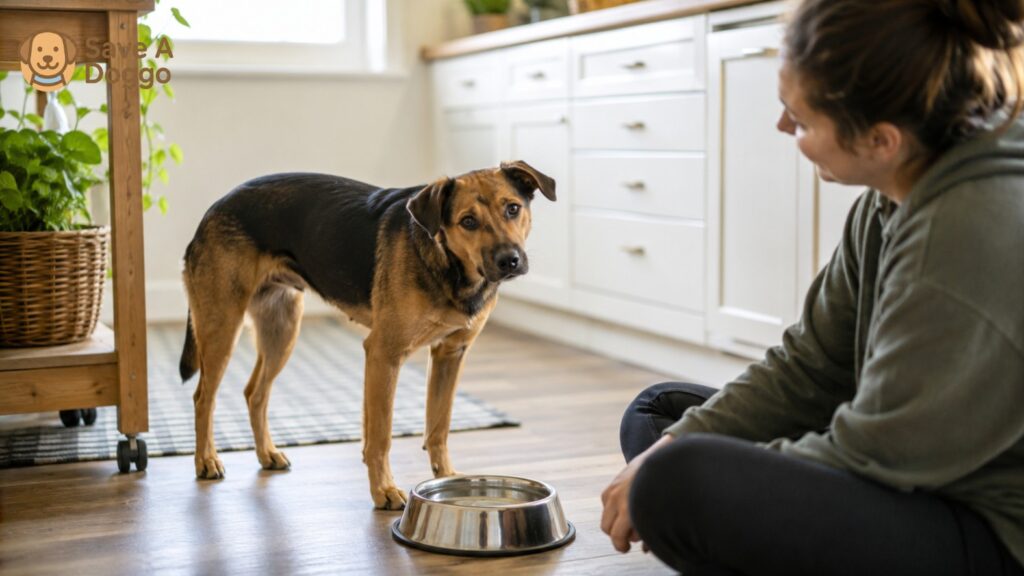
If your rescue dog is not drinking water after adoption, offer fresh water in a quiet, easy-to-reach place and assess the whole dog—not just the bowl. Stress, an unfamiliar bowl, a different water taste, travel, wet food, or fear of the room may temporarily reduce visible drinking. However, nausea, pain, fever, mouth or swallowing problems, toxin exposure, and other illnesses can also cause a dog to avoid water.
Do not force water into your dog’s mouth and do not deliberately withhold water. Call a veterinarian promptly if you have not seen the dog drink since adoption, cannot confirm their recent intake, or notice any change in energy, appetite, urination, vomiting, diarrhea, breathing, gums, or comfort. Go to an emergency veterinary hospital now for collapse, confusion, seizures, breathing difficulty, repeated vomiting, inability to keep water down, suspected poisoning, heatstroke signs, or straining to urinate with little or no urine.
Quick Answer: What Should You Do First?
- Put fresh water beside the dog’s safe resting area. Use a stable bowl on a non-slip surface.
- Add a second water station. Choose a quiet route that does not require crossing a slippery floor or passing people, pets, or noisy appliances.
- Step away. Do not hover, lead the dog’s face to the bowl, or repeatedly call them over.
- Check the whole dog. Note energy, appetite, gum moisture and color, vomiting, diarrhea, panting, urination, and any attempt to drink or swallow.
- Measure rather than guess. Record how much water you put down and how much remains, allowing for spills and water obtained from food.
- Call early when uncertain. There is no single number of hours that is safe for every dog. Age, size, weather, diet, activity, illness, and recent intake all change the risk.
A dog who is alert, comfortable, urinating normally, eating moisture-rich food, and taking occasional drinks is different from a dog who is dull, hot, vomiting, or producing little urine. When the dog’s history is incomplete—as is common after adoption—use a lower threshold for calling the shelter, rescue, or veterinarian.
At a Glance: Monitor, Call, or Go Now?
| What you observe | Best next step |
|---|---|
| Dog is bright and comfortable, has just arrived, has fresh water available, and may have drunk before transport | Set up two quiet water stations, step away, and begin a written intake and urination log |
| Dog eats wet food, drinks small amounts, urinates normally, and has no other concerning signs | Continue monitoring; count moisture from food when describing intake to the veterinarian |
| You have not seen any drinking since adoption or do not know when the dog last drank | Call the shelter/rescue and your veterinarian the same day for individualized guidance |
| Dog avoids the bowl but approaches water placed in another room or container | Keep the successful setup and investigate bowl noise, location, flooring, traffic, and fear |
| Dry or sticky gums, reduced urination, unusual tiredness, poor appetite, vomiting, diarrhea, or signs of pain | Contact a veterinarian promptly; dehydration and underlying illness need assessment |
| Dog tries to drink but coughs, gags, repeatedly drops the head, cannot swallow, or immediately brings water back up | Seek urgent veterinary advice; do not syringe water or continue offering large amounts |
| Heavy panting, excessive drooling, weakness, confusion, vomiting, diarrhea, seizure, or collapse after heat exposure | Begin safe cooling and travel to an emergency veterinary hospital immediately |
| Straining to urinate with little or no urine, a painful or swollen abdomen, breathing difficulty, collapse, suspected toxin exposure, or repeated vomiting | Go to an emergency veterinary hospital now |
This table is a triage guide, not a diagnosis. A veterinarian who knows the dog’s age, medical history, medications, diet, weather exposure, and examination findings can judge urgency more accurately.
Why a Newly Adopted Dog May Drink Less
Reduced drinking after adoption can have environmental, behavioral, dietary, or medical causes. More than one factor may be present.
| Possible contributor | Clues you may notice | Safe first response |
|---|---|---|
| Transition stress | Dog freezes, hides, startles, avoids busy rooms, or drinks only when alone | Lower stimulation, give space, and place water near the safe area |
| Unfamiliar bowl | Dog approaches but backs away when tags hit metal or the bowl moves | Try a stable ceramic, glass, or stainless-steel bowl without forcing an approach |
| Difficult location | Bowl is near a washing machine, doorway, other pet, high traffic, or slippery floor | Move one bowl to a quiet, non-slip route and leave the original available |
| Different water smell or taste | Dog drank normally at the shelter but hesitates at home | Ask what water and bowl setup the dog previously used; keep all offered water clean and fresh |
| Moisture-rich food | Dog eats canned or rehydrated food and drinks less from the bowl | Track food type, water added to meals, urination, and overall condition |
| Recent intake or low activity | Dog drank before travel and is now resting in a cool room | Continue free access and observe without pressure |
| Nausea or gastrointestinal illness | Lip licking, drooling, poor appetite, vomiting, diarrhea, hunched posture | Call the veterinarian; do not use home remedies or force water |
| Mouth, dental, throat, or neck pain | Dropping food, chewing on one side, bad breath, pawing at the mouth, coughing, gagging | Arrange veterinary assessment and avoid manipulating a painful mouth |
| Fever, systemic illness, medication effect, or pain elsewhere | Lethargy, trembling, restlessness, behavior change, appetite change | Contact the veterinarian and report all medications and recent treatments |
| Difficulty swallowing or keeping water down | Repeated attempts, coughing, gagging, regurgitation, or vomiting after drinking | Seek urgent veterinary advice and stop attempts to syringe-feed water |
Stress is plausible on adoption day, but it should not be used to explain away physical warning signs. A frightened dog can also be sick, injured, overheated, or dehydrated.
Set Up Water So the Dog Can Drink Safely
A newly adopted dog may need privacy and an easier route more than encouragement.
Use at least two water stations
Place one bowl close to the dog’s resting area and another in a separate quiet location. Both should be easy to reach without entering a narrow space or passing another animal.
Choose locations that are:
- Away from washing machines, dishwashers, speakers, doors, and sudden household traffic
- On a non-slip mat rather than a shiny or unstable floor
- Out of direct sun and away from heat sources
- Accessible without stairs when the dog is weak, sore, senior, or mobility-impaired
- Separate from another pet that may block or guard the bowl
- Visible, but not in a place where people will stand over the dog
Do not remove water at night to prevent accidents unless the veterinarian has given a specific medical instruction. House-training inconvenience is not a safe reason to restrict access.
Try a different bowl without creating pressure
Some dogs dislike a bowl that slides, tips, reflects light, holds odors, or makes noise when a collar tag touches it. Offer a clean, stable option made for food and water. Wash it with mild dish soap, rinse thoroughly, and refill with fresh water.
If changing the bowl helps, keep the successful setup consistent. Do not repeatedly present many containers in the dog’s face; that can add pressure and make the water station feel less safe.
Give the dog privacy
Fill the bowl, place it down, and move away. Watch from a distance or use a camera if you need to confirm drinking without entering the room. Never pull the dog by the collar, push their head toward the water, or crowd them into a corner.
The first-week schedule for a rescue dog can help you keep water access, meals, toilet trips, rest, and observations predictable without overwhelming the dog.
Safe Ways to Increase Moisture
Fresh plain water should remain available at all times. If the dog is eating and the veterinarian has not prescribed a restricted diet, you can ask whether adding water to the dog’s regular food or using an appropriate wet version of that food is suitable.
Keep these safeguards in mind:
- Do not make a sudden diet change solely to increase water intake.
- Do not add salt, sugar, sports drinks, electrolyte powders, milk, or human rehydration products unless a veterinarian directs you.
- Do not use broth without checking every ingredient and obtaining veterinary approval. Many broths are high in sodium or contain onion, garlic, or other unsuitable ingredients.
- Do not replace the only water bowl with flavored water. The dog should always have access to plain fresh water.
- Do not offer large amounts rapidly to a vomiting dog without veterinary instructions.
- Do not use ice as a treatment for suspected heatstroke or dehydration. A dog who simply enjoys an ice cube may have one only when chewing and swallowing it are safe for that individual.
Food moisture can make bowl drinking appear lower, but it does not prove hydration is adequate. Urination, energy, examination findings, current illness, and measured total intake still matter.
Do Not Force or Syringe Water
Forcing water can cause fear, a bite, choking, or aspiration into the airway. It is particularly unsafe when a dog is weak, nauseated, resisting, coughing, gagging, neurologically abnormal, or having difficulty swallowing.
Do not:
- Pry the mouth open
- Pour water down the throat
- Squirt water from a syringe without veterinary instruction
- Hold the dog’s muzzle in a bowl
- Add water to medication unless the prescriber says it is safe
- Delay veterinary care while repeatedly trying home remedies
If a veterinarian recommends oral fluids, follow the exact type, amount, timing, and delivery method they provide for your dog. A dog who cannot safely take water by mouth may need fluids and monitoring at a clinic.
How to Check for Possible Dehydration
Possible signs include:
- Dry or sticky gums
- Sunken-looking or dull eyes
- Unusual tiredness or weakness
- Thick or ropey saliva
- Reduced urination or darker-looking urine
- Poor appetite
- A fast or weak pulse
- Skin that returns slowly after being gently lifted
- Collapse or altered awareness in severe cases
The Merck Veterinary Manual lists dry gums, sunken eyes, and skin that does not quickly return to position among dehydration findings. However, a home skin test is not reliable enough to rule dehydration in or out. Age, body condition, skin characteristics, and other illnesses can change the result. Merck’s professional fluid-therapy guidance also notes that estimating dehydration from physical signs is subjective and can be misleading in young, geriatric, or very thin animals.
Check the gums only if the dog is comfortable with safe handling. Do not put your hands near the mouth of a fearful, painful, growling, or unfamiliar dog. Your safety matters, and a veterinarian can assess hydration without requiring you to perform a risky home examination.
Track Water, Food, and Urination
Good records help separate “I did not see the dog drink” from “the dog took in very little fluid.” They also give the veterinarian useful context.
Use the same measuring cup to fill each bowl. At regular intervals, measure what remains and record obvious spills. If several pets share water, temporarily use separate supervised areas only if doing so is calm and safe; never restrict another animal’s access.
Record:
| Time | Water offered | Water remaining | Possible spill | Food and added water | Urination | Vomiting/diarrhea | Energy and behavior |
|---|---|---|---|---|---|---|---|
Also note:
- When and where the dog was last known to drink
- Whether the shelter or foster home observed normal drinking
- Travel duration and weather exposure
- Dry, canned, raw, or rehydrated diet and the amount eaten
- Urine frequency, amount, and color
- All medications, supplements, and recent medical procedures
- Any coughing, gagging, drooling, vomiting, diarrhea, or pain
- Whether another pet or person was near the bowl
Do not use an internet formula as a reason to wait when the dog seems ill. Water needs vary with body size, diet, activity, temperature, humidity, pregnancy or nursing, and medical conditions. Your veterinarian can set an appropriate target when precise monitoring is needed.
When to Call a Veterinarian the Same Day
Call the shelter or rescue for recent history, and contact a veterinarian the same day when:
- You have not observed any drinking since the dog arrived.
- You do not know when the dog last drank or urinated.
- Intake is clearly much lower than the shelter, foster, or veterinarian reported.
- The dog is also eating less, sleeping unusually deeply, hiding more, or acting painful.
- Gums appear dry or sticky, or urine is reduced or unusually dark.
- There is vomiting, diarrhea, drooling, fever, coughing, gagging, or trouble chewing.
- The dog is a puppy, senior, pregnant or nursing, very small, underweight, or medically fragile.
- The dog has kidney, heart, endocrine, gastrointestinal, or urinary disease.
- The dog takes medication that may affect thirst, urination, alertness, nausea, or fluid balance.
- Hot weather, exercise, travel, or limited prior access to water may have increased fluid loss.
- You are unsure whether home observation is still appropriate.
Do not wait for every dehydration sign to appear. Clinical signs can lag behind fluid loss, and the dog’s pre-adoption history may be incomplete. If this is the dog’s first health assessment after placement, use the first vet visit after adoption checklist to prepare the timeline, records, medications, diet, and questions.
When It Is an Emergency
Go to an emergency veterinary hospital immediately if the dog has any of the following:
- Collapse, inability to stand, severe weakness, confusion, or seizures
- Difficulty breathing, blue or gray gums, or severe breathing effort
- Pale, white, blue, gray, or abnormally dark-red gums
- Repeated vomiting or inability to keep water down
- Vomiting or diarrhea with weakness, blood, abdominal pain, or swelling
- Heavy panting and excessive drooling that do not settle in a cool environment
- Suspected heatstroke
- Suspected poisoning, medication ingestion, or contact with a toxic substance
- Coughing, gagging, choking, or inability to swallow when attempting to drink
- Straining to urinate with little or no urine
- Severe pain, a swollen abdomen, or rapid deterioration
The Merck Veterinary Manual’s emergency guide identifies heatstroke, poisoning, breathing difficulty, shock, loss of consciousness, seizures, and blocked urine flow as problems requiring immediate care. Call the clinic while traveling so the team can prepare.
Heatstroke: Do Not Wait for the Dog to Drink
Heatstroke is a life-threatening emergency, not a problem to solve by placing more water bowls. Early overheating may cause heavy panting, drooling, shade seeking, whining, or reluctance to move. Weakness, confusion, vomiting, bloody diarrhea, breathing difficulty, seizures, or collapse require immediate hospital care.
If heatstroke is possible:
- Move the dog out of direct sun into a comfortably cool area.
- Call the nearest emergency veterinary hospital and begin transport.
- Start cooling as the veterinary team advises; use room-temperature water and airflow rather than ice-cold immersion.
- Do not force the dog to drink.
- Continue to the hospital even if the dog seems to improve.
Cornell University College of Veterinary Medicine describes heatstroke as a life-threatening emergency and recommends immediate veterinary care for persistent excessive panting and drooling, breathing difficulty, vomiting, weakness, confusion, seizures, or collapse. The American Veterinary Medical Association’s pet first-aid guide advises beginning safe cooling and taking the pet to the closest veterinary hospital as soon as possible.
If the Dog Vomits After Drinking
Do not allow repeated large drinks and do not remove water for an extended period on your own. Call a veterinarian for instructions based on the dog’s size, age, medical history, and frequency of vomiting.
Tell the clinic whether the event looked like vomiting—usually nausea, retching, and abdominal effort—or passive regurgitation. Mention whether water stays down, how often it occurs, and whether there is blood, pain, weakness, diarrhea, or possible foreign-object or toxin exposure.
The Merck Veterinary Manual’s guide to vomiting in dogs warns that dehydration and electrolyte problems can accompany vomiting and that water should not be withheld unless supplemental fluids are being provided under veterinary care. Follow the clinic’s specific instructions rather than a generic fasting schedule.
A Calm First-Day Water Plan
On arrival
- Place fresh water near the quiet resting area.
- Add a second bowl along a non-slip, low-traffic route.
- Ask the shelter or foster when the dog last drank and urinated.
- Record the starting water amount.
- Let the dog decompress without visitors or repeated prompting.
After the first quiet toilet trip
- Refresh the water if it is dirty or warm.
- Observe whether the dog urinates and note approximate amount and color.
- Check for vomiting, diarrhea, panting, coughing, gagging, or weakness.
- Keep activity low and avoid a long, hot, or exciting walk.
During the next observation period
- Recheck bowl levels and spills.
- Record food type and any water already mixed into it.
- Watch from a distance rather than standing over the bowl.
- Call the veterinarian the same day if you still have not observed drinking, the recent history is unknown, or any other sign concerns you.
The first 24 hours with a rescue dog guide can help you keep arrival quiet while you collect the health information a clinic may need.
Frequently Asked Questions
Is it normal for a rescue dog not to drink on the first day?
Some rescue dogs drink less—or drink only when alone—because travel and a new environment are stressful. That does not make a full day without confirmed intake automatically safe. Offer quiet access, check the dog’s overall condition and urination, ask the shelter when the dog last drank, and call a veterinarian the same day if you have not seen any intake or the history is uncertain.
How long can a newly adopted dog safely go without water?
There is no universal safe waiting time. Weather, body size, age, diet, activity, recent intake, vomiting, diarrhea, and medical conditions change the risk. Do not use a fixed online cutoff to delay care. Call a veterinarian when you cannot confirm intake or notice any other change.
Can stress alone make a rescue dog avoid water?
Yes, stress can reduce drinking or make a dog wait until the room is empty. But stress and illness can occur together. A dog who is weak, painful, vomiting, having diarrhea, urinating less, panting heavily, or acting unusually needs veterinary guidance rather than a stress-only explanation.
Should I put water in my dog’s food?
Ask the veterinarian first if the dog has a prescribed diet or heart, kidney, digestive, or urinary disease. For an otherwise healthy dog who is eating normally, the veterinarian may approve adding water to the regular food. Keep plain fresh water available as well.
Can I add chicken broth to encourage drinking?
Do not add broth automatically. Many products contain excessive sodium, onion, garlic, seasonings, or ingredients inappropriate for a dog’s medical condition. Ask the veterinarian whether a specific product is suitable, and never replace all plain water with flavored liquid.
Is a skin-tent test enough to check dehydration?
No. Skin elasticity varies with age, body condition, and other factors. Dry or sticky gums, sunken eyes, weakness, reduced urination, and slow skin return can support concern, but no single home test reliably rules dehydration in or out. A veterinarian may need an examination and laboratory tests.
What if my rescue dog eats wet food but barely visits the bowl?
Wet food supplies water, so visible bowl drinking may be lower. Record the food type and amount, any added water, bowl intake, urination, energy, and other signs. Contact the veterinarian if total intake is uncertain or behavior, appetite, gums, urine, vomiting, or stool changes.
Why does my dog approach the bowl but not drink?
The bowl may move, reflect light, retain an odor, or make noise against a collar tag. The route may also feel unsafe because of slippery flooring, people, appliances, or another pet. Offer a stable bowl in a second quiet location. If the dog seems thirsty but cannot drink, coughs, gags, or repeatedly tries to swallow, seek urgent veterinary advice.
Should I syringe water into my dog’s mouth?
No, unless a veterinarian has examined the situation and given exact instructions. Syringing water can cause aspiration, choking, fear, or a bite, especially when a dog is weak, nauseated, painful, or having trouble swallowing.
What if my dog is not drinking and not urinating?
Contact a veterinarian urgently. Reduced urine may accompany dehydration, but repeated straining with little or no urine can indicate urinary obstruction and is an emergency. Do not wait for the dog to drink on their own before seeking help.
Sources and Further Reading
- Merck Veterinary Manual: Evaluation and Initial Treatment of Dog and Cat Emergencies
- Merck Veterinary Manual: The Fluid Resuscitation Plan in Animals
- Merck Veterinary Manual: Vomiting in Dogs
- Cornell University College of Veterinary Medicine: Summer Heat Safety Tips for Dogs
- American Veterinary Medical Association: Pet First Aid
The Save A Doggo Editorial Team creates practical, welfare-first resources for rescue-dog adopters, foster families, and shelter supporters. We prioritize primary and authoritative sources, distinguish observation from diagnosis, correct material errors transparently, and explain when veterinary or qualified behavior support is needed. We do not claim veterinary credentials or professional review unless a named, verifiable reviewer has approved the final article.