Choosing where to adopt can feel surprisingly complicated. A shelter may let you meet several dogs in one visit, while a foster-based rescue may offer detailed notes from a home. Both models can support excellent matches, and both have limits. The useful question is not “Which is better?” but “Which information and process do I need?”
Quick Answer: Neither a municipal shelter nor a foster-based rescue is universally better. Shelters may provide direct access, standardized observations, and multiple dogs in one location. Foster-based rescues may provide information about routines and behavior in a home. In either model, verify where each observation came from, which situations remain untested, and what support is available after adoption.
How municipal shelters work
Municipal sheltering takes several forms in the United States. A shelter may be operated directly by a government agency or by a nonprofit working under a local contract. Open-admission organizations generally serve a defined community and may receive stray, surrendered, injured, or seized animals according to local responsibilities and policies.
This model can provide:
- A central location where adopters can meet multiple dogs
- Staff and volunteer observations from walks, kennels, play areas, and handling
- Intake records and information supplied by a previous guardian when available
- Standardized adoption counseling or behavior-assessment systems
- Connections to veterinary, foster, transfer, and rescue partners
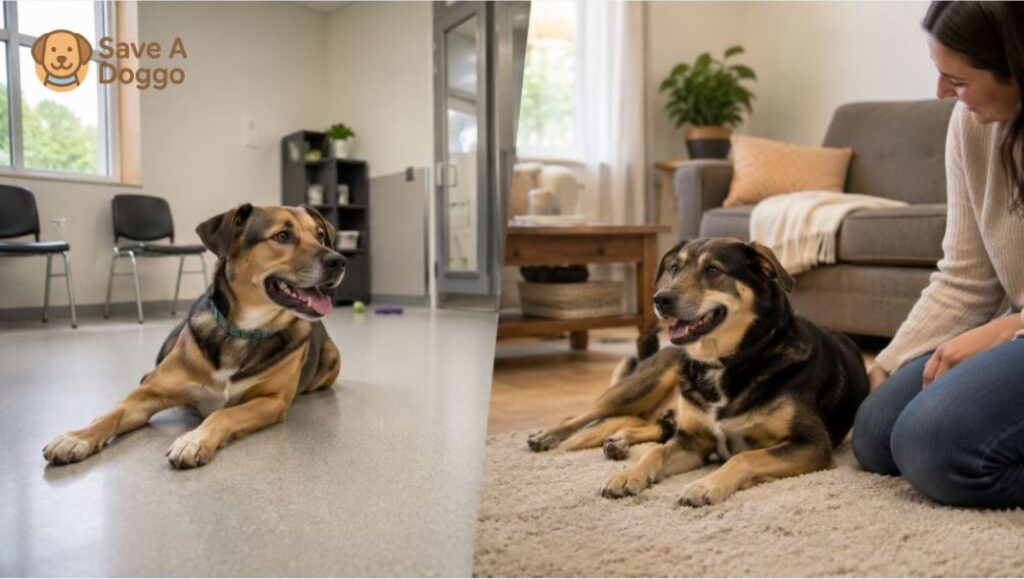
A shelter environment is not the same as a home. Noise, confinement, unfamiliar handlers, limited rest, and changing routines can influence appetite, sleep, sociability, and behavior. This does not make shelter observations useless; it means their setting must remain attached to the description.
Shelters also vary widely. Some place many dogs in foster homes, while others rely primarily on kennels. Learning how shelters help dogs recover can make the questions you ask more specific and fair.
How foster-based rescues work
A foster-based rescue generally houses dogs in private volunteer homes rather than maintaining a public kennel facility. Dogs may come from municipal shelters, owner surrenders, transfer partners, or other approved sources. Some rescues also use boarding, adoption-event, or limited facility space, so “foster-based” does not always mean every dog has spent extensive time in a home.
Foster care may reveal:
- Eating, sleeping, and house-training patterns
- Behavior around ordinary appliances and household movement
- Responses to visitors, time alone, stairs, elevators, or car travel
- Ability to settle after walks or excitement
- Interactions with specific adults, children, dogs, or cats in that foster home
The Best Friends dog foster manual encourages caregivers to observe appetite, energy, health, routines, house-training, and behavior. Those notes can be valuable, but they still reflect one home, one caregiver, and the situations that actually occurred.
Foster capacity can affect which dogs a rescue accepts, when dogs become available, and how quickly meetings can be scheduled. Adoption events may also present a temporary, stimulating environment that looks different from the foster home.
What behavior data each setting can provide
Instead of asking which setting provides “more accurate” behavior information, sort every claim by source and context.
| Information source | What it can show | What it cannot guarantee |
|---|---|---|
| Shelter staff or volunteer | Leashing, kennel behavior, walks, handling, recovery from shelter events, and responses to multiple caregivers | Behavior during an ordinary day in your home |
| Foster caregiver | Household routines, rest, elimination, time alone, visitors, and specific resident animals | Behavior in a different household, neighborhood, or social group |
| Previous guardian | Potentially longer-term history and behavior in a familiar home | Whether all details are complete, current, or independently observed |
| Structured assessment | Behavior during defined exercises in a particular setting | A fixed personality or response to every future situation |
| Adoption-event meeting | Behavior during that meeting and ability to interact in a stimulating environment | How the dog will behave after decompression at home |
Use three labels in your notes: observed, reported, and unknown. “No problem observed” may simply mean the relevant situation never occurred. For example, a dog cannot be described as comfortable alone if nobody recorded what happened when the dog was actually left.
Ask for observable details: What did the dog do? What happened immediately before it? How long did the response last? What helped the dog recover? Avoid conclusions based only on labels such as friendly, dominant, stubborn, quiet, or good with pets.
Medical records and support
Either model may provide excellent medical documentation—or only the information available since intake. The organizational label does not tell you whether the dog received a comprehensive examination or whether older records exist.
Ask both types of organization for:
- Examination notes and test results
- Vaccine and preventive-care dates
- Microchip registration information
- Spay or neuter status
- Known diagnoses, injuries, allergies, or mobility concerns
- Current medication, veterinary directions, and remaining supply
- Diet and recent appetite or elimination changes
- Recommended follow-up and the clinic that provided care
Foster caregivers may contribute daily observations, but they do not replace veterinary records. Shelter veterinary teams may have clear intake documentation but no medical history from before arrival. Arrange your own veterinary appointment after adoption and do not change medication or treatment without professional guidance.
Post-adoption support also varies by organization rather than model. Ask whether help includes check-ins, veterinary follow-up, training resources, behavior consultations, written plans, referrals, or a designated contact person.
Speed, availability, and screening
A municipal shelter may allow walk-in browsing or same-day meetings because animals and counselors are in one facility. A foster-based rescue may require registration, matching, travel to an event, or a scheduled meeting because dogs live in separate homes.
Those are tendencies, not rules:
- A shelter may require appointments, applications, landlord confirmation, or multiple meetings.
- A foster rescue may complete registration in advance and move quickly once a match is available.
- Either model may offer foster-to-adopt or trial arrangements for selected dogs.
- High demand, staffing, foster capacity, medical care, or dog-specific needs can change timelines.
Do not mistake speed for transparency or a lengthy application for quality. Evaluate whether the process gathers relevant information, discloses known concerns, welcomes questions, and explains what happens if the adoption needs support.
Verified New York City examples
Animal Care Centers of NYC: As of July 3, 2026, ACC’s official adoption-process page describes an application, counseling session, and interaction with the animal at a care center. Its published dog behavior levels may incorporate shelter observations and owner-reported history when available.
Muddy Paws Rescue: As of July 3, 2026, Muddy Paws identifies itself as a foster-based New York City rescue without a public shelter. Its adoption page requires prospective adopters to register before scheduling meetings at events or other arranged settings. It also states that foster descriptions may differ from behavior displayed at an adoption event and offers a Flex Adoption option for eligible dogs.
These examples show how two organizations in the same region can use different access and matching systems. They do not establish rules for every municipal shelter or foster-based rescue. Recheck both organizations’ current policies before publication or adoption.
Questions to ask either organization
- Where has this dog lived since entering your care?
- How long was the dog observed in each setting?
- Which information was directly observed, previously reported, or remains unknown?
- What does a typical day currently look like?
- How does the dog show stress, and what helps with recovery?
- What has been observed during handling, leashing, grooming, and veterinary care?
- Is there a known bite, snap, guarding, escape, or severe-fear history?
- What happened when the dog was left alone, and for how long was that observed?
- What interactions occurred with children, visitors, dogs, cats, or small animals?
- Which situations have not been assessed?
- What medical records and follow-up recommendations will I receive?
- What post-adoption support is available, from whom, and for how long?
- Is foster-to-adopt or another trial arrangement available for this dog?
- What does the contract require if I need help or cannot keep the dog?
Useful script: “I understand that no setting can predict everything. Could you separate what you directly observed, what someone else reported, and what is still unknown? For the most important behaviors, please describe the setting, trigger, response, and recovery.”
Which model may fit different adopters
| Your priority | Where you might begin | What to verify |
|---|---|---|
| You want to meet several available dogs in one visit. | A centralized shelter may be convenient. | Browsing hours, appointment rules, and counselor availability |
| You want household-specific routine notes. | A foster-based rescue or a shelter dog currently in foster may help. | Length of foster stay and which situations were actually observed |
| You prefer a scheduled matching process. | A foster rescue may use registration and arranged meetings. | Timeline, meeting location, hold policy, and availability |
| You need substantial post-adoption guidance. | Either model may be appropriate. | Exact support, response time, eligibility, and professional qualifications |
| You have children or resident animals. | Choose the organization with the most relevant, contextual information. | What was observed versus assumed, plus the introduction plan |
| You need time to evaluate the match. | Ask both models about foster-to-adopt or trial options. | Which dogs qualify, contract terms, and return procedure |
The organization’s model matters less than the quality and relevance of its information. A well-documented shelter dog may be easier to evaluate than a foster dog with brief or incomplete notes. A long-term foster may provide household details that a short shelter stay cannot.
Comparison table
| Factor | Municipal or centralized shelter | Foster-based rescue |
|---|---|---|
| Housing | Dogs commonly stay at a central facility, though some may enter foster care. | Dogs commonly live in volunteer homes; boarding or event spaces may also be used. |
| Meeting dogs | May allow several dogs to be viewed in one location. | Meetings may require registration, scheduling, or an adoption event. |
| Behavior context | Can show responses to kennel routines, multiple handlers, walks, and shelter activity. | Can show responses to household routines and specific home experiences. |
| Main limitation | The shelter environment may not reflect behavior in a home. | One foster home may not reflect behavior in a different household. |
| History | May include intake, finder, previous-guardian, staff, volunteer, or foster notes. | May combine source-shelter records with foster observations. |
| Medical information | Depends on intake records, available history, examination, and organizational resources. | Depends on source records, partner veterinary care, and foster observations. |
| Availability | May have more dogs visible at one time. | Depends partly on available foster homes and meeting coordination. |
| Screening | May range from conversational counseling to formal applications. | May range from open adoption to multistep registration and matching. |
| Support | May offer staff contacts, classes, referrals, or behavior resources. | May offer foster insight, coordinator support, trainers, or adopter groups. |
| Best use | A strong starting point when access, variety, and direct counseling matter. | A strong starting point when home-context notes and scheduled matching matter. |
Before committing through either route, review the practical differences between shelter and rescue organizations and complete a rescue dog adoption checklist.
Frequently Asked Questions
Are shelter dogs less predictable than foster dogs?
Not necessarily. The useful question is whether the available observations match your home concerns and whether their context is clearly explained.
Can a municipal shelter dog also live in foster care?
Yes. Many organizations use hybrid systems, and shelters may place selected dogs in foster homes. Ask where the individual dog has lived.
Can I meet a foster dog more than once?
Possibly, but policies and availability vary. Ask before applying whether repeat meetings, household meetings, or trial options are offered.
Is foster-to-adopt limited to foster-based rescues?
No. Shelters and foster-based rescues may both offer trial or foster-to-adopt programs for selected dogs. Confirm eligibility and contract terms.
Safety note: Neither shelter assessments nor foster observations guarantee future behavior. Do not provoke fear, guarding, aggression, or distress to test a dog. Discuss bite history, severe fear, medical concerns, and significant behavior needs with the organization, a veterinarian, and a qualified reward-based professional.
Sources & Further Reading
- Best Friends Animal Society: Adopt a Pet
- Best Friends Animal Society: Foster a Pet
- Best Friends Animal Society: Dog Foster Care Manual
- Animal Care Centers of NYC: Adoption Process
- Muddy Paws Rescue: Register to Adopt
Use the comparison table to choose where to begin—not which model is ‘best.’

The Save A Doggo Editorial Team creates practical, welfare-first resources for rescue-dog adopters, foster families, and shelter supporters. We prioritize primary and authoritative sources, distinguish observation from diagnosis, correct material errors transparently, and explain when veterinary or qualified behavior support is needed. We do not claim veterinary credentials or professional review unless a named, verifiable reviewer has approved the final article.