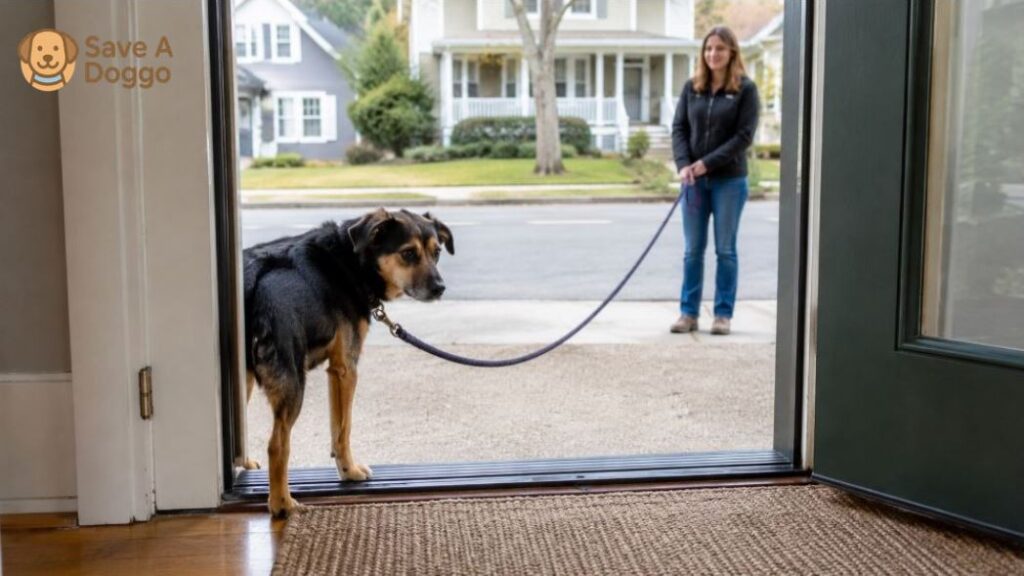
If your rescue dog won’t walk outside, start by noticing exactly where movement stops. The problem may begin when the harness appears, at the doorway, in an echoing hallway, on a slippery surface, or near traffic. That stopping point provides more useful information than labeling the dog stubborn.
Quick Answer: First check for pain, paw problems, and uncomfortable or insecure equipment. If those concerns are addressed, begin at the last place where your dog can still sniff, eat, look around, and choose to move. Reward voluntary steps, allow retreat, and keep outings short. Never drag, corner, punish, or lure a frightened dog farther than they can comfortably handle.
First Rule Out Pain and Equipment Problems
A reluctance to move can be behavioral, physical, or both. Arrange a veterinary examination when the change is sudden or the dog shows limping, stiffness, difficulty rising, an altered gait, unusual posture, sensitivity to touch, reduced activity, or reluctance to use stairs. Cornell includes slower walking and reluctance to exercise among possible signs of pain.
Before each outing, visually check the dog’s paws, nails, and walking equipment without forcing handling. Consider:
- Does the dog stop when the harness, collar, coat, or leash appears?
- Does any strap rub, pinch, restrict movement, or shift unexpectedly?
- Can the dog back out of the equipment?
- Does the leash clip strike the dog or create uncomfortable pressure?
- Is the surface too hot, cold, sharp, slippery, or unfamiliar?
Use securely fitted, non-aversive equipment appropriate for the individual dog. Ask the shelter, veterinarian, or qualified reward-based professional to check the fit, particularly when the dog is a flight risk. Do not use a prong, choke, or electronic collar to make the dog move.
Freeze, Shutdown, or Simple Hesitation?
“Shutdown” is an informal description, not a diagnosis. Focus on observable behavior instead of guessing what the dog feels.
| What you see | What it may tell you | Helpful response |
|---|---|---|
| Brief pause, scanning, sniffing, and ability to turn or take food | The dog may be assessing something unfamiliar. | Wait without leash pressure and reward voluntary movement. |
| Lowered posture, tucked tail, ears back, lip licking, repeated yawning, or avoidance | The dog appears worried or uncomfortable. | Increase distance and reduce the intensity of the environment. |
| Rigid stillness, prolonged immobility, inability to orient, frantic retreat, or escape attempts | The situation is too difficult for productive learning. | Leave calmly and restart later from a safer location. |
| Limping, uneven weight, shortened steps, stiffness, or pain with movement | A physical problem may be contributing. | Stop the session and contact a veterinarian. |
The RSPCA’s body-language guidance describes lowered posture, tucked tails, ears held back, avoidance, lip licking, and yawning as signs of worry. Learn to read fear and stress signals before asking for more distance.
When a Rescue Dog Won’t Walk Outside: Map the Trigger Distance
Trigger distance is the space between the dog and something that changes their behavior. The trigger may be a moving car, person, dog, trash truck, open doorway, stairwell, elevator, or simply the combined intensity of the outdoors.
Instead of measuring only how far the dog walks, record the last point where the dog can still perform normal, voluntary behaviors.
| Zone | Observable signs | Decision |
|---|---|---|
| Green | Loose movement, sniffing, normal breathing, checking in, and ability to choose direction | Practice here and reward exploration. |
| Yellow | Slowing, repeated scanning, lower posture, delayed response, or reduced interest in food | Pause or retreat before the dog freezes. |
| Red | Rigid body, sustained freeze, escape behavior, frantic pulling home, or inability to reorient | Leave the situation and make the next attempt easier. |
Food refusal alone does not diagnose fear, but a sudden change from taking food to being unable to eat can help identify where the environment became more difficult. Useful landmarks might be “inside with the door open,” “one step onto the porch,” or “before the first parked car.”
Begin at the Doorway
If the threshold is the stopping point, the first goal is not a complete walk. It is relaxed, voluntary interaction with the doorway.
- Begin several feet inside, where the dog can move normally.
- Reward the dog for looking toward or approaching the closed door.
- Open the door briefly while allowing the dog to remain inside or retreat.
- Reward one voluntary step closer, then move away from the door together.
- If the dog chooses to cross, allow an immediate return indoors.
- Repeat only while the dog remains in the green zone.
Do not block the route back inside. Approach-and-retreat practice works because the dog learns that moving toward the doorway does not remove the option to leave. A session ending after one relaxed look or step can still be successful.
Use Sniffing and Choice
Sniffing can become the activity rather than a reward for covering distance. Allow the dog to investigate one safe patch of ground, choose between two quiet directions, or stop and observe from a comfortable location.
Food can reinforce voluntary movement, but it should not be used to pull the dog across a frightening threshold. Place rewards where the dog already feels able to eat, or deliver them after the dog chooses a step. If the dog follows food into a scary place and then realizes retreat is difficult, trust may suffer.
Keep the leash loose enough to permit natural movement while maintaining safety. Follow the dog’s safe choices instead of steering continuously. This is one way to build trust through choices.
Keep Outings Short and Successful
Success is not reaching the end of the block. It may be stepping onto the porch, sniffing for 20 seconds, and returning with a loose body. Several low-pressure repetitions are generally more useful than one outing that ends in panic.
Change only one variable at a time:
- Distance from the doorway
- Time spent outside
- Time of day
- Amount of traffic or pedestrian activity
- Walking surface
- Presence of another familiar person
Practice during the quietest realistic period. As the dog becomes comfortable leaving home, you can try slower decompression walks centered on sniffing rather than distance.
Always preserve an easy route home. If the dog becomes worried, retreating is useful information—not a failed walk.
What Not to Do
- Do not drag or pull the dog forward by the leash.
- Do not push from behind, corner the dog, or block retreat.
- Do not carry the dog into a frightening environment as routine training.
- Do not lure the dog farther than they would voluntarily travel.
- Do not use crowded areas to force the dog to “get used to it.”
- Do not punish freezing, growling, barking, or attempts to move away.
- Do not force greetings with people or other dogs.
- Do not add aversive equipment or leash corrections.
The American Veterinary Society of Animal Behavior recommends reward-based training and advises against aversive methods. The aim is to create safer emotional associations and usable skills, not suppress the dog’s warnings.
Progress Log
Record one line after each attempt. Video may also help a veterinarian or behavior professional if it can be captured without changing the session or compromising safety.
| Date and time | Stopping point | Environment | Body language | Choices made | Recovery |
|---|---|---|---|---|---|
| __________ | Door, hall, porch, sidewalk, or landmark | Noise, traffic, weather, people, dogs, surface | Loose, scanning, lowered, frozen, retreating | Looked, sniffed, stepped forward, turned back | Where and how quickly normal behavior returned |
| __________ | ________________ | ________________ | ________________ | ________________ | ________________ |
| __________ | ________________ | ________________ | ________________ | ________________ | ________________ |
Use the log to make the next session easier. For example:
“The dog could sniff with the door open but froze after one step outside when a truck passed. Next session: practice inside with the door open during a quieter period.”
This is a hypothetical example, not a documented case.
When to Get Professional Help
Contact a veterinarian when refusal starts suddenly, worsens, occurs on particular surfaces or stairs, or appears with limping, stiffness, difficulty rising, altered posture, touch sensitivity, appetite changes, or reduced activity. Seek urgent care after trauma, when the dog cannot stand or walk, or when severe pain or breathing difficulty is present.
After pain and equipment problems have been evaluated, request help from a qualified reward-based trainer or behavior professional if:
- The dog cannot leave the doorway for essential toilet breaks.
- Freezing or escape attempts are frequent or intensifying.
- The dog will not recover after returning to a familiar place.
- Fear includes snapping or a significant bite risk.
- Progress remains stalled despite consistently easier sessions.
- The home environment makes trigger distance difficult to create safely.
Cornell recommends predictability and individualized behavior strategies for anxious dogs. Severe fear may require coordination between a veterinarian and a qualified behavior professional.
Frequently Asked Questions
Should I gently pull until my dog starts walking?
No. Even steady pressure can increase fear, create equipment discomfort, or cause a frightened dog to resist or escape. Reduce the difficulty and reward voluntary steps instead.
Should I carry my rescue dog outside?
Carrying may be necessary for an immediate safety or medical reason, but it is not a substitute for gradual training. Do not lift a fearful or painful dog unless handling is safe and necessary.
What if my dog takes treats indoors but not outside?
The outdoor environment may be too intense, or the dog may not be interested in food at that moment. Move back to a quieter location where normal behavior returns; do not switch to increasingly tempting food to pull the dog farther.
Can a confident dog help?
A calm, familiar dog may help some individuals, but another dog can also add pressure or excitement. Use this option only when both dogs are comfortable and can be handled safely.
How long will it take before my rescue dog walks normally?
There is no reliable deadline. Pain, previous experience, environment, equipment, and individual temperament all affect progress. Track recovery, voluntary movement, and comfort rather than comparing distances or timelines.
Sources & Further Reading
- AVSAB: Humane Dog Training Position Statement
- RSPCA: Understanding a Dog’s Body Language
- Cornell University: Anxious Behavior in Dogs
- Cornell University: Recognizing Pain in Dogs
Safety note: This article provides general education, not a diagnosis or individualized treatment plan. Stop the outing and contact a veterinarian if your dog shows pain, limping, weakness, an altered gait, or a sudden change in movement. Use secure, non-aversive equipment and avoid handling a frightened or painful dog in ways that could lead to escape or a bite.
Record the distance your dog can move while still relaxed, not the distance you wish they could walk.
The Save A Doggo Editorial Team creates practical, welfare-first resources for rescue-dog adopters, foster families, and shelter supporters. We prioritize primary and authoritative sources, distinguish observation from diagnosis, correct material errors transparently, and explain when veterinary or qualified behavior support is needed. We do not claim veterinary credentials or professional review unless a named, verifiable reviewer has approved the final article.