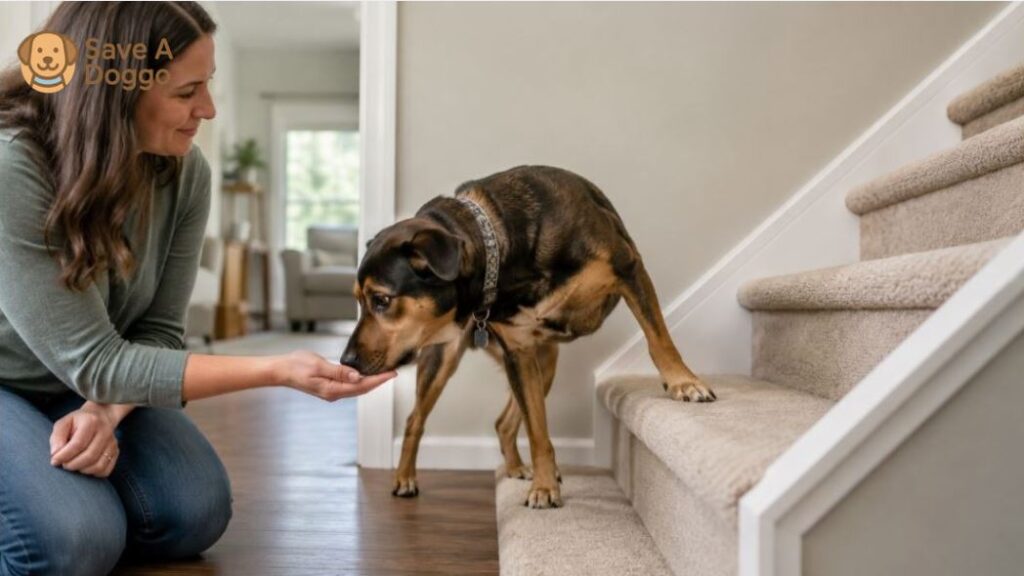
If your rescue dog is afraid of stairs, pause before treating the problem as a lack of confidence. Pain, reduced vision, weak traction, poor lighting, and the staircase itself can make each step physically risky. Training should begin only after the environment and the dog’s mobility have been assessed.
Quick Answer: Block unsupervised stair access, check for pain or vision changes, and improve traction and lighting before training. Begin on a safe landing and reward looking, approaching, or placing one paw voluntarily. Let the dog retreat at any time. Never pull by the leash, push from behind, place the dog midway up the staircase, or use food to lure them beyond a safe stopping point.
Why Stairs Can Feel Unsafe
A rescue dog may have little experience with indoor stairs. A previous home might have been single-level, while a shelter kennel may not have included steps at all. Staircases also differ dramatically in height, depth, sound, surface, openness, and lighting.
Possible sources of difficulty include:
- Slick wood, tile, laminate, metal, or worn carpet
- Narrow treads or unusually steep steps
- Open risers that allow the dog to see through the staircase
- Shadows, glare, or poor contrast between steps
- Noise or movement above, below, or beside the staircase
- A previous slip, fall, or forced experience
- Pain, weakness, limited joint movement, or reduced balance
- Reduced vision, particularly in dim conditions
Going up and going down are separate skills. A dog may manage one direction but stop, rush, or lose balance in the other.
A Rescue Dog Afraid of Stairs Needs a Veterinary and Mobility Check
Stair avoidance can be a subtle sign of discomfort. VCA’s pain guidance lists reluctance to climb stairs, stiffness, limping, reduced activity, resistance to handling, and stopping during walks among possible signs of pain.
Contact a veterinarian before training when:
- The fear began suddenly or is getting worse.
- The dog limps, moves unevenly, or appears stiff.
- Rising, sitting, jumping, or getting into a car has also become difficult.
- The dog vocalizes, trembles, pants at rest, or reacts to touch.
- A paw drags, a leg buckles, or balance appears unreliable.
- The dog recently had an injury, surgery, or medication change.
- The dog is a senior or has a known orthopedic or neurologic condition.
Vision should also be considered when hesitation is worse in dim light, when going down, or in unfamiliar locations. Cornell notes that progressive vision loss may appear as reluctance to enter dark areas, hesitation on stairs, or clumsiness in new surroundings. An eye examination is needed to determine the cause; do not diagnose vision loss from stair behavior alone.
Do not give human pain medication or change veterinary treatment to make stair practice possible.
Improve Traction and Lighting First
Training on an unsafe staircase only teaches the dog that caution was justified. Complete this environmental audit before inviting the dog to approach:
| Feature | What to inspect | Safer adjustment |
|---|---|---|
| Surface | Slippery finish, loose rugs, worn carpet, or curled tread edges | Install secure non-slip treads or a firmly attached runner. |
| Lighting | Dark landings, strong glare, moving shadows, or failed bulbs | Provide even lighting at the top, bottom, and along the flight. |
| Visibility | Steps blend together or have open risers | Ask a veterinarian or rehabilitation professional whether safe visual contrast or an alternative route would help. |
| Structure | Loose boards, clutter, narrow treads, steep incline, or unstable railings | Repair or block access; do not train until the route is physically sound. |
| Access | The dog can reach the stairs without supervision | Install gates designed and secured for that stair location. |
Loose towels and unsecured mats may slide with the dog. VCA recommends non-skid surfaces and restricted unsupervised stair access for dogs affected by joint pain or reduced balance.
Break the Staircase Into Tiny Choices
Do not begin by asking for the entire staircase. Start on the landing where the dog is already comfortable.
- Reward the dog for calmly looking toward the stairs.
- Reward a voluntary approach to the bottom landing.
- Move away together so retreat remains part of the exercise.
- Reward sniffing the first step or shifting weight toward it.
- If the dog chooses, reward placing one paw on the first step.
- Progress to two paws or one complete step only when movement remains controlled.
- After one step up, allow the dog to step back onto the landing rather than continuing upward.
Do not place the dog on a middle step to “show” them how. Do not block the route back, push from behind, or stand above pulling on the leash. One calm approach followed by retreat may be a complete session.
Choice-based practice helps build confidence without rushing. Increase only one element at a time: number of steps, direction, duration, or environmental distraction.
Reward Looking and Approaching
Food can reinforce voluntary movement, but it should not function as bait that pulls the dog into a position they would not otherwise choose. Deliver the reward on the landing or step the dog has reached comfortably.
Useful behaviors to reward include:
- Looking toward the staircase with a loose body
- Approaching and then choosing to retreat
- Sniffing a tread
- Shifting weight forward without slipping
- Placing and removing one paw calmly
- Pausing instead of rushing
If the dog stretches toward food while keeping most of their weight far back, freezes, crouches, or grabs the treat and scrambles away, make the next repetition easier. Learn to recognize early stress signals rather than measuring success by the number of steps completed.
The American Veterinary Society of Animal Behavior recommends reward-based methods and advises against physical or psychological punishment.
Going Up Versus Going Down
| Direction | Why it may be difficult | Safer starting point |
|---|---|---|
| Going up | The movement may reveal hind-limb weakness, stiffness, discomfort, or poor traction. | Practice approaching the bottom step and placing one paw without continuing. |
| Going down | The staircase may look visually exposed, and controlled weight transfer may feel less secure. | After the dog can comfortably step onto the first low step, practice returning to the landing. |
Never start descent training by placing the dog at the top of a full flight. If the dog can go up but cannot safely return down, do not continue upward. A rehabilitation professional may recommend work on a low, stable practice platform before using the actual staircase.
Hesitation that consistently affects only one direction is useful information for the veterinarian. Record whether the dog slips, shortens a step, favors a limb, or changes posture.
Harness and Barrier Safety
A well-fitted body harness can provide controlled guidance, but it should not be used to drag or suspend the dog. A support or lifting harness should be selected and fitted with guidance from a veterinarian or canine rehabilitation professional when mobility assistance is needed.
- Keep the leash short enough to prevent tangling but without constant tension.
- Do not wrap the leash around your hand, wrist, or railing.
- Maintain your own balance and an unobstructed escape route.
- Do not stand directly below a large or unstable dog.
- Keep children and other animals away during practice.
- Use secure barriers at the top and bottom between sessions.
A frightened or painful dog may react defensively when grabbed. Review how to handle a frightened dog safely, and stop if assistance cannot be provided without risking a fall or bite.
Progress Tracker
Record observable details rather than writing “did well” or “was stubborn.”
| Date | Direction | Starting point | Surface and lighting | Voluntary choice | Body and movement | Next step |
|---|---|---|---|---|---|---|
| __________ | Up / down | Distance or step | Dry, secure, bright, dim, shadowed | Looked, approached, sniffed, paw, full step | Loose, hesitant, crouched, slipped, favored limb | Repeat, make easier, or stop for evaluation |
| __________ | __________ | __________ | __________ | __________ | __________ | __________ |
| __________ | __________ | __________ | __________ | __________ | __________ | __________ |
| Observation | Decision |
|---|---|
| Loose body, controlled footing, and voluntary approach | Repeat the same small step before adding difficulty. |
| Lowered posture, prolonged pause, lip licking, retreat, or hurried movement | Return to the landing and make the next attempt easier. |
| Slip, fall, limb favoring, vocalization, buckling, or inability to control speed | Stop stair use and contact a veterinarian. |
When Stairs Should Be Avoided
A dog does not need to master every staircase. Continue using gates and arrange a single-level routine when:
- A veterinarian or rehabilitation professional advises against stair use.
- Pain, weakness, poor balance, or vision loss creates a fall risk.
- The dog rushes or loses control despite improved traction.
- The staircase is too steep, narrow, open, damaged, or slippery to modify safely.
- The dog is recovering from surgery or injury.
- The handler cannot assist without risking a fall or bite.
- Fear remains severe despite appropriately small, voluntary steps.
Cornell recommends gates to block stair access for dogs with progressive vision loss. A ramp is not automatically safer; it must have an appropriate incline, stable footing, secure edges, and a gradual introduction suited to the dog’s medical and mobility needs.
Frequently Asked Questions
Why is my dog more afraid of going downstairs?
Going down may feel more visually exposed and requires controlled footing. Poor lighting, limited vision, pain, or a previous slip may contribute. Record the difference and share it with your veterinarian.
Should I carry my dog on the stairs?
Only when the dog can be lifted safely and a veterinarian considers it appropriate. Carrying a painful, frightened, large, or struggling dog can injure both of you. A single-level setup may be safer.
Can I place treats on several steps?
A line of treats can encourage a dog to move farther than intended or rush on a slippery surface. Reward at the dog’s current safe position instead of creating a trail up the staircase.
How long will stair training take?
There is no universal timeline. Stair design, health, vision, mobility, previous experience, and fear intensity all matter. Progress should be measured by controlled, voluntary movement rather than speed.
Is adding carpet enough to solve the problem?
Secure traction may help, but it cannot resolve pain, weakness, impaired vision, or an unsafe staircase design. Complete the veterinary and environmental checks before assuming confidence is the only issue.
Sources & Further Reading
- AVSAB: Humane Dog Training Position Statement
- RSPCA: Understanding Dog Behavior
- VCA Animal Hospitals: Pain Management for Dogs
- VCA Animal Hospitals: Multimodal Pain Management
- Cornell University: Progressive Retinal Atrophy
Safety note: This article provides general education, not a diagnosis, rehabilitation program, or individualized treatment plan. Stop stair use after a slip, fall, sudden mobility change, apparent pain, or loss of balance. Do not give human pain medication or physically lift, pull, or support a dog unless doing so is safe and professionally appropriate.
Make the stairs physically safer before asking for any training step.
The Save A Doggo Editorial Team creates practical, welfare-first resources for rescue-dog adopters, foster families, and shelter supporters. We prioritize primary and authoritative sources, distinguish observation from diagnosis, correct material errors transparently, and explain when veterinary or qualified behavior support is needed. We do not claim veterinary credentials or professional review unless a named, verifiable reviewer has approved the final article.