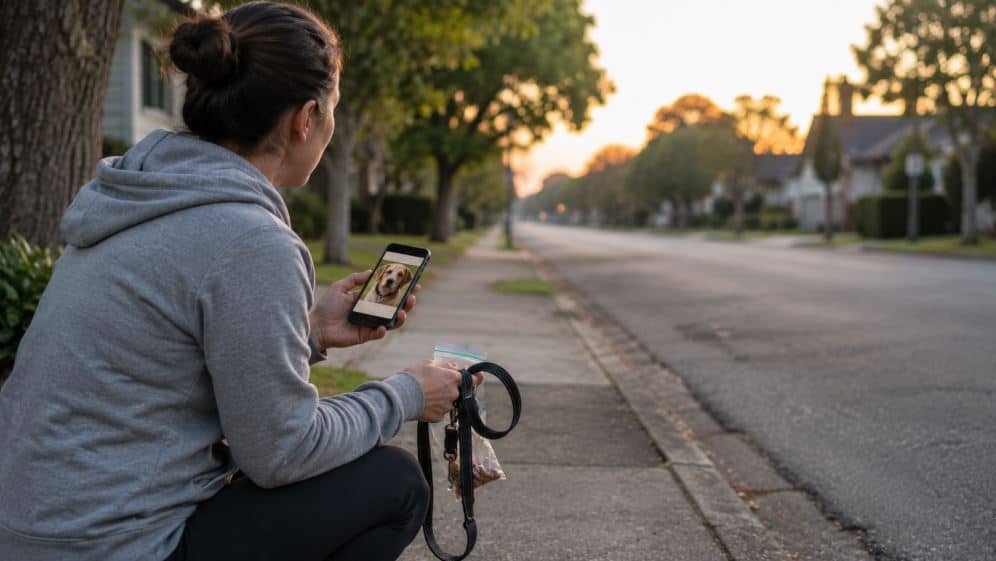
A newly adopted dog can slip through a door, back out of unfamiliar walking gear, or run after a sudden fright. Your panic is understandable, but the search needs to stay calm. The first goal is not to cover the greatest distance—it is to avoid pushing a frightened dog away while building a reliable picture of where they went.
Quick Answer: When a rescue dog goes missing, do not chase or organize a loud search party. Secure the escape point, record the exact time and direction, and begin a quiet nearby search. Report the dog missing to the microchip registry, shelter, animal control, adoption organization, and local clinics. Give observers one instruction: do not pursue—report the location immediately.
First 15 minutes: Secure the escape point and stop chasing
If the dog is still visible but moving away, stop running. Chasing, shouting, repeated name-calling, or approaching head-on can feel threatening to a frightened dog. Ask bystanders to stop and give the dog space.
If it is safe to remain nearby, lower your profile, turn partly sideways, avoid staring, and stay quiet. You can place or gently toss familiar food near you without moving toward the dog. If the dog begins approaching, resist the urge to lunge or grab. Let a familiar handler secure the dog only when it can be done calmly and safely.
If the dog disappears from view:
- Note the exact escape time, location, and direction of travel.
- Secure the open gate, door, fence gap, or vehicle so the dog has a safe place to return.
- Leave one calm, familiar person at or near the escape point when safe.
- Ask nearby people not to chase, call, whistle at, or follow the dog.
- Check the immediate property, garage, porch, shrubs, sheds, and other hiding places.
A newly adopted dog may not yet respond reliably to their name. Their behavior outdoors may also differ from what you saw in the shelter or home. Knowing how to recognize fearful body language can help you avoid turning a sighting into another flight.
First 2 hours: Use a quiet search and familiar scent
Search slowly outward from the last confirmed location. Walk or drive at a low speed where legal and safe, checking under porches, behind buildings, along fence lines, near parked vehicles, and around quiet cover. Ask neighbors to check garages, sheds, crawl spaces, and camera footage rather than sending a crowd into the area.
Place a familiar scent item—such as the dog’s bed or an unwashed shirt worn by a bonded person—at the escape point or another safe return location. Keep it off the roadway, obtain property-owner permission, and do not scatter scent items across multiple locations.
Give searchers assigned routes and one central contact. A coordinated search produces clearer sightings than several people following different tips while calling the dog.
| If this happens | Do this | Avoid this |
|---|---|---|
| The dog is visible and stationary | Stop, stay quiet, turn sideways, and allow distance. | Walking directly toward the dog or surrounding them. |
| The dog moves away | Record the time, location, and direction, then contact the search coordinator. | Following, driving behind, or sending several people after them. |
| A neighbor has camera footage | Ask for the timestamp, direction of travel, and a copy of the relevant clip. | Posting an unconfirmed location that may attract a crowd. |
| The dog approaches willingly | Stay relaxed and let the familiar handler secure the dog carefully. | Sudden reaching, grabbing, cheering, or rushing in. |
Contact the microchip company
Find the microchip number in the adoption, shelter, or veterinary records. Contact the registry that maintains the record and:
- Report the dog as missing.
- Confirm that your phone number, email, and address are current.
- Add an alternate trusted contact if the registry permits it.
- Confirm that ownership was transferred from the shelter or rescue.
- Ask what lost-pet alert services are available through that registry.
If you know the number but not the registry, use the AAHA Microchip Registry Lookup. The lookup identifies registries to contact; it does not update the chip or reveal private owner information. Do not publish the complete microchip number in a public alert.
Notify shelters, animal control, clinics, and neighbors
Contact the shelter, rescue, foster home, or adoption coordinator first. They may know the dog’s fears, prior escape behavior, favorite food, or response to familiar people.
Next, file lost-dog reports with:
- Municipal and private animal shelters serving the escape area
- Local animal-control agencies
- Nearby veterinary and emergency clinics
- Local rescue groups and lost-pet community pages
- Neighbors, building staff, delivery workers, and other regular observers
Ask each shelter how it handles lost reports, found-dog photographs, in-person checks, and report expiration. The ASPCA and Best Friends Animal Society recommend checking shelters repeatedly rather than relying on one phone call.
| Local contact | Name and phone number | Report filed |
|---|---|---|
| Adoption organization | ________________________________ | □ |
| Municipal shelter | ________________________________ | □ |
| Animal control | ________________________________ | □ |
| Emergency veterinary clinic | ________________________________ | □ |
| Microchip registry | ________________________________ | □ |
Build a clear lost-dog alert
Create one consistent alert for flyers, community groups, shelters, and lost-pet databases. Use a sharp, recent photograph that shows the dog’s face and body. Register the dog with Petco Love Lost and search its reported found pets.
Include:
- A large “LOST DOG—DO NOT CHASE” heading
- Date, time, and cross streets or landmark where last seen
- Direction of travel, if known
- Size, color, coat, sex, and distinctive markings
- Collar, harness, or leash description
- Relevant fears, such as strangers, traffic, or loud voices
- A phone number monitored throughout the search
- Instructions to text the exact location, time, direction, and a photo if safely possible
Do not publish your exact home address, complete microchip number, or every identifying detail. Retaining one detail can help verify that a caller has genuinely seen or found the dog.
Alert template: “LOST RESCUE DOG—DO NOT CHASE OR CALL. Last seen [date and time] near [cross streets or landmark], moving toward [direction]. [Size, color, coat, and distinctive feature]. Wearing [collar or harness]. Fearful of [known fears]. Please text [number] with the exact location, time, direction of travel, and a photo if safe.”
Search at low-traffic times
Return to the last-seen area during quieter periods, particularly late evening or early morning, when there are fewer people, vehicles, and competing noises. Best Friends recommends checking the loss area at these times with familiar food and a flashlight.
Move quietly and pause often to listen. A single soft, familiar cue may help a dog who remains socially engaged, but stop calling if the dog startles or moves away. For a dog running in panic, location reports are usually more valuable than repeated attempts to approach.
Maintain a sighting log:
| Time | Exact location | Direction | Dog’s behavior | Photo or camera confirmed? |
|---|---|---|---|---|
| ________ | ________________ | ____________ | ________________ | ____________ |
| ________ | ________________ | ____________ | ________________ | ____________ |
Cameras, feeding stations, and professional recovery help
Use a feeding station only when sightings suggest that the dog is returning to one safe location. Place it away from traffic, obtain the property owner’s permission, and pair it with a trail or security camera when possible. Food can attract wildlife and other animals, so the station must be monitored and adjusted with local guidance.
Camera timestamps can reveal when the dog visits, which direction they use, and whether a recovery setup is realistic. Avoid placing several feeding stations that make movement harder to interpret.
Do not set a humane trap casually. The Missing Animal Response Network recommends confirming the dog’s presence at a feeding station before considering a trap. Seek help from an experienced lost-pet recovery professional, shelter, rescue, or animal-control agency that can select a safe location, monitor the equipment, and respond promptly.
What not to do
- Do not chase the dog on foot or in a vehicle.
- Do not send a noisy crowd toward an unconfirmed sighting.
- Do not repeatedly yell the dog’s name if they are fleeing.
- Do not corner, tackle, or grab a frightened dog.
- Do not punish the dog after recovery.
- Do not trespass, stop in traffic, or enter unsafe terrain.
- Do not post unverified sightings as confirmed locations.
- Do not pay a stranger who claims to have the dog without requesting proof.
- Do not share verification codes, account passwords, or full microchip details with callers.
- Do not use an unattended trap or place food near a busy road.
If a located dog appears injured, trapped near traffic, or likely to bite when approached, contact animal control, emergency services, or an experienced recovery professional. Do not put yourself or others in danger attempting a capture.
First 24-hour checklist
- □ Exact escape time, location, and direction recorded
- □ Escape point secured and one calm return location maintained
- □ Recent photo and full description collected
- □ Known fears and likely responses documented
- □ Adoption organization or foster contacted
- □ Microchip registry identified and missing status activated
- □ Contact information and ownership transfer confirmed
- □ Shelter and animal-control reports filed
- □ Nearby veterinary clinics notified
- □ Petco Love Lost and local lost-pet listings created
- □ Consistent “DO NOT CHASE” alert distributed
- □ Neighbors asked to check cameras, garages, and sheds
- □ Search routes assigned to avoid duplication
- □ Low-traffic search scheduled
- □ Sightings recorded in one central log
- □ Professional recovery help considered after confirmed sightings
Frequently Asked Questions
Can a microchip show my dog’s live location?
No. A standard microchip is an identification device, not a GPS tracker. A shelter or clinic must scan it and use the registered information to contact you.
Should strangers try to catch my rescue dog?
Usually not if the dog is fleeing or fearful. Ask observers not to chase or call. They should report the exact location, time, direction, and behavior instead.
Should I offer a reward?
A reward is optional. If you offer one, keep one identifying detail private and require proof before meeting or paying anyone. Investigate responses carefully and never share account codes or passwords.
Should I stop searching after the first 24 hours?
No. Continue checking shelters and found-pet listings, refreshing flyers, verifying sightings, and updating the search map. Keep the alert design and contact number consistent.
Safety note: Never enter private property, active roadways, construction areas, waterways, or other dangerous locations during a search. A frightened or injured dog may bite defensively. Use trained local help when safe recovery is beyond your experience.
Sources & Further Reading
- ASPCA: Finding a Lost Pet
- Best Friends Animal Society: How to Find a Lost Dog, Cat, or Other Pet
- Petco Love Lost: Lost and Found Pet Database
- American Animal Hospital Association: Microchip Registry Lookup
- Missing Animal Response Network: Lost Dog Behavior
Save your microchip, shelter, animal-control, and emergency contact details before adoption day.

The Save A Doggo Editorial Team creates practical, welfare-first resources for rescue-dog adopters, foster families, and shelter supporters. We prioritize primary and authoritative sources, distinguish observation from diagnosis, correct material errors transparently, and explain when veterinary or qualified behavior support is needed. We do not claim veterinary credentials or professional review unless a named, verifiable reviewer has approved the final article.