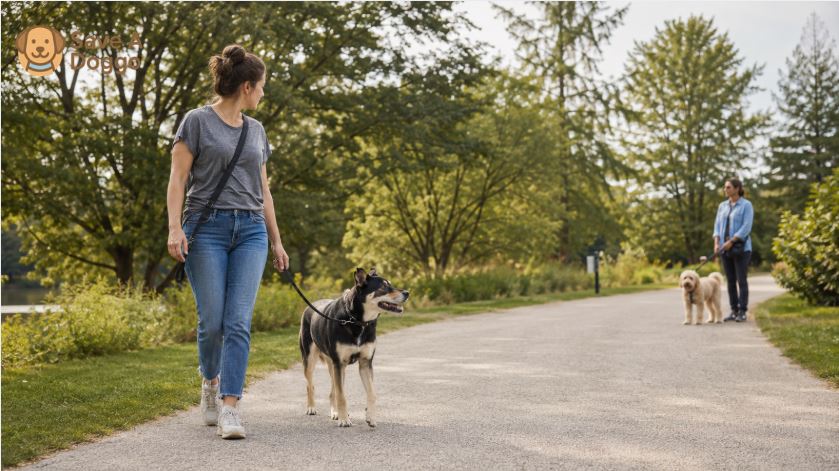
Leash reactivity in rescue dogs can feel intense: barking, lunging, spinning, pulling, or freezing when another dog, person, bike, car, or child appears. It is easy to feel embarrassed on the sidewalk. But your first job is not to “fix” the reaction in public. It is to create enough distance for your dog to feel safer and learn.
Quick Answer: Leash reactivity in rescue dogs is best handled with distance, safe equipment, predictable exits, and rewards for disengaging from triggers. Do not force greetings or correct the reaction. Map your dog’s workable distance, practice emergency U-turns in quiet places, use visual barriers, keep sessions short, and get professional help if there is lunging, snapping, biting, or poor recovery.
What Leash Reactivity in Rescue Dogs Can Look Like
Leash reactivity is a visible reaction to a trigger while the dog is on leash. It may include barking, whining, growling, lunging, jumping, spinning, pulling hard, freezing, hiding behind you, or trying to flee. Some dogs react only to other dogs. Others react to men, children, strollers, bikes, skateboards, delivery trucks, traffic, or people who stare or reach.
A reactive dog is not automatically “aggressive.” Reactivity can come from fear, frustration, excitement, lack of social experience, pain, learned patterns, or the stress of being restrained. A leash removes escape options, so a dog who might choose distance off leash may bark or lunge when they feel trapped.
Cornell’s canine anxiety guidance describes stress signs such as barking, panting, shaking, lip licking, and showing the whites of the eyes. The RSPCA also emphasizes that body posture, ears, tail, facial tension, avoidance, and movement all matter. Watch the whole dog, not just the bark.
Rule Out Pain and Equipment Issues
Before making a training plan, check whether discomfort is adding fuel. A dog who hurts may have less tolerance for close passes, sudden leash pressure, or being guided away.
- Call your veterinarian if reactivity is new, suddenly worse, or paired with limping, stiffness, yelping, appetite change, sleep change, or sensitivity to touch.
- Check fit on harnesses and collars. Gear should not rub behind the legs, restrict shoulder movement, press on the throat, or twist during walks.
- Use secure, humane equipment. Many dogs do well on a well-fitted harness and regular leash. Avoid prong collars, choke chains, shock collars, and leash corrections.
- Prevent escape. If your dog has backed out of gear before, ask a qualified professional about safer fitting, backup clips, or a double-attachment setup.
AVSAB’s current humane training position recommends reward-based methods and states that aversive tools and physical or psychological punishment should not be used for training or behavior modification. Safer equipment should help you manage distance, not force your dog through fear.
Map Triggers and Working Distance
Your dog’s “working distance” is the closest distance where they can notice the trigger and still think. That means they can take food, sniff, look away, respond to an easy cue, or move with you without exploding.
| Trigger detail | Easier version | Harder version |
|---|---|---|
| Other dogs | Quiet dog standing still across a park | Barking dog pulling directly toward your dog |
| People | Person walking away | Person staring, reaching, jogging, or speaking loudly |
| Vehicles | Parked car | Motorcycle, garbage truck, or fast traffic |
| Environment | Open park with exits | Narrow sidewalk, elevator, doorway, or busy lobby |
Start a simple map:
- Trigger type: ______________________________
- Closest workable distance: __________________
- Distance where barking/lunging starts: _______
- Best walking location: ______________________
- Hardest walking location: ___________________
- Recovery time after exposure: _______________
If your dog can stay relaxed at 100 feet, begin there. If they react at 100 feet, try 150 feet, a parked car as a barrier, or a quieter route. Progress is based on your dog’s body language, not on a calendar.
Emergency U-Turn and Visual Barriers
An emergency U-turn is a rehearsed escape route, not a punishment. Practice it when no trigger is present so your dog learns that turning away predicts good things.
- In a quiet place, say a cheerful cue such as “This way.”
- Turn your shoulders and feet away from the imaginary trigger.
- Guide your dog with happy movement, not leash pressure.
- Drop a few treats on the ground after the turn so your dog can sniff and reset.
- Repeat until the turn feels easy before using it near real triggers.
Visual barriers buy your dog time. Move behind a parked car, hedge, fence, open garage door, building corner, or large tree. If you are on a narrow sidewalk, cross early instead of waiting until the trigger is close.
For safe dog handling on walks, choose space over pride. It is better to turn around calmly than to prove your dog can “handle it” and end up rehearsing a bigger reaction.
Reward Disengagement
Disengagement means your dog notices the trigger and then chooses to look away, sniff, turn back to you, or move away. That moment is valuable. Pay it.
Try this simple pattern when your dog is still under threshold:
- Your dog notices the trigger at a safe distance.
- You stay quiet and keep the leash loose if possible.
- The moment your dog looks away or checks in, mark with “yes” or another familiar marker.
- Reward near your leg or on the ground away from the trigger.
- Move farther away before trying another repetition.
Do not use food to lure your dog toward another dog or person. VCA’s desensitization and counterconditioning guidance explains that exposure should begin at a low enough level that the pet is not showing fear or stress. Food should support a safe emotional change, not pull the dog closer than they can handle.
Short Practice Sessions
Reactive-dog practice should feel almost boring. If every walk becomes a training test, stress can stack quickly.
- Practice for 3 to 5 minutes, then take a sniff break.
- Choose open spaces where you can leave easily.
- Work with one trigger at a time when possible.
- Stop after a good repetition instead of pushing for one more.
- Skip hard training after vet visits, visitors, grooming, poor sleep, or a stressful morning.
Use a positive reinforcement training plan that rewards doable choices. The goal is not a perfectly obedient sidewalk dog. The goal is a dog who can notice a trigger and recover without panic.
What Not to Do
- Do not force leash greetings. Many dogs feel trapped face-to-face on leash, even if the other dog is friendly.
- Do not correct barking or lunging. Leash pops, yelling, spray bottles, prong collars, choke chains, or shock collars can add fear or pain to the trigger.
- Do not hold your dog in a sit while the trigger approaches. Stillness is not calm if your dog is frozen or hard staring.
- Do not walk into narrow spaces without an exit. Doorways, elevators, tight sidewalks, and crowded trails reduce choices.
- Do not punish growling. Growling is information. Suppressing warnings can make behavior less predictable.
- Do not judge progress by silence alone. A silent dog may still be over threshold if they are stiff, frozen, or refusing food.
If you are unsure whether your dog is calm or shut down, learn to read your rescue dog’s body language before increasing difficulty.
Progress Measures
Progress with leash reactivity is not just “barked” or “didn’t bark.” Better measures are distance, intensity, recovery, and choice.
| Date | Trigger | Starting distance | Reaction level 1-5 | Recovery time | What helped? |
|---|---|---|---|---|---|
| ________ | Dog / person / bike / car / child | ________ | 1 2 3 4 5 | ________ | U-turn / barrier / treats / sniff break / more distance |
| ________ | Dog / person / bike / car / child | ________ | 1 2 3 4 5 | ________ | U-turn / barrier / treats / sniff break / more distance |
| ________ | Dog / person / bike / car / child | ________ | 1 2 3 4 5 | ________ | U-turn / barrier / treats / sniff break / more distance |
Reaction Scale
- 1: notices trigger, stays loose, can eat, can disengage
- 2: mild tension, brief stare, recovers quickly
- 3: stiff, pulling, whining, slow to respond
- 4: barking, hard staring, refusing food, difficult to move away
- 5: lunging, snapping, panic, escape attempts, or redirected biting
If the distance is slowly decreasing while recovery stays quick, you are likely on the right track. If reactions are louder, recovery takes longer, or your dog starts scanning earlier in the walk, the plan is too hard.
When Reactivity Is a Bite Risk
Leash reactivity needs professional help when it includes snapping, biting, muzzle punching, repeated lunging at close range, redirected biting toward the handler, or inability to recover after the trigger leaves. It also needs extra caution if children, elderly people, small dogs, or dense apartment hallways are part of the walking environment.
Start with your veterinarian if the behavior is new, worsening, or paired with possible pain, illness, appetite change, sleep disruption, or mobility changes. Pain and medical discomfort can lower tolerance. For serious fear, aggression, or bite risk, ask for referral to a board-certified veterinary behaviorist, certified applied animal behaviorist, or qualified force-free trainer experienced with reactivity.
A basket muzzle can be part of a safety plan for some dogs, but it must be introduced gradually with rewards. A muzzle is not permission to move closer to triggers. Distance and management still matter.
FAQs
Can leash reactivity in rescue dogs improve?
Yes, many dogs improve when their people stop forced greetings, increase distance, use safer setups, and reward calm disengagement. Severe reactivity or bite risk should be guided by a veterinarian and qualified behavior professional.
Should my reactive dog meet more dogs to get used to them?
Not on leash and not by force. More close exposure can make reactions worse if your dog feels trapped. Start with distance where your dog can stay relaxed and learn.
What if my dog takes treats but still lunges?
Food alone does not prove your dog is comfortable. If lunging happens, the trigger is too close, too intense, or the session has gone too long. Add distance and simplify.
Are group training classes good for leash reactivity?
Sometimes, but only if the class is designed for reactive dogs, uses force-free methods, provides barriers and distance, and does not require close greetings. Ask how safety is managed before enrolling.
Should I walk my reactive dog less?
Maybe temporarily. Some dogs benefit from shorter, quieter walks plus enrichment at home while you rebuild skills. Avoid removing all exercise without adding safe outlets for sniffing, chewing, and mental activity.
Brief Safety Note
This article is general education, not a diagnosis or a personalized aggression plan. If your dog has bitten, snapped, redirected onto you, or repeatedly lunged at people or animals, use distance and barriers immediately and consult your veterinarian and a qualified force-free behavior professional.
Sources & Further Reading
- AVSAB: Position Statements and Humane Dog Training
- RSPCA: Understanding Dog Behaviour
- Cornell Riney Canine Health Center: Anxious Behavior in Dogs
- VCA Animal Hospitals: Desensitization and Counterconditioning
- MSD Veterinary Manual: Behavior Problems of Dogs
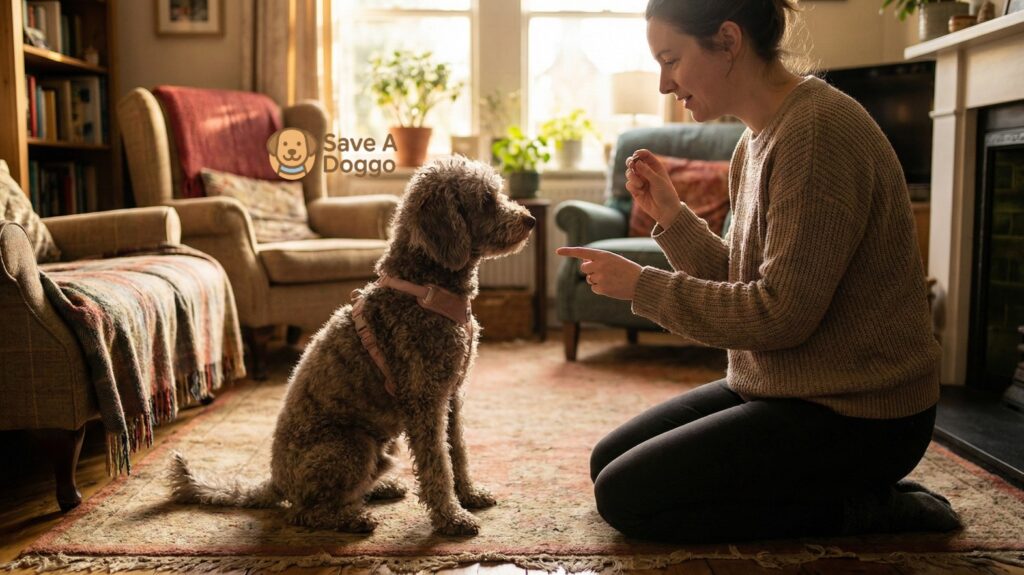
Practice the emergency U-turn in a quiet place before you need it.
The Save A Doggo Editorial Team creates practical, welfare-first resources for rescue-dog adopters, foster families, and shelter supporters. We prioritize primary and authoritative sources, distinguish observation from diagnosis, correct material errors transparently, and explain when veterinary or qualified behavior support is needed. We do not claim veterinary credentials or professional review unless a named, verifiable reviewer has approved the final article.