
If your rescue dog is afraid of men, begin with safety and observation rather than introductions. The meaningful trigger may be height, facial hair, a hat, work boots, direct movement, a deep voice, or a particular setting—not necessarily every man. Your dog does not need to greet or accept touch to make progress.
Quick Answer: Give your dog a protected retreat, prevent unplanned approaches, and ask men to ignore the dog at first. Work at a distance where the dog can notice the person while remaining able to eat, sniff, move, and disengage. Pair that person’s presence with safe outcomes delivered by the guardian. Never pull the dog closer, restrain them for petting, punish warnings, or lure them into contact.
A Rescue Dog Afraid of Men Does Not Prove a Hidden Trauma Story
Fearful behavior alone cannot tell you what happened before adoption. Abuse is one possibility only when supported by reliable history; it should not be presented as fact based on barking, hiding, or avoidance.
Other possibilities include:
- Limited positive exposure to men during earlier life
- A learned association with a particular appearance, movement, or setting
- General discomfort with unfamiliar people
- Fear of hats, uniforms, boots, beards, canes, tools, or bulky clothing
- Sensitivity to direct approaches, looming posture, or deep voices
- Pain or illness that lowers the dog’s tolerance for social interaction
- One frightening event that may have had nothing to do with abuse
Record what you can observe and label the history “unknown” when it is unknown. This protects the dog from unnecessary testing and keeps the plan focused on present needs.
Read Distance-Increasing Signals
Dogs commonly communicate discomfort before barking, lunging, snapping, or biting. Early signals ask for space and should lead to more distance—not correction.
| Observable signals | Likely message | Your response |
|---|---|---|
| Head turn, lip licking, yawning, lowered posture, paw lift, or moving away | “I am uncomfortable and need more space.” | Stop the approach and increase distance. |
| Hiding, tucked tail, trembling, freezing, refusal to move, or sustained avoidance | The dog may be overwhelmed or unable to participate. | Use a visual barrier or move the dog to a protected retreat. |
| Stiff posture, hard stare, growling, barking, or showing teeth | The lower-level signals have not created enough distance. | End the interaction without punishment and separate safely. |
| Lunging, snapping, charging, or biting | There is an immediate safety risk. | Use secure separation and obtain professional help. |
The RSPCA’s body-language guidance identifies lowered posture, tucked tails, ears held back, lip licking, yawning, avoidance, stiffness, and showing teeth as important emotional signals. Learn to read the dog’s early stress signals before the dog needs to escalate.
Never punish a growl. Suppressing a warning does not resolve the fear and may leave you with less information before a bite.
Manage the Home Setup Before Visitors Arrive
Management prevents frightening rehearsals while giving the dog control over distance. Set up the home before anyone rings the bell or opens the door.
- Prepare a quiet room, gated area, or other retreat the visitor will not enter.
- Place the dog behind a secure barrier before opening the exterior door.
- Keep food, water, bedding, and enrichment available in the protected area.
- Block narrow hallways or corners where the dog could feel trapped.
- Keep children and other animals from interfering with the retreat.
- Use visual barriers when seeing the visitor is too difficult.
- Prevent the visitor from reaching over or leaning across a gate.
For a dog with a bite history or intense lunging, use more than one reliable layer of separation. Do not depend on obedience cues, a person holding the collar, or the visitor promising to be careful.
The dog may remain completely separate for the entire visit. Separation is not a failed training session; sometimes it is the safest and kindest plan.
Instructions for Male Family Members and Visitors
Send instructions before the person arrives. A visitor who improvises a greeting may undo an otherwise careful setup.
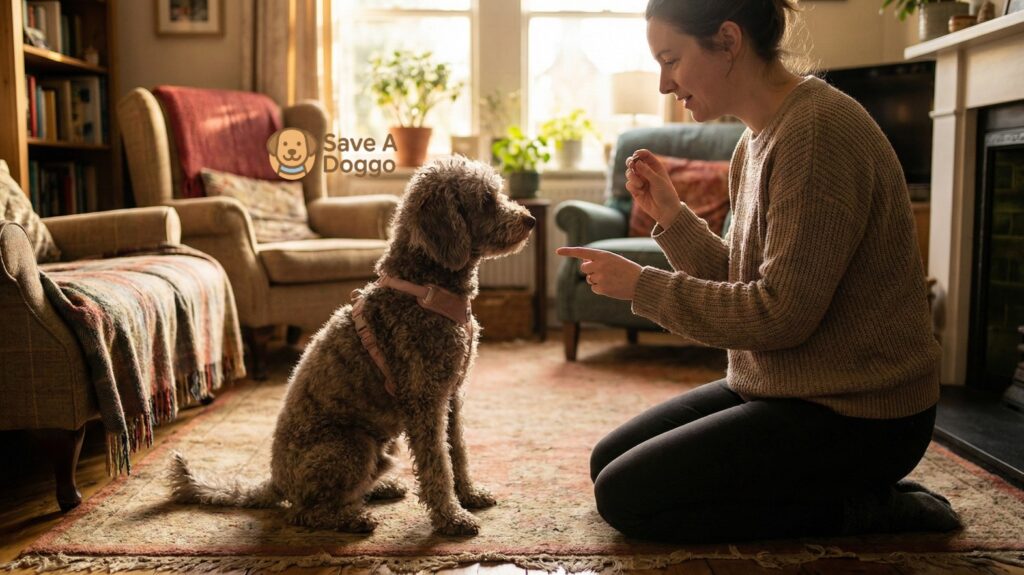
One-minute “ignore first” briefing: “Please do not look at, call, approach, reach toward, or try to pet the dog. Enter calmly, sit where I show you, turn slightly sideways, and let the dog keep as much distance as needed. If the dog approaches, continue ignoring them until I say otherwise. I will handle the treats and tell you if the plan changes.”
Ask male family members and visitors to:
- Move slowly and predictably without creeping toward the dog.
- Avoid sustained eye contact, looming, bending over, and reaching.
- Use a conversational voice rather than calling or repeatedly reassuring the dog.
- Remain seated at first when standing or walking triggers a reaction.
- Leave the dog’s bed, crate, hiding place, and gated area alone.
- Tell the guardian before changing hats, coats, tools, or other noticeable items.
- Allow the guardian—not the visitor—to decide when the session ends.
Do not ask a visitor to extend a hand for sniffing. A hand placed near the dog’s face is still an approach, and sniffing does not create an obligation to be touched.
Pair a Man’s Presence With Safe Outcomes
Counterconditioning pairs the appearance of a feared person with something the dog values. Desensitization reduces the intensity of that person’s presence—through greater distance, less movement, quieter speech, or a visual barrier—so the dog can remain below a strong fear response.
The MSD Veterinary Manual explains that counterconditioning should be combined with gradual desensitization rather than exposing an animal at full intensity.
- Choose a distance where the dog can notice the man without freezing, barking, or trying to escape.
- Have the man sit or stand sideways and remain neutral.
- When the man appears, the guardian calmly provides food, play, or another known reward.
- When the man leaves, the special reward ends.
- Keep the exposure brief and allow the dog to retreat at any point.
- Repeat at the same difficulty until the dog shows easier recovery.
- Change only one variable at a time: distance, movement, voice, clothing, or duration.
The goal is not to make the dog approach. The first goal is for the man’s presence at a safe distance to predict predictable, nonintrusive outcomes.
If the dog stops eating, scans continuously, hides, freezes, or reacts, increase distance or end the session. Food interest is only one observation; it is not proof that the dog feels safe.
Avoid Luring the Dog Into Contact
A fearful dog may approach for valuable food while still wanting to avoid the person. Hand-feeding can place the dog close enough to take a treat but too close to retreat comfortably. This conflict may result in a sudden scramble, growl, snap, or bite.
At first, rewards should come from the guardian. If the dog remains consistently relaxed and a professional plan supports visitor involvement, the man can gently toss a treat to the side or behind the dog. Tossing away from the visitor lets the dog eat while increasing distance.
Do not:
- Hold food near the visitor’s body to draw the dog closer.
- Pet the dog because they accepted a treat.
- Block retreat after the dog approaches.
- Hold the leash tight while the visitor reaches.
- Encourage the dog onto a couch beside the visitor.
- Use hunger to pressure the dog into interaction.
Taking food is not consent to touch. Choosing to sniff a person is not consent either. Consistent respect for retreat helps build trust without requiring contact.
Track Recovery, Not Proximity
Getting closer is not the only—or best—measure of progress. A dog may move closer while tense because food is present or the escape route is blocked. More meaningful changes include less intense signals, easier disengagement, and faster recovery at the same distance.
Trigger and Recovery Log
| Date and context | Person and presentation | Distance | Dog’s response | Recovery | Next adjustment |
|---|---|---|---|---|---|
| Home, yard, walk, doorway | Seated, standing, moving, voice, beard, hat, coat, boots | Room, barrier, or landmark | Looked, sniffed, ate, turned away, hid, froze, barked | What helped and when normal behavior returned | Repeat, add distance, reduce movement, or end visits |
| __________ | __________ | __________ | __________ | __________ | __________ |
| __________ | __________ | __________ | __________ | __________ | __________ |
| Observation | Decision |
|---|---|
| Loose movement, sniffing, voluntary disengagement, and normal recovery | Repeat the same setup before changing one variable. |
| Lowered posture, avoidance, food grabbing, delayed recovery, or repeated scanning | Increase distance or use a visual barrier. |
| Freeze, growl, lunge, snap, escape attempt, or inability to recover | End exposure, secure separation, and seek professional guidance. |
Record clothing, motion, and voice independently. A dog who is comfortable with a seated man in a T-shirt may respond differently when that same person stands, wears a hood, carries a bag, or speaks loudly.
When Fear Becomes a Safety Risk
Begin with a veterinary appointment when fear starts suddenly, worsens rapidly, or appears with pain, illness, sensory changes, or broader behavior changes. Cornell emphasizes that anxiety is not a simple diagnosis and that treatment should be based on the underlying cause and the individual dog.
Seek help from a qualified reward-based professional or veterinary behaviorist when:
- The dog has bitten, snapped, charged, or made contact with clothing.
- Lunging or barking cannot be managed with distance and barriers.
- The dog redirects onto the handler, another person, or another animal.
- A male household member cannot move through the home safely.
- Children, older adults, caregivers, or frequent visitors may be exposed.
- The dog cannot eat, sleep, toilet, or recover normally when a man is present.
- Fear is spreading to more people, places, or situations.
- The household cannot reliably maintain the management plan.
VCA advises professional help for dogs that are very frightened of people and recommends veterinary evaluation before a behavior plan. Professionally guided basket-muzzle conditioning may be part of some safety plans, but a muzzle should never be used to force greetings or move the dog closer.
The American Veterinary Society of Animal Behavior recommends reward-based methods and advises against aversive equipment and punishment. You can also learn more about rescue-dog anxiety while arranging individualized support.
Frequently Asked Questions
Does fear of men mean my rescue dog was abused?
No. Fear alone cannot establish a history of abuse. Limited exposure, unfamiliar appearance, movement, voice, context, pain, or a previous frightening event may all contribute.
Should male visitors feed my dog by hand?
Not initially. Hand-feeding can draw a fearful dog too close. Let the guardian provide rewards or, when appropriate, have the visitor toss food away from themselves.
What should I do if my dog barks at a man?
Create more distance or use a visual barrier. Do not scold, tighten the leash, or ask the person to approach. Record what happened immediately before the barking.
Can a male family member eventually feed or walk the dog?
Possibly, but begin with low-pressure tasks only after the dog can remain comfortable around that person. A qualified professional should guide the transition when fear is severe or there is bite risk.
How long will it take for my dog to trust men?
There is no universal timeline, and friendly contact may not be a realistic or necessary goal with every person. Measure improved safety, choice, and recovery rather than demanding physical affection.
Sources & Further Reading
- AVSAB: Humane Dog Training Position Statement
- RSPCA: Understanding a Dog’s Body Language
- Cornell University: Anxious Behavior in Dogs
- MSD Veterinary Manual: Treatment of Behavior Problems
- VCA Animal Hospitals: Fears and Phobias in Dogs—Animals and People
Safety note: This article provides general education, not a diagnosis or individualized aggression-treatment plan. Use secure separation when there is a bite risk, and do not attempt exposure exercises that place any person or animal in danger. Sudden or severe behavior changes require veterinary evaluation and qualified behavior support.
Give every visitor a one-minute ‘ignore first’ briefing before they enter.
The Save A Doggo Editorial Team creates practical, welfare-first resources for rescue-dog adopters, foster families, and shelter supporters. We prioritize primary and authoritative sources, distinguish observation from diagnosis, correct material errors transparently, and explain when veterinary or qualified behavior support is needed. We do not claim veterinary credentials or professional review unless a named, verifiable reviewer has approved the final article.