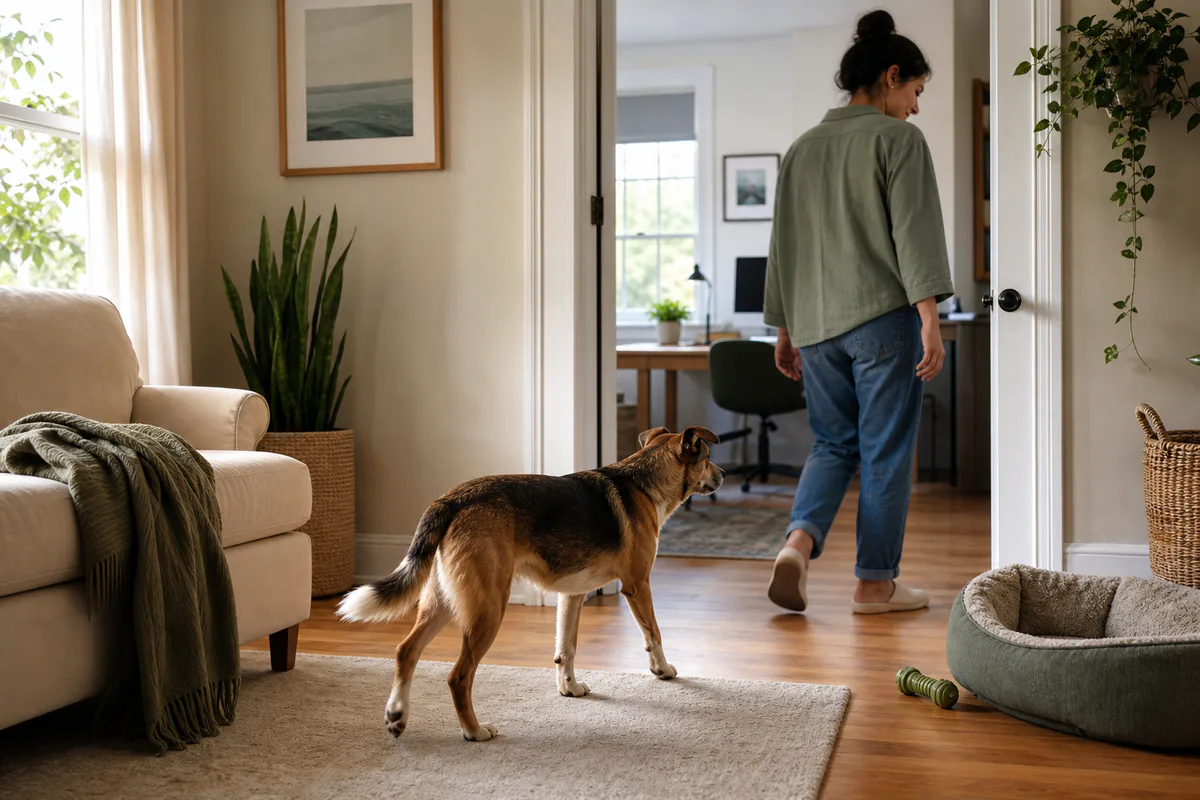
Why does my rescue dog follow me everywhere? In many newly adopted dogs, following simply means you are the safest and most predictable person in a brand-new environment.
Your dog may be learning your routine, checking where resources are, or using your calm presence as a reference point. It is not automatically a sign of separation anxiety.
For most adopters, “why does my rescue dog follow me everywhere?” is a temporary adjustment question that becomes clearer as the dog learns the home.
The important question is what happens when you create a little distance. A relaxed dog can eventually eat, sniff, sleep, or settle without touching you.
A distressed dog may panic as you leave, pace, bark, scratch at doors, drool, destroy exit points, or struggle to recover. This guide helps you tell the difference and build independence gently.
Quick answer: if you are asking why does my rescue dog follow me everywhere, rescue dogs often follow because of safety, attachment, routine, attention, or uncertainty.
Treat the behavior as information, not a diagnosis. Observe the whole pattern for several days, rule out sudden health changes with your veterinarian, and keep any separation practice below your dog’s fear threshold.
Why does my rescue dog follow me everywhere? Start with context
When you ask, “why does my rescue dog follow me everywhere?”, begin with context rather than a label. Note whether your dog is relaxed, curious, tense, or unable to settle. That small distinction determines whether you need routine-building or a formal separation plan.
At a glance: what your dog’s following may mean
| What you notice | Most likely interpretation | Helpful next step |
|---|---|---|
| Loose body, soft eyes, can nap nearby | Normal attachment or settling-in | Reward calm time on a bed or mat |
| Follows after meals, walks, or household cues | Learning a predictable routine | Keep the routine consistent and low-key |
| Follows and becomes tense around keys, shoes, or the door | Possible departure-related worry | Film a short absence and contact a force-free professional if distress appears |
| Howls, scratches, escapes, or soils only when alone | Separation-related distress is possible | Pause long absences and ask your veterinarian for a plan |
| Sudden clinginess with pain, appetite, or sleep changes | Possible medical or sensory problem | Arrange a veterinary check rather than assuming it is behavioral |
Seven common reasons a rescue dog follows you
1. You are the safest point in an unfamiliar home
Adoption changes nearly everything at once: smells, floors, voices, doors, feeding times, and the people who move through the space.
Staying close to one steady caregiver can help a dog collect information without feeling lost. This is especially common during the first days or weeks, when your dog has not yet learned that the new home is permanent.
If you are still wondering why does my rescue dog follow me everywhere after the first few days, look for the dog’s ability to settle, explore, and recover—not just the distance between you.
Offer calm company without turning every approach into a big event. A quiet voice, a predictable meal, and a comfortable resting place can communicate safety more clearly than constant petting.
2. Your dog is learning the household routine
Dogs are excellent observers. If you stand up before a walk, open a cupboard before dinner, or pick up a laptop before working, your dog may follow to see what happens next. Following can be a practical way to learn the rhythm of a new family, not a demand for attention.
Use that curiosity to create predictability. Keep meals, toilet breaks, walks, and rest periods broadly consistent while your dog adjusts. Predictable does not mean rigid; it means your dog can make a reasonable guess about what comes next.
3. Following has been rewarded
Every time a dog follows and receives food, eye contact, play, or reassurance, the behavior can become more valuable. That is normal learning, not bad behavior. If you want more independent settling, notice and reward the moments your dog chooses a bed, chews quietly, or watches you from a distance.
You do not need to ignore your dog. Simply make calm, independent choices pay well too. Place a treat on the mat when your dog lies down, then return to your own activity.
4. Your dog prefers social contact
Some dogs are naturally social and enjoy being in the same room as their people. They may follow from the kitchen to the office, then sleep while you work. If the body is loose and the dog can disengage, this is usually a relationship preference rather than a problem.
Healthy attachment includes flexibility. A social dog can want company and still cope with a closed bathroom door, a baby gate, or a short rest in another room.
5. The environment still feels uncertain
New sounds, visitors, stairs, mirrors, appliances, and outside traffic can all make a rescue dog cautious. Following you may be a way to avoid exploring alone. Look for other signs of uncertainty such as a low body, tucked tail, lip licking, freezing, scanning, or repeated checking of your face.
Reduce pressure. Let your dog choose distance, provide a quiet safe zone, and introduce new experiences one small step at a time. If your dog wants to retreat, allow the retreat; confidence grows when a dog can leave a difficult situation safely.
6. Your dog is worried about what happens when you leave
The question “why does my rescue dog follow me everywhere?” matters most when following starts before departure cues and ends in panic. That timing tells you where to look next.
Following becomes more concerning when it is linked to departure cues. Does your dog rush to the door when you put on shoes, pant when you pick up keys, or become frantic the moment a gate closes? These patterns can point to separation-related distress, although only a qualified professional can assess the cause.
Do not test the theory with a long absence. A camera recording of the first 30 minutes alone can show whether your dog settles, stays alert, vocalizes, or attempts to escape. Share the recording with your veterinarian or a reward-based behavior professional.
7. A sudden health change is making your dog clingy
New or rapidly increasing following deserves a health check if it comes with reduced appetite, changes in drinking or toileting, nighttime restlessness, stiffness, hearing or vision changes, vomiting, pain, or unusual irritability. Dogs may seek extra contact when they feel unwell.
Behavior advice cannot replace medical care. If the change is sudden, severe, or paired with self-injury, call your veterinarian promptly.
Following is not the same as separation anxiety
Knowing why does my rescue dog follow me everywhere does not require guessing about attachment. Measure what your dog does when contact is gently interrupted.
Separation anxiety is about the dog’s emotional response to being separated from a particular person or left alone—not simply about walking behind you.
The ASPCA and veterinary behavior references describe signs such as distress before or shortly after departure, persistent vocalizing, destructive attempts at doors or windows, escape behavior, house-soiling despite normal training, pacing, panting, drooling, refusal to eat, and exaggerated reunions.
| More reassuring pattern | Pattern that needs closer attention |
|---|---|
| Follows but can settle in the same room | Cannot settle when you move out of sight |
| Accepts a chew or food toy and sleeps | Ignores food once departure cues begin |
| Brief whining that stops as the home stays quiet | Escalating barking, howling, panting, or drooling |
| Can stay behind a gate for a few calm seconds | Scratches, bites, or throws itself at barriers |
| Returns to normal after a short separation | Long recovery, self-injury, or repeated escape attempts |
When a family asks why does my rescue dog follow me everywhere, these are the clues to record first. They are not a diagnosis.
A camera helps because some dogs look calm at the door but become distressed after several minutes. Others vocalize briefly and then rest. Record what happens rather than guessing from the greeting alone.
A simple seven-day observation plan
- Write down the context. Note time, trigger, where you went, and what your dog did with its body, voice, and appetite.
- Check basic needs. Confirm toilet access, water, appropriate exercise, rest, and a comfortable temperature.
- Film one short absence. Use a phone or pet camera for a safe, brief interval. Stop if your dog shows escalating panic.
- Find the starting point. Can your dog relax while you sit two feet away? Behind a gate? With the door closed for one second? Start where the answer is yes.
- Repeat easy wins. Practice several tiny separations, ending before worry rises. Progress is measured in calm repetitions, not dramatic tests.
- Share the pattern. Send notes and video to your veterinarian or a qualified force-free behavior professional if the dog cannot settle.
Keep the log practical: “settled on mat for 20 seconds” is more useful than “seems needy.” It also helps you notice improvement that is easy to miss day to day.
How to build independence without breaking trust
If why does my rescue dog follow me everywhere is the question you hear every day, start by making short independent choices safe and rewarding.
Create a predictable home base
Choose a bed, mat, or open crate in a quiet area where your dog can see enough of the home without being in the middle of traffic. Add water and a safe chew if appropriate. Never use the space as punishment. The goal is a place your dog can choose when it wants a break.
Reward calm choices
When your dog lies down, sniffs, watches birds, or chews without following, quietly place a treat nearby. Keep your voice soft and your movements ordinary. Reinforcing calm independence teaches a clear alternative to trailing every step.
Practice tiny separations below threshold
Stand up, take one step, and return while your dog is still relaxed. Then try two steps, a half-closed door, or one second behind a gate. Change only one variable at a time. If your dog stops eating, freezes, vocalizes intensely, or rushes the barrier, the step was too hard; make it easier next time.
Make departure cues boring
Pick up keys, put on a coat, or open the door and then sit back down. Repeat at random times without leaving. This can reduce the prediction that every cue means a long absence. It is not a substitute for a complete separation plan, but it is a useful foundation.
Use enrichment as support, not a cure
Sniffing walks, scatter feeding, food puzzles, and safe chewing can help a dog decompress. Offer them when your dog is calm enough to use them. A dog in full panic usually cannot eat or learn, so enrichment should not be used to mask severe distress.
Protect your dog from repeated panic
During training, arrange help from a friend, sitter, neighbor, or trusted day-care option when possible. Repeated long absences can rehearse the very fear you are trying to change. If your dog must be left, prioritize safety and ask a professional how to bridge the gap.
What not to do
- Do not punish following, barking, accidents, or destruction. Punishment can add fear and does not teach the dog how to feel safe alone.
- Do not use “cry it out” for panic. Waiting for a terrified dog to stop can increase distress and risk injury.
- Do not ban all closeness overnight. Sudden isolation is a huge jump for a dog who has just lost its familiar world.
- Do not force a crate or closed room. Confinement can be part of a plan only when the dog is comfortable with it and the space is safe.
- Do not label your dog as manipulative or needy. Describe the observable behavior and look for the need underneath it.
When to call your veterinarian or a behavior professional
Ask for help if following is intense, worsening, or preventing sleep, eating, work, or safe movement around the home.
Contact your veterinarian promptly for sudden changes, pain, collapse, repeated vomiting, breathing trouble, self-injury, or refusal to eat.
For separation concerns, choose a qualified, reward-based professional who will assess video, work under threshold, and coordinate with your veterinarian when medication may be appropriate.
Save A Doggo’s step-by-step rescue dog separation anxiety guide can help you prepare questions. You may also find our gentle new-home adjustment guide, first-night plan, and signs your rescue dog is relaxing useful companions.
Frequently asked questions
Should I ignore my rescue dog when it follows me?
No. Ignoring every approach can make a newly adopted dog feel less secure. Greet your dog calmly, then reward a short independent settle so your attention is not the only way to feel safe.
Why does my rescue dog follow me from room to room?
If you keep asking why does my rescue dog follow me everywhere, compare calm room-to-room following with distress at a closed door.
It may be learning your routine, seeking social contact, or checking that you are still available. If the dog can rest and eat when you are briefly out of sight, room-to-room following is usually an adjustment habit. If it escalates into panic, record it and seek guidance.
Will my rescue dog ever stop following me everywhere?
Many adopters ask why does my rescue dog follow me everywhere, and many dogs become more independent as the home becomes predictable.
Progress may take days, weeks, or longer depending on history, age, health, and temperament. Look for small changes such as choosing a bed, pausing before following, or settling after a door closes.
Does following mean my dog trusts me?
It can be one sign that your dog finds you reassuring, but following alone cannot prove trust. Trust also looks like relaxed body language, voluntary exploration, normal sleep and appetite, and the ability to recover from ordinary surprises.
Should I use a camera?
Yes, a camera can reveal what happens after you leave. Keep the first recording short and stop if your dog is distressed. A professional can interpret the pattern and help you choose a safe starting point.
How long should independence training take?
Use the shortest duration your dog can handle calmly, sometimes only a second. Add time in tiny increments and repeat successful steps. If progress stalls or panic appears, reduce difficulty and get professional help rather than pushing through.
The takeaway: why does my rescue dog follow me everywhere?
A rescue dog that follows you everywhere is communicating something: “You are safe,” “I am learning this routine,” “I expect good things,” or “I am worried about being alone.”
Watch the details, meet basic needs, reward calm independence, and keep separations gradual. With patience and the right support, closeness can grow into secure confidence.
This article is educational information for adopters, not a diagnosis or a substitute for veterinary care. Seek prompt professional help for severe distress, self-injury, or sudden health changes.
Sources and further reading
- ASPCA: Separation Anxiety
- Merck Veterinary Manual: Behavior Problems of Dogs
- RSPCA: Treatment for separation-related behavior
- Dogs Trust: Separation anxiety
- AVSAB: Humane Dog Training Position Statement
The Save A Doggo Editorial Team creates practical, welfare-first resources for rescue-dog adopters, foster families, and shelter supporters. We prioritize primary and authoritative sources, distinguish observation from diagnosis, correct material errors transparently, and explain when veterinary or qualified behavior support is needed. We do not claim veterinary credentials or professional review unless a named, verifiable reviewer has approved the final article.