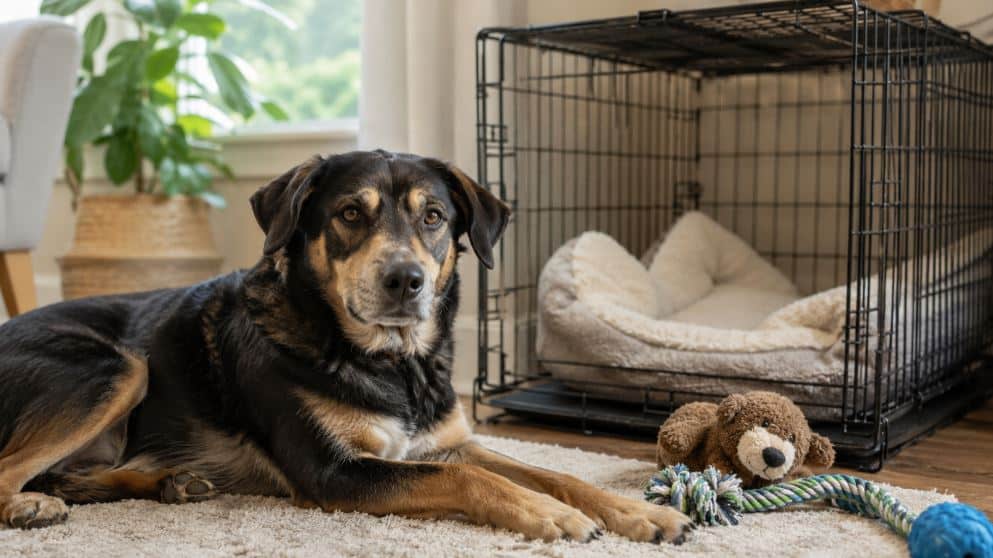
Crate training can be helpful for some rescue dogs, but only when it is introduced gently.
A crate should never feel like a trap, punishment, or place of isolation. For a rescue dog with an unknown past, confinement may feel scary at first. Some dogs may have been over-crated, punished, abandoned, or left alone for long periods. Others may simply be unsure because everything in the home is new.
Learning how to crate train a rescue dog without fear starts with patience. The goal is not to shut the door and hope your dog “gets used to it.” The goal is to help your dog form a calm, positive association with the crate one small step at a time.
For the right dog, a crate can become a quiet resting space. For the wrong dog, or when introduced too fast, it can increase panic.
Go slowly. Watch your dog’s body language. Let safety and trust lead the process.
Quick Answer
To crate train a rescue dog, start with the crate door open, add soft bedding, place treats and meals near or inside the crate, and let your dog explore without pressure. Gradually build from looking at the crate, to stepping inside, to resting inside, to closing the door for very short sessions. Never force your dog into the crate, use it as punishment, or leave a panicking dog trapped inside.
Is Crate Training Right for Every Rescue Dog?
No. Crate training is not right for every rescue dog.
Some dogs feel safer in a crate once they learn it is comfortable and predictable. Others may feel trapped, especially if they have separation anxiety, confinement fear, or a history of being left in cages for too long.
Crate training may be helpful if your dog:
- Likes small resting spaces
- Chooses to sleep under tables or in corners
- Needs a quiet place away from household activity
- Is recovering from stress and needs structure
- Needs safe management during short periods
- Will need crate comfort for travel, vet care, or recovery
Crate training may not be the best first choice if your dog:
- Panics when confined
- Tries to escape and may injure themselves
- Barks, claws, drools, or trembles intensely in the crate
- Has severe separation anxiety
- Has been over-crated in the past
- Cannot relax when the door closes
If your dog shows panic, crate training should pause. You may need a larger safe area instead, such as a puppy-proofed room, gated space, or exercise pen.
If your dog struggles at night, you may also find this helpful: How to Calm a Rescue Dog at Night.
Choosing the Crate
The right crate should feel safe, comfortable, and easy for your dog to enter.
A crate should be large enough for your dog to:
- Stand up comfortably
- Turn around easily
- Lie down fully
- Stretch without being cramped
Common crate types include:
- Wire crates
- Plastic travel crates
- Soft-sided crates
- Heavy-duty crates
- Exercise pens or gated spaces as alternatives
For many rescue dogs, a wire crate with a cover over part of it can feel more open while still creating a quiet space. Some dogs prefer plastic crates because they feel more enclosed. Others do better with no crate at all and prefer a bed in a quiet corner.
Place the crate in a calm area of the home, not in the middle of chaos. Avoid areas that are too hot, too cold, drafty, noisy, or isolated.
A good crate setup may include:
- Soft bedding
- A safe chew or toy
- Water nearby
- A familiar blanket
- Non-slip flooring
- Door secured open during early training
Do not put the crate somewhere your dog feels banished. A family room corner, bedroom corner, or quiet living space often works better than a garage, laundry room, or isolated basement.
Building Positive Association
Positive association means your dog learns that the crate predicts good things.
At first, the door should stay open.
Let your dog notice the crate without pressure. Do not push, pull, lift, or drag them inside. If they only sniff the outside, that is still progress.
Start with simple steps:
- Place treats near the crate
- Toss treats just inside the door
- Put a favorite toy near the opening
- Feed meals beside the crate
- Move the food bowl gradually closer
- Let your dog walk away anytime
- Praise calmly, not loudly
If your dog is nervous, toss treats so they can move away after taking them. This helps them feel in control.
Once your dog is comfortable eating near the crate, place the bowl just inside the entrance. Over time, move it farther back only if your dog remains relaxed.
Watch for relaxed body language:
- Loose body
- Soft eyes
- Normal breathing
- Willingness to enter
- Eating comfortably
- Ability to turn around and exit calmly
Watch for stress signals:
- Freezing
- Lip licking
- Trembling
- Backing away
- Refusing food
- Panting when not hot
- Whale eye
- Trying to bolt
- Scratching at the crate
If you see stress, make the step easier.
The crate should never become a test your dog has to pass.
First-Week Training Plan
This first-week plan is gentle. Some rescue dogs may move faster. Others may need several weeks for the same steps. That is normal.
Do not move to the next step until your dog is relaxed at the current step.
Day 1: Let the Crate Exist
Set up the crate with the door open.
Place treats around the outside and just inside the entrance. Let your dog explore naturally. If they ignore it, that is okay.
Goal: Your dog notices the crate without fear.
Do not close the door.
Day 2: Feed Near the Crate
Feed meals near the crate entrance.
If your dog is comfortable, place the bowl partly inside. If not, keep it outside but close enough to create a calm association.
Goal: The crate area predicts food and safety.
Do not force your dog to step inside.
Day 3: Reward Voluntary Steps Inside
Toss treats inside the crate and let your dog walk in and out freely.
If they place one paw inside, reward. If they put their whole body inside, reward calmly. Let them leave whenever they want.
Goal: Your dog chooses to enter.
The door still stays open.
Day 4: Add Short Settling Moments
When your dog enters the crate, offer a safe chew, stuffed food toy, or small treat scatter.
Let them spend a few calm moments inside with the door open.
Goal: The crate becomes a resting place, not just a treat station.
If your dog carries the treat out, allow it. That is not failure.
Day 5: Touch the Door Briefly
If your dog is relaxed inside, gently move the door slightly without closing it.
Reward. Open space again. Repeat only if your dog stays calm.
Then try closing the door for one second, feeding a treat, and opening it again.
Goal: The door moving does not predict panic.
Keep this very short.
Day 6: Build to 10-30 Seconds
Close the door for a few seconds while your dog eats treats or enjoys a chew.
Stay nearby. Open the door before your dog becomes worried.
Goal: Your dog learns that closed doors open again.
Do not wait for barking or panic before opening. Try to end while your dog is still calm.
Day 7: Practice Calm Short Sessions
Try several short sessions throughout the day.
Examples:
- 10 seconds
- 30 seconds
- 1 minute
- 2 minutes
- 5 minutes
Only increase time if your dog remains relaxed.
Sit nearby at first. Then briefly step away and return. Keep arrivals and departures calm.
Goal: The crate feels predictable and safe.
What to Do If Your Dog Panics
Panic is different from mild protest.
A panicking dog may:
- Claw at the crate
- Bite the bars
- Drool heavily
- Bark nonstop
- Tremble
- Try to escape
- Soil themselves
- Ignore food
- Injure their mouth, paws, or nails
- Become frantic when the door closes
If your rescue dog panics, stop crate training at that level.
Do not leave them to “cry it out.” Panic can make fear worse and may lead to injury.
Instead:
- Open the door when safe
- Stay calm
- Do not punish
- Return to easier steps later
- Use a larger safe area if needed
- Try a baby gate, pen, or dog-proofed room
- Talk to a veterinarian or qualified behavior professional
If the panic happens mostly when you leave, your dog may be struggling with separation anxiety. In that case, the crate may prevent destruction, but it may not solve the anxiety and can sometimes make distress worse.
Read more here: Rescue Dog Separation Anxiety.
Common Crate Training Mistakes
Avoid these mistakes when crate training a rescue dog:
- Forcing the dog inside
- Closing the door too soon
- Using the crate for punishment
- Leaving the dog crated too long
- Ignoring panic
- Putting the crate in an isolated area
- Letting children bother the dog inside
- Only using the crate when leaving home
- Moving too fast because the dog entered once
- Expecting every rescue dog to love crates
A crate should be a safe option, not a life sentence.
Dogs still need exercise, human connection, training, enrichment, potty breaks, and freedom to move.
How Long Can a Rescue Dog Stay in a Crate?
There is no single perfect number for every dog.
A newly adopted rescue dog should not be crated for long periods right away. Start with seconds and minutes during training. Build gradually only if your dog is calm.
General rules:
- Keep early sessions very short
- Avoid long daytime confinement
- Give potty breaks before and after
- Provide exercise and enrichment outside the crate
- Do not crate all day and all night
- Use a larger safe space if longer management is needed
Dogs who are anxious, senior, sick, recovering, or house-training may need special adjustments. Puppies and dogs with medical needs may need more frequent potty breaks.
When in doubt, choose more space, more breaks, and more supervision.
FAQ
How long does it take to crate train a rescue dog?
It depends on the dog. Some rescue dogs adjust within days, while others need several weeks or longer. Dogs with confinement fear, separation anxiety, or past negative crate experiences may need a slower plan or a different setup.
Should I force my rescue dog into the crate?
No. Forcing a rescue dog into the crate can create fear and damage trust. Use treats, meals, toys, and patience. Let your dog choose to enter, then build comfort gradually.
Is it okay if my dog cries in the crate?
Mild whining can happen, but panic should not be ignored. If your dog is frantic, clawing, drooling, trembling, or trying to escape, stop and make the training easier. Never punish crying or fear.
Can crate training help separation anxiety?
Not by itself. A crate may help some dogs feel secure, but for dogs with true separation anxiety, confinement can sometimes increase panic. Separation anxiety usually needs a careful desensitization and counterconditioning plan, often with professional support.
Should my rescue dog sleep in a crate at night?
Only if they are comfortable with it. Many rescue dogs do better when the crate is near the owner at first, such as in the bedroom or nearby hallway. If your dog panics in the crate, use a dog bed, pen, or gated area instead.
What should I put inside the crate?
Use soft bedding if your dog does not chew or ingest fabric, plus safe toys or chews. Avoid anything your dog might swallow, shred dangerously, or get tangled in. Comfort matters, but safety comes first.
What if my rescue dog refuses to enter the crate?
Start easier. Feed meals near the crate, toss treats around it, and leave the door open. Do not close the door until your dog is entering comfortably on their own. If they remain fearful, a crate may not be the right tool yet.
Can I use the crate for time-outs?
Avoid using the crate as punishment. If the crate becomes associated with fear, isolation, or correction, your dog may resist it. The crate should predict calm, comfort, and safety.
Final Thought
Crate training a rescue dog should never be about control through fear.
It should be about helping your dog feel safe, one small step at a time.
Keep the door open at first. Reward curiosity. Feed near the crate. Practice short sessions. Stop if your dog panics. And remember that some rescue dogs may need a different kind of safe space.
Keep sessions short and positive.
Sources & Further Reading
- Humane World for Animals: How to Crate Train Your Dog or Puppy
- AVSAB Humane Dog Training Position Statement
- ASPCA: Separation Anxiety

The Save A Doggo Editorial Team creates practical, welfare-first resources for rescue-dog adopters, foster families, and shelter supporters. We prioritize primary and authoritative sources, distinguish observation from diagnosis, correct material errors transparently, and explain when veterinary or qualified behavior support is needed. We do not claim veterinary credentials or professional review unless a named, verifiable reviewer has approved the final article.