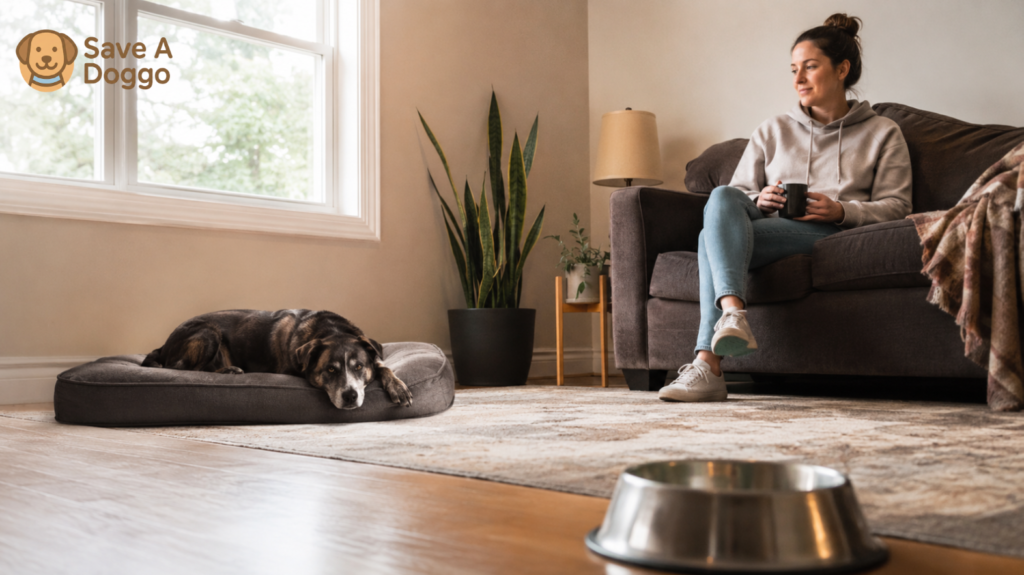
Resource guarding happens when a dog tries to keep a person or another animal away from something they value, such as food, a chew, a toy, a bed, a stolen object, a doorway, or even a favorite person. If your newly adopted rescue dog freezes, stares, growls, shows teeth, snaps, or bites around a resource, stop approaching and calmly create distance.
Do not punish the warning or take the item by force. Move children and other pets away, use barriers to prevent another incident, and let the dog finish eating or settle when it is safe to do so. Contact a veterinarian if the behavior is sudden or may be connected to pain. Get qualified behavior help promptly if the dog has snapped or bitten, guards several resources, or lives with children.
Quick Answer: What Should You Do About Resource Guarding?
- Stop moving toward the dog or resource. Do not stare, reach, grab the collar, or corner the dog.
- Create distance. Move people and pets away instead of forcing the dog to move.
- Do not punish growling. A growl is a warning that helps you prevent escalation.
- Manage the environment. Feed separately, remove tempting objects, and use gates or closed doors.
- Do not test the dog. Repeatedly approaching the bowl or taking items is not training.
- Rule out pain. Sudden guarding of touch, movement, furniture, or resting spaces warrants a veterinary exam.
- Get professional help when safety is uncertain. Snapping, biting, guarding from several feet away, or guarding around children should not be handled alone.
What Resource Guarding Looks Like
Resource guarding is not limited to growling over a food bowl. It often begins with subtle changes that are easy to miss.
| What you may see | What it may communicate | What to do immediately |
|---|---|---|
| Eating faster when someone approaches | Worry that food may be taken | Stop approaching and let the dog eat alone |
| Lowering the head or body over an item | An attempt to keep control of the resource | Increase distance; do not reach for the item |
| Freezing or becoming suddenly still | A serious early warning | Stop the interaction and move away calmly |
| Turning away or carrying an item elsewhere | The dog wants more space | Allow the dog to leave; do not chase |
| Hard staring or showing the whites of the eyes | Rising tension or conflict | Avoid staring back and create distance |
| Growling or showing teeth | A clear request to stop or move away | Respect the warning and secure the area |
| Air snapping, lunging, or biting | The situation has escalated | Separate safely and contact a qualified professional |
Watch the whole body rather than one signal in isolation. A stiff posture, closed mouth, hard eyes, and still tail are more concerning than a loose, wiggly dog making noise during play. SaveADoggo’s guide to rescue dog body language can help you notice stress before the dog needs to growl.
What Can a Rescue Dog Guard?
A dog may guard:
- Food bowls or feeding areas
- Treats, bones, chews, or food puzzles
- Toys or balls
- Trash, laundry, tissues, or stolen objects
- Beds, crates, sofas, or sleeping spots
- Doorways, hallways, rooms, or vehicles
- Access to water
- A favorite person or another animal
- Their own body when touch feels painful or threatening
Some dogs guard only one item from one person. Others guard several resources from anyone who approaches. The pattern, distance, intensity, and bite history all matter when assessing risk.
Why Do Newly Adopted Rescue Dogs Guard Resources?
Resource guarding does not prove that a dog was abused, starved, or forced to compete for food. Those experiences may be relevant for some dogs, but guarding can also reflect temperament, learning history, stress, pain, or the value of the resource.
The transition into a new home may reveal behavior that was not obvious in a shelter or foster setting. The people, rooms, routines, objects, and expectations have changed. A dog may not yet know that meals are predictable or that people will respect their resting space.
Guarding can also become stronger when every human approach predicts loss. If people repeatedly remove the bowl, grab toys, chase the dog for stolen items, or pull the dog from a bed, the dog may learn to defend resources earlier and more intensely.
Pain is another possible contributor. Dental pain, arthritis, injury, skin problems, or other medical conditions can make a dog less tolerant of approach, touch, or movement. Resource guarding is a behavior description, not a complete diagnosis.
What to Do During an Active Guarding Incident
When your dog freezes, growls, or guards an item, use this sequence:
- Stop approaching. Keep your hands away from the dog, item, bowl, bed, or collar.
- Move vulnerable people away. Calmly remove children, visitors, and other animals from the area.
- Avoid confrontation. Do not stare, shout, loom over the dog, or attempt to physically overpower them.
- Create a safe exit. If possible, give the dog room to move away without passing close to anyone.
- Leave a non-dangerous item alone. A chew or toy is not worth risking a bite.
- Prevent another approach. Close a door or place a secure barrier at a safe distance.
- Write down what happened. Record the resource, distance, people present, body language, and any contact with teeth.
If the dog has medication, a toxic substance, a sharp object, or something that could cause an obstruction, do not reach into the mouth. Move people away and call your veterinarian or an animal poison service for immediate instructions. Tell them the dog may bite so they can help you choose the safest response.
What Not to Do
Avoid these common but risky approaches:
- Do not put your hand in the food bowl to make the dog “get used to it.”
- Do not repeatedly take the bowl away while the dog is eating.
- Do not grab chews, toys, or stolen items from the dog’s mouth.
- Do not chase or corner the dog.
- Do not punish growling, snarling, or moving away.
- Do not use alpha rolls, pinning, yelling, leash corrections, shock collars, or intimidation.
- Do not allow children to perform trades or feeding exercises.
- Do not test the dog’s tolerance after a calm day.
- Do not follow a generic online training protocol when a bite is possible.
The American Veterinary Society of Animal Behavior recommends reward-based methods for dog training and behavior modification and advises against aversive methods. Punishment may increase fear and conflict without making the dog feel safer about losing a valued resource.
A Safer Home Setup You Can Start Today
Management does not cure the underlying behavior, but it prevents avoidable confrontations while you arrange veterinary or behavior support.
Feed in a protected area
Prepare the meal before bringing the dog into the feeding space. Put the bowl down, step away, and prevent people or animals from entering until the dog has finished and left. Pick up the empty bowl later.
A closed room, secure gate, or exercise pen may work. Use a crate only if the dog already chooses to rest there comfortably and does not guard it.
Separate animals around valuable resources
Feed resident dogs and cats in separate closed areas. Give chews and food puzzles separately. Pick up unfinished resources before animals are together again.
Do not expect a newly adopted dog to share bowls, beds, toys, or human attention. Separate resources reduce conflict and let each animal relax.
Reduce access to stolen objects
Use lidded trash cans, closed laundry baskets, cleared counters, and doors on rooms that contain children’s toys or other tempting items. Prevention reduces the number of emergencies in which someone feels compelled to take something away.
Protect resting spaces
Place the dog’s bed in a low-traffic area. Household members should not step over, hug, push, or pull a resting dog. Call the dog away rather than physically removing them.
For additional handling precautions, read Safe Dog Handling Tips Every Owner Should Know.
Resource Guarding Around Food
If your dog guards meals, the safest first step is privacy, not a food-bowl exercise.
- Feed on a predictable schedule in a quiet location.
- Keep children, visitors, and other animals out of the feeding area.
- Do not stand over the dog or reach toward the bowl.
- Wait until the dog has left before collecting the empty bowl.
- Avoid hand-feeding if the dog is tense around hands or has snapped.
The ASPCA’s guidance on food guarding recommends taking precautions and seeking professional help when bite risk is present. Children should not participate in food-guarding exercises.
Guarding Toys, Chews, or Stolen Items
Temporarily limit access to items the dog guards intensely. This is especially important for long-lasting chews, bones, food-filled toys, and objects that cannot be safely left with the dog.
A trained trade can be useful, but it should be taught before an emergency and with low-value objects. The basic idea is that releasing an item predicts something better and does not always mean permanent loss. However, timing and distance matter. If your dog stiffens, stops eating, stares, growls, or guards the practice item, stop the session.
Do not begin trade practice with a guarded bowl, favorite chew, stolen sock, or dangerous object. If the dog has snapped or bitten, ask a qualified professional to demonstrate the plan in your home or by video consultation.
Guarding Beds, Sofas, Crates, or Doorways
A dog who growls from a bed, sofa, crate, hallway, or doorway may be guarding a resting place, controlling access, feeling trapped, or anticipating painful handling.
For now:
- Do not drag the dog by the collar.
- Do not reach into the crate.
- Do not push the dog off furniture.
- Prevent access to conflict-prone furniture when nobody is supervising.
- Provide a comfortable alternative bed in a quiet location.
- Reward the dog for voluntarily moving with a cue such as “this way.”
- Change household traffic patterns with gates when a narrow space causes conflict.
If this behavior begins suddenly or the dog seems stiff, reluctant to rise, sensitive to touch, or unable to settle, schedule a veterinary examination.
Guarding a Favorite Person
A dog may position themselves between a favorite person and other people or pets, stiffen on a lap, block access to furniture, or growl when someone approaches. This is not evidence that the dog loves one person more. It is a safety concern involving control of access to a valued resource.
Avoid crowded lap or sofa situations while you seek guidance. Reward the dog for relaxing on their own bed, and use gates or separate areas to prevent rehearsing the behavior. Do not have another family member challenge, stare down, or physically remove the dog.
Because guarding a person affects normal movement and relationships inside the home, obtain professional help early—especially if children or other pets are involved.
Children and Resource Guarding
Resource guarding around children requires immediate management. Children may miss subtle warnings, move quickly, or approach food and toys unexpectedly.
- Use closed doors or secure gates during meals, chews, and rest.
- Do not rely on verbal reminders or supervision alone.
- Do not ask a child to feed the dog, take an item, or practice trades.
- Keep children’s food and toys away from the dog.
- Do not allow face-to-face contact, hugging, or climbing on the dog.
- Contact a veterinarian and qualified behavior professional promptly.
If reliable separation is not possible, tell the adoption organization, veterinarian, or behavior professional immediately so that a safer plan can be made.
When to Call a Veterinarian
Arrange a veterinary examination when:
- Guarding appears suddenly or becomes noticeably worse.
- The dog reacts when touched, lifted, groomed, or asked to move.
- The dog guards a bed or resting place and seems stiff or painful.
- You notice limping, difficulty standing, appetite changes, hiding, panting at rest, or sleep changes.
- The dog is older or has a known medical condition.
Cornell University’s College of Veterinary Medicine lists uncharacteristic snapping or growling among the possible behavioral signs of pain. Training cannot resolve untreated pain.
When to Get Behavior Help
Contact a qualified, reward-based professional promptly if:
- The dog has air-snapped, lunged, or bitten.
- Teeth have touched a person or animal, even without breaking skin.
- Children, older adults, or vulnerable people live in or visit the home.
- The dog guards several resources or a large area.
- Guarding begins when someone is still several feet away.
- The dog guards a person, doorway, sofa, bed, or crate intensely.
- Incidents are becoming more frequent or severe.
- You cannot safely feed, leash, move around, or provide normal care.
- You feel afraid in your home.
Start with a veterinarian if pain or illness may be involved. For complex or high-risk cases, look for a board-certified veterinary behaviorist through the American College of Veterinary Behaviorists directory or a certified consultant with relevant aggression experience through the IAABC consultant locator.
Ask the professional how they handle growling and what tools they use. Avoid anyone who recommends provoking the dog, punishing warnings, establishing dominance, or guaranteeing a quick cure. SaveADoggo also explains when to call a dog trainer or behaviorist.
What Progress Looks Like
Progress is not measured by how close you can stand to the bowl or how many objects you can take away. Safer signs include:
- The dog eats at a normal pace in their protected area.
- The dog chooses to move away instead of freezing or growling.
- Their body remains loose when people pass at a safe distance.
- They voluntarily release low-value items during planned training.
- They rest without guarding a doorway or large area.
- Household members consistently follow the management plan.
- Incidents become less frequent, less intense, or easier to predict.
Keep a written record of the resource, distance, body language, response, and recovery time. This gives your veterinarian or behavior professional useful evidence and makes small improvements easier to recognize.
Frequently Asked Questions
Is resource guarding common in rescue dogs?
Resource guarding can occur in rescue dogs and dogs from many other backgrounds. Adoption stress may reveal the behavior, but guarding alone does not prove past abuse or food deprivation. Treat it as a current safety and behavior concern rather than guessing at the dog’s history.
Should I punish my rescue dog for growling over food?
No. Stop approaching and let the dog eat in a protected area. Punishment can increase fear and conflict without changing how the dog feels about someone approaching the food. Growling gives you an opportunity to prevent a bite and improve the setup.
Should I take my dog’s food bowl away while they are eating?
No. Repeatedly removing the bowl may teach the dog that human approach predicts loss. Put the meal down in a quiet separated area, leave the dog alone, and collect the empty bowl after the dog has moved away.
Can resource guarding be fixed?
Many dogs improve with careful management, treatment of medical contributors, and individualized reward-based behavior modification. The outcome depends on what the dog guards, the intensity and distance of the response, bite history, household members, and whether the safety plan can be followed consistently.
How do I take a dangerous object from a resource-guarding dog?
Do not reach into the dog’s mouth or corner them. Move people and animals away. If the dog has swallowed or is guarding medication, poison, a sharp object, or something that could block the intestines, call a veterinarian or animal poison service immediately and explain the bite risk.
Will my rescue dog stop guarding once they trust me?
Trust and predictability may reduce stress, but time alone is not a treatment plan. Guarding can persist even in a loving home. Continue management and seek qualified help when the behavior is intense, escalating, or unsafe.
What should I do if my rescue dog growls when I approach?
Stop moving closer and calmly create distance. Look at what the dog is near, what happened immediately beforehand, and whether the body is stiff or painful. For a broader response plan, read Rescue Dog Growling at New Owner: What to Do Now.
Sources and Further Reading
- American Veterinary Society of Animal Behavior: Position Statements and Humane Dog Training
- ASPCA: Food Guarding
- Cornell University College of Veterinary Medicine: Recognizing Pain in Dogs
- Cornell University College of Veterinary Medicine: Anxious Behavior in Dogs
- VCA Animal Hospitals: Dog Aggression Diagnosis and Overview
The Save A Doggo Editorial Team creates practical, welfare-first resources for rescue-dog adopters, foster families, and shelter supporters. We prioritize primary and authoritative sources, distinguish observation from diagnosis, correct material errors transparently, and explain when veterinary or qualified behavior support is needed. We do not claim veterinary credentials or professional review unless a named, verifiable reviewer has approved the final article.