
Bringing home a rescue dog is emotional, hopeful — and sometimes overwhelming.
You expected tail wags.
Instead, you got pacing, trembling, hiding, barking at every sound, or refusing to eat.
If you’re searching for how to train a rescue dog with anxiety at home, you are not failing. You are simply at the beginning of a trust-building process.
An anxious rescue dog does not need dominance.
They need structure, safety, and patient training.
This guide will show you exactly how to build that foundation step by step.
Why Rescue Dogs Develop Anxiety
Before training begins, you must understand the psychology behind it.
Rescue dogs often carry:
- Abandonment trauma
- Inconsistent socialization
- Shelter stress
- Fear of new environments
- Previous neglect or harsh correction
Many adopters notice anxiety during the first days — which is normal under the 3-3-3 Rule for Adopting a Rescue Dog adjustment timeline:
- First 3 days → overwhelmed
- First 3 weeks → testing boundaries
- First 3 months → building trust
Anxiety during this phase is not disobedience. It is survival behavior.
Training must be trust-based, not correction-based.
Step 1: Create Psychological Safety Before Obedience
You cannot train an anxious brain effectively.
Before teaching sit, stay, or leash manners, focus on environmental stability.
Build a Safe Zone
- One quiet room
- A consistent bed or crate
- Predictable feeding schedule
- Minimal visitors for first 2 weeks
If your dog shows common anxiety symptoms (panting, pacing, whining, hiding), review these signs in Signs of Dog Anxiety After Adoption (And How to Help Them Heal) and compare behaviors carefully.
Consistency reduces cortisol.
Reduced cortisol improves learning capacity.
Step 2: Establish Predictable Daily Structure
Anxious rescue dogs calm down when life becomes predictable.
Create a fixed routine:
- Wake-up time
- Feeding time
- Walk time
- Quiet time
- Training time
- Bedtime
Dogs learn through pattern recognition.
Structure communicates safety.
This aligns strongly with principles discussed in How to Help a Rescue Dog Adjust to Their New Home — stability builds confidence faster than forced exposure.
Step 3: Start with Micro-Training Sessions (5 Minutes Only)
When learning how to train a rescue dog with anxiety at home, the biggest mistake is overtraining.
Anxious dogs fatigue mentally very quickly.
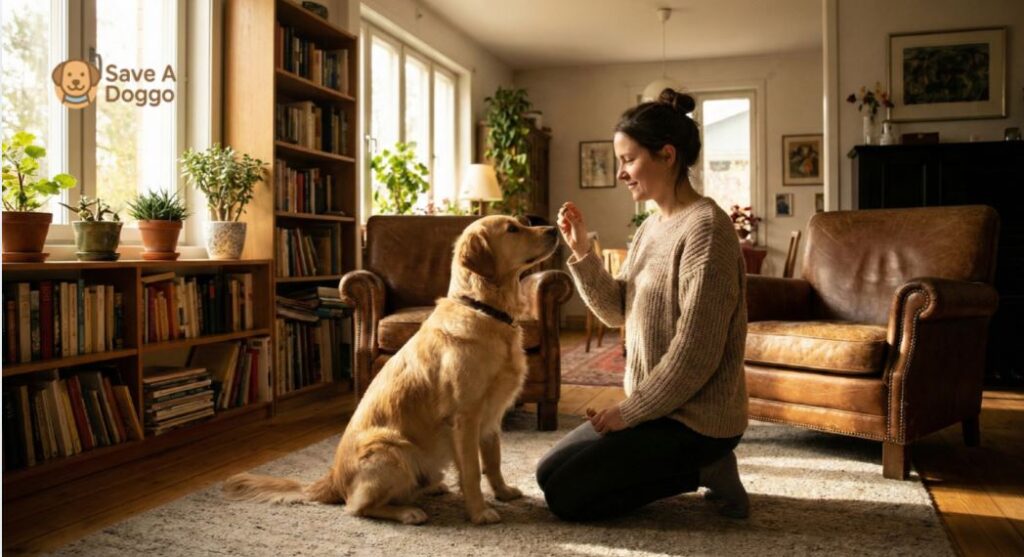
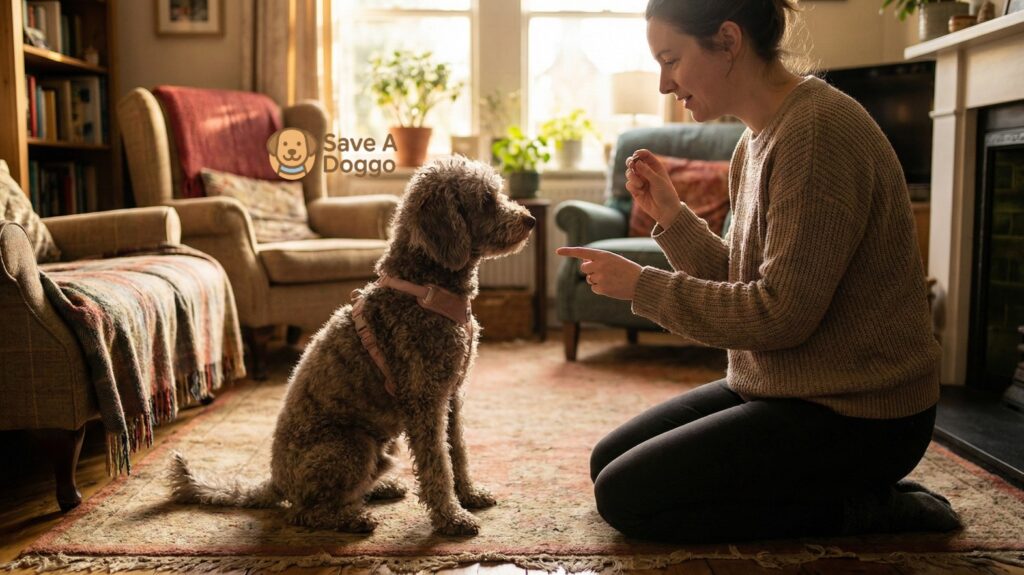
Start with:
- 5-minute sessions
- 2–3 times per day
- End on success
First Commands to Teach
- Name recognition
- “Look at me”
- Sit
- Touch (nose to hand target)
Why these first?
Because they build:
- Focus
- Engagement
- Positive reinforcement association
Detailed foundations are explained in Basic Training for Dogs at Home: Step-by-Step Guide for Beginners, which complements this anxiety-specific approach.
Step 4: Use Positive Reinforcement Only
Never use:
- Yelling
- Leash corrections
- Physical manipulation
- Dominance techniques
An anxious rescue dog interprets correction as threat.
Instead, use:
- Small high-value treats
- Calm voice tone
- Marker word (“Yes!”)
- Gentle praise
This is core to modern rescue dog anxiety training methodology.
Trust grows when training feels safe.
Step 5: Desensitization to Triggers (Gradual Exposure)
Most anxious rescue dogs react to:
- Door sounds
- Strangers
- Other dogs
- Sudden noises
- Being left alone
Desensitization training means:
Expose → Reward calm → Increase slowly
Example:
If your dog fears door sounds:
- Lightly tap door
- Immediately give treat
- Repeat daily
- Increase volume gradually
This technique reduces fear response over time.
It is one of the most effective tools in dog anxiety training at home.
Step 6: Crate Training for Security (If Appropriate)
Many anxious rescue dogs benefit from crate training — not as confinement, but as a safe den.
Important:
- Never force entry
- Never use crate as punishment
- Always associate crate with rewards
Steps:
- Leave crate open
- Toss treats inside
- Reward voluntary entry
- Slowly increase duration
Some dogs with trauma may resist crates — assess personality carefully.
Step 7: Teaching Calm Behavior (Not Just Commands)
Training an anxious rescue dog isn’t just about obedience.
It’s about emotional regulation.
Teach “place” or “settle”:
- Dog lies on mat
- Reward calm posture
- Extend duration gradually
This becomes invaluable during:
- Guest visits
- Loud weather
- Household activity
For deeper behavioral strategies, review Dog Training Tips for Behavior: A Complete Guide to Fixing and Preventing Common Issues.
Step 8: Separation Anxiety Protocol (If Present)
Many adopters searching how to train a rescue dog with anxiety at home are facing separation anxiety.
Symptoms include:
- Barking when alone
- Destructive chewing
- Scratching doors
- Excessive drooling
Start with micro-absences:
- Leave for 30 seconds
- Return calmly
- No dramatic greetings
- Gradually increase time
Never make departures emotional.
Calm exit = calm return.
If symptoms are severe, consult professional behavioral support.
Step 9: Body Language Awareness (Critical Skill)
Learning to read your dog prevents setbacks.
Signs your dog is overwhelmed:
- Lip licking
- Yawning (stress yawning)
- Turning head away
- Tail tucked
- Freezing
If you see these, pause training.
Trust is built when you respect limits.
This concept connects closely to emotional insights shared in How to Care for a Rescue Dog: A Compassionate Guide for the First 30 Days.
Step 10: Celebrate Small Progress
Progress for anxious rescue dogs looks like:
- Eating normally
- Sleeping through night
- Approaching you voluntarily
- Tail wagging loosely
- Initiating play
Not instant obedience.
Transformation timelines vary.
Many adopters document this journey similarly to stories found in Rescue Dog Heartwarming Story — From Fear to Trust (A Real Adoption Journey).
Behavioral growth is emotional healing in action.
Common Mistakes When Training an Anxious Rescue Dog
Avoid these:
❌ Over-socializing too early
❌ Taking to busy parks immediately
❌ Expecting instant results
❌ Comparing to other dogs
❌ Punishing fear-based behavior
Training anxious rescue dogs requires patience measured in weeks — not days.
How Long Does It Take?
Typical timeline:
Week 1 → Stress high, minimal learning
Week 2–3 → Beginning engagement
Week 4–6 → Basic commands stable
Month 3 → Noticeable emotional shift
Full transformation can take 3–6 months.
This aligns with adjustment principles outlined in the 3-3-3 Rule for Adopting a Rescue Dog framework.
When to Seek Professional Help
Consider professional assistance if:
- Aggression appears
- Severe separation anxiety persists
- Self-harm behaviors
- Panic attacks
- No improvement after 2 months
A certified positive reinforcement trainer is ideal.
The Emotional Side of Training
Many adopters expect obedience first.
But with rescue dogs, trust comes before compliance.
An anxious rescue dog does not need to be “fixed.”
They need to feel safe.
And when safety becomes routine, training becomes natural.
The most beautiful transformations happen quietly — in living rooms, not obedience rings.
If you are learning how to train a rescue dog with anxiety at home, remember this:
You are not just teaching commands.
You are rebuilding confidence.
Your dog is not stubborn.
They are cautious.
Your patience is the bridge between fear and trust.
And one day, without realizing it, you will notice:
The trembling stopped.
The hiding stopped.
The anxious eyes softened.
That is when you know training worked.
Frequently Asked Questions About Training a Rescue Dog with Anxiety
1. How long does it take to train a rescue dog with anxiety at home?
Most rescue dogs begin showing small improvements within 3–6 weeks when consistent routine and positive reinforcement are used. However, full emotional adjustment often takes 3–6 months depending on the dog’s history, trauma level, and stability of the home environment.
Patience is not optional — it is the foundation of progress.
2. Can I train an anxious rescue dog without a professional trainer?
Yes, many dogs improve significantly with structured at-home training, predictable schedules, and gradual desensitization.
However, if your dog shows:
- Aggression
- Severe separation anxiety
- Panic attacks
- Self-harming behaviors
You should consult a certified positive reinforcement trainer or veterinary behaviorist.
3. What is the best training method for a rescue dog with anxiety?
The most effective method is:
✔ Positive reinforcement
✔ Gradual exposure (desensitization)
✔ Calm, predictable routines
Avoid punishment, dominance techniques, or yelling. These increase fear and slow trust-building.
4. Should I socialize my anxious rescue dog immediately?
No.
Over-socialization in the first weeks often increases stress. Follow the gradual timeline similar to the 3-3-3 Rule for Adopting a Rescue Dog, allowing your dog to first feel safe at home before introducing new people, dogs, or environments.
Start small. Increase exposure slowly.
5. Is crate training good for rescue dogs with anxiety?
Crate training can help if introduced positively and gradually. Many anxious dogs feel safer in den-like spaces.
Important rules:
- Never force entry
- Never use the crate as punishment
- Always associate it with rewards
If your dog has confinement trauma, use a quiet safe corner instead.
6. How do I calm a rescue dog during anxiety episodes?
When your dog shows signs of anxiety:
- Lower your voice
- Reduce stimulation
- Avoid direct eye contact
- Offer a safe space
- Reward calm behavior
Do not scold or over-comfort emotionally. Calm energy helps regulate their nervous system.
7. Why does my rescue dog seem worse before getting better?
This is common.
As your dog begins to feel safer, they may start testing boundaries or expressing suppressed behaviors. This does not mean training is failing — it often means trust is slowly building.
Consistency during this phase is critical.
8. Can anxiety in rescue dogs ever fully disappear?
In many cases, yes — especially mild to moderate anxiety.
For dogs with deeper trauma, anxiety may not disappear entirely, but it can become manageable and significantly reduced with structured training and stable routines.
Healing is not about perfection.
It is about progress.
Safety Limits for At-Home Anxiety Training
At-home exercises should keep the dog below the point of panic. Work with easy versions of a trigger, reward voluntary calm behavior, and stop or increase distance when you see escalating panting, trembling, frantic escape attempts, refusal of food, hard staring, growling, or snapping. Flooding a dog with a feared situation can worsen the response.
Use reward-based methods. The American Veterinary Society of Animal Behavior recommends reward-based training and advises against aversive tools and punishment for behavior modification. Punishing fearful behavior may suppress warning signals without changing the underlying emotion.
Arrange a veterinary examination when anxiety is sudden, severe, worsening, accompanied by pain or house-soiling, or interfering with eating and sleep. Seek qualified behavior help for bite risk, self-injury, panic, or cases that do not improve with careful management. Medication decisions belong with a veterinarian or veterinary behaviorist.
Sources and further reading
- AVSAB: Humane Dog Training Position Statement
- Merck Veterinary Manual: Diagnosing Behavior Problems in Dogs
- ASPCA: Behavioral Help for Your Pet

The Save A Doggo Editorial Team creates practical, welfare-first resources for rescue-dog adopters, foster families, and shelter supporters. We prioritize primary and authoritative sources, distinguish observation from diagnosis, correct material errors transparently, and explain when veterinary or qualified behavior support is needed. We do not claim veterinary credentials or professional review unless a named, verifiable reviewer has approved the final article.