Dog Training Tips for Beginners at Home (Without Overcomplicating It)
If you’re here, chances are you’re either:
- A first-time dog owner
- A recent adopter
- Or someone staring at a lovable but slightly chaotic dog wondering… “Where do I even start?”
Let me say this clearly:
You do not need to be a professional trainer to raise a well-behaved dog.
What you need is structure. Patience. And consistency.
These dog training tips for beginners at home are designed for real people — in real living rooms — with real schedules.
Not perfection.
Just progress.
Why Training at Home Matters More Than You Think
Training isn’t about control.
It’s about communication.
Especially if you adopted a rescue dog, training becomes part of emotional healing. Dogs coming from shelters often crave stability. Structure tells them:
“You’re safe here.”
If you’re still in the early adoption phase, I strongly recommend reviewing the principles in The 3-3-3 Rule for Adopting a Rescue Dog. It explains how dogs decompress over their first days, weeks, and months.
Training fits directly into that adjustment process.
Foundational Dog Training Tips for Beginners at Home
Before commands. Before tricks.
Let’s start with fundamentals.
1. Keep Sessions Short (This Is Non-Negotiable)
5–10 minutes.
That’s it.
Dogs — especially beginners — have short attention spans. Long sessions lead to frustration for both of you.
End on a win. Always.
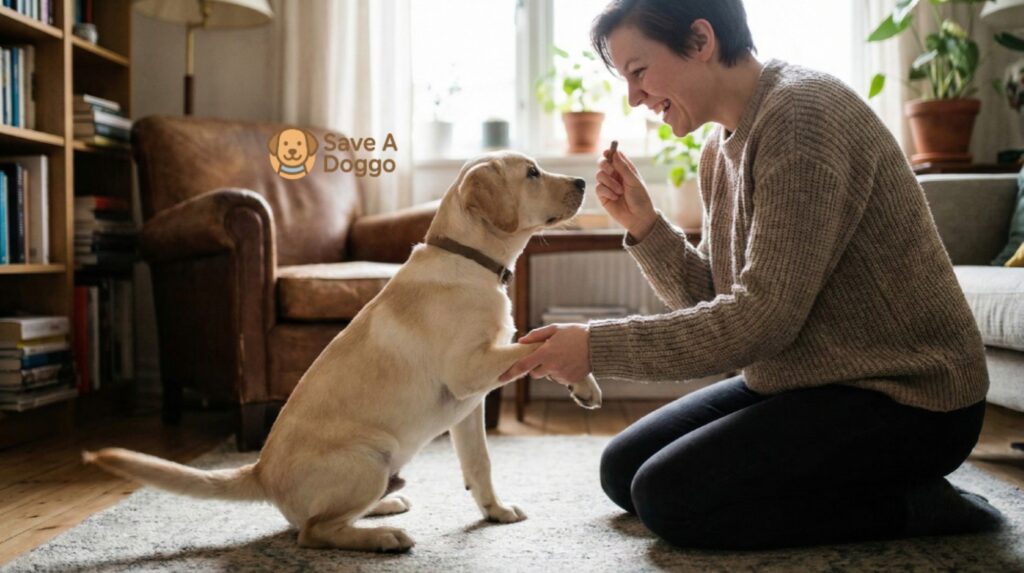
2. Use Positive Reinforcement Only
This is where I’ll state something that might spark debate:
Punishment-based training may stop behavior temporarily — but it does not build trust.
And for rescue dogs, trust is everything.
Reward:
- Desired behaviors
- Calm responses
- Attention
- Effort
Avoid yelling. Avoid physical corrections. Avoid dominance-based myths.
Positive reinforcement builds long-term reliability.
3. Be Consistent With Words
If one person says “Down” and another says “Off,” confusion happens.
Choose:
- Sit
- Stay
- Come
- Down
- Leave it
And stick to them.
Clarity reduces stress.
Step-by-Step Dog Training Tips for Beginners at Home
Now let’s get practical.
Step 1: Name Recognition
Before anything else, your dog must respond to their name.
How:
- Say their name warmly.
- When they look at you — reward immediately.
- Repeat throughout the day.
This builds engagement.
No engagement = no training.
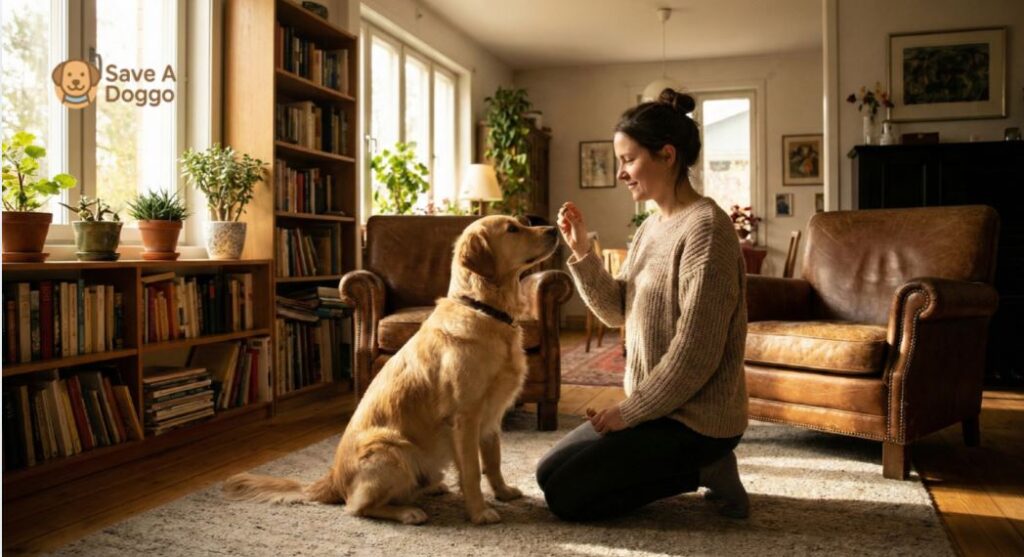
Step 2: Teach “Sit”
This is the foundation command.
How to train:
- Hold a treat near the nose.
- Slowly move it upward.
- As the head lifts, the bottom lowers.
- The moment they sit — say “Sit” and reward.
Repeat 5–10 times.
If you need a deeper walkthrough, see How to Train a Dog at Home Step by Step for expanded guidance.
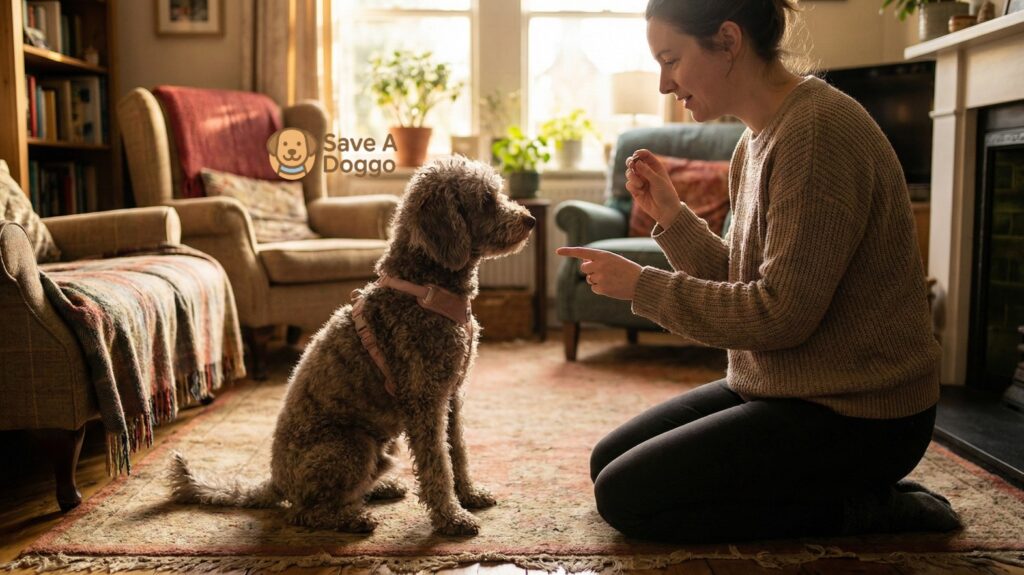
Step 3: Teach “Stay”
Impulse control starts here.
- Ask for “Sit.”
- Show your palm and say “Stay.”
- Step back slightly.
- Reward even one second of stillness.
Gradually increase time and distance.
Small increments matter.
Step 4: Recall (“Come”)
This may save your dog’s life one day.
Use a happy tone. Always.
Say “Come!”
Reward generously when they approach.
Never punish after recall — even if they were misbehaving before.
You want recall to equal safety.
Step 5: Loose Leash Walking
Pulling is instinct.
Calm walking is taught.
When your dog pulls:
- Stop walking.
- Wait silently.
- Continue once the leash relaxes.
Yes, it takes patience.
But consistency wins.
Dog Training Tips for Beginners at Home (Rescue Dog Edition)
Rescue dogs sometimes learn faster than puppies.
Why?
They want stability.
But they may also carry fear.
If your dog shows signs of anxiety — pacing, excessive panting, hiding — review Signs of Dog Anxiety After Adoption.
Training and emotional adjustment go hand in hand.
You may also find value in How to Help a Rescue Dog Adjust to Their New Home for a gentler transition strategy.
Common Beginner Mistakes (And How to Avoid Them)
Let’s talk about what usually goes wrong.
Mistake 1: Expecting Instant Results
Training takes weeks. Sometimes months.
Improvement is gradual.
Celebrate small wins.
Mistake 2: Training Only When There’s a Problem
Training should be daily — not reactive.
Consistency prevents issues.
Mistake 3: Inconsistent Rules
If jumping is allowed sometimes, it becomes confusing.
Boundaries must be clear.
Mistake 4: Too Many Commands at Once
Focus on 2–3 behaviors at a time.
Mastery > overload.
How Long Does It Take to See Results?
Most beginners see improvement within 2–4 weeks of consistent practice.
Full reliability?
3–6 months.
But confidence improves faster than obedience.
And confidence changes everything.
Creating a Calm Training Environment at Home
Choose:
- Quiet room
- Minimal distractions
- Same training spot initially
Gradually increase difficulty.
Living room → backyard → sidewalk → park.
Training in layers builds reliability.
Mental Stimulation Is Part of Training
Training is not just commands.
It’s enrichment.
Add:
- Food puzzles
- Snuffle mats
- Short obedience games
- “Find it” scent games
A mentally tired dog is calmer than a physically exhausted one.
This is often overlooked by beginners.
Building a Healthy Daily Routine
Here’s a simple structure:
Morning
- Potty
- 5-minute training
- Walk
Afternoon
- Mental enrichment
- Short reinforcement session
Evening
- Calm interaction
- Review 1–2 commands
Routine builds predictability.
Predictability reduces anxiety.
What If Your Dog Isn’t Responding?
Pause.
Ask:
- Am I rewarding fast enough?
- Are sessions too long?
- Is the environment too distracting?
- Am I consistent?
Training failure is usually clarity failure — not stubbornness.
Dogs want to succeed.
When to Seek Professional Help
Consider a certified trainer if you notice:
- Aggression
- Resource guarding
- Severe separation anxiety
- Trauma responses
Basic dog training tips for beginners at home work — but safety comes first.
The Emotional Side of Training
Here’s a perspective that may surprise you:
Training deepens attachment more than cuddling does.
Because training requires mutual attention.
It’s shared focus.
It’s teamwork.
Especially with rescue dogs, I’ve seen behavioral changes happen simply because someone dedicated 10 consistent minutes daily.
Not perfect sessions.
Not dramatic breakthroughs.
Just repetition.
Trust builds quietly.
Dog training tips for beginners at home do not require complicated tools.
They require:
Consistency.
Clarity.
Patience.
And perhaps most importantly — compassion.
Because at the end of the day, your dog isn’t trying to challenge you.
They’re trying to understand you.
And once that understanding forms?
Everything changes.
FAQ – Dog Training Tips for Beginners at Home
How many times per day should beginners train their dog?
Two to three short sessions per day (5–10 minutes each) is ideal.
Can I train my dog without treats?
You can, but treats accelerate learning in the early stages. Gradually transition to praise and intermittent rewards.
What is the easiest command to teach first?
“Sit” is usually the easiest and forms the foundation for other commands.
How do I stop my dog from jumping on guests?
Teach “Sit” as an alternative behavior and reward calm greetings consistently.

The Save A Doggo Editorial Team creates practical, welfare-first resources for rescue-dog adopters, foster families, and shelter supporters. We prioritize primary and authoritative sources, distinguish observation from diagnosis, correct material errors transparently, and explain when veterinary or qualified behavior support is needed. We do not claim veterinary credentials or professional review unless a named, verifiable reviewer has approved the final article.